


ShaderToy-MCP
Integrate FlowHunt with ShaderToy-MCP to automate shader discovery, analysis, and generation using AI-driven workflows. Unlock seamless connectivity between lar...
4 min read
AI
ShaderToy
+4

Bridge your AI assistant with ShaderToy to generate, explore, and share GLSL shaders using FlowHunt’s ShaderToy MCP Server.
ShaderToy-MCP is an MCP (Model Context Protocol) Server designed to bridge AI assistants with ShaderToy, a popular website for creating, running, and sharing GLSL shaders. By connecting LLMs (Large Language Models) like Claude to ShaderToy via MCP, this server allows the AI to query and read entire ShaderToy web pages, enabling it to generate and refine complex shaders beyond its standalone capabilities. This integration enhances the development workflow for shader artists and AI developers by providing seamless access to ShaderToy’s content, facilitating more sophisticated shader creation, exploration, and sharing.
No information regarding prompt templates is provided in the repository.

Start your free trial today and see results within days.
No explicit resource definitions found in the available files or documentation.
No explicit tool list or server.py file is present in the repository with details on MCP tools.
Get latest tips, trends, and deals for free.
.windsurf/config.json configuration file.{
"mcpServers": {
"shadertoy": {
"command": "npx",
"args": ["@shadertoy/mcp-server@latest"]
}
}
}
config.json settings.{
"mcpServers": {
"shadertoy": {
"command": "npx",
"args": ["@shadertoy/mcp-server@latest"]
}
}
}
cursor.config.json in your user directory.{
"mcpServers": {
"shadertoy": {
"command": "npx",
"args": ["@shadertoy/mcp-server@latest"]
}
}
}
.cline/config.json file.{
"mcpServers": {
"shadertoy": {
"command": "npx",
"args": ["@shadertoy/mcp-server@latest"]
}
}
}
{
  "mcpServers": {
    "shadertoy": {
      "command": "npx",
      "args": ["@shadertoy/mcp-server@latest"],
      "env": {
        "SHADERTOY_API_KEY": "${SHADERTOY_API_KEY}"
      },
      "inputs": {
        "apiKey": "${SHADERTOY_API_KEY}"
      }
    }
  }
}
Note: Store your API keys in environment variables for security.
Using MCP in FlowHunt
To integrate MCP servers into your FlowHunt workflow, start by adding the MCP component to your flow and connecting it to your AI agent:
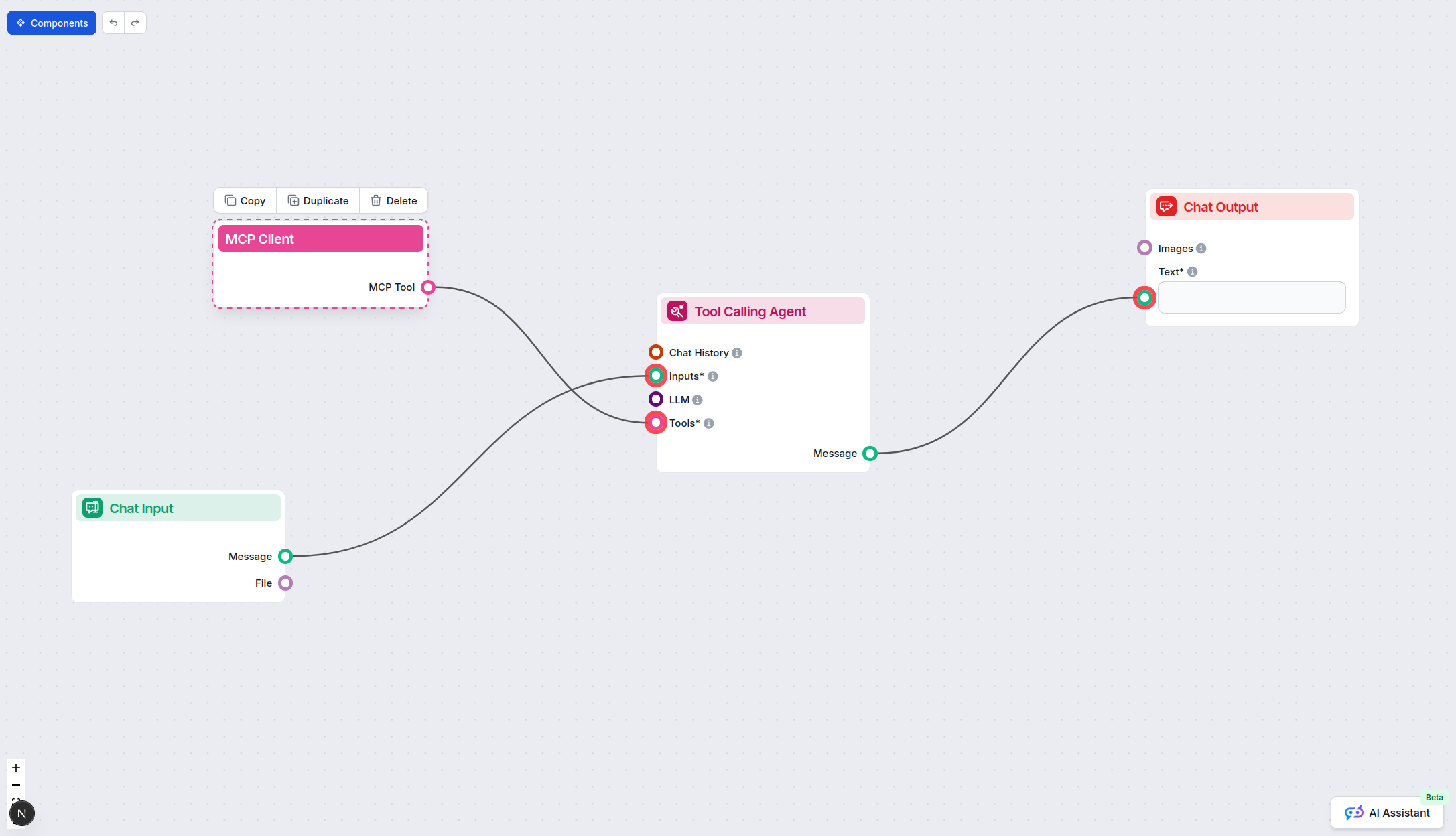
Click on the MCP component to open the configuration panel. In the system MCP configuration section, insert your MCP server details using this JSON format:
{
  "shadertoy": {
    "transport": "streamable_http",
    "url": "https://yourmcpserver.example/pathtothemcp/url"
  }
}
Once configured, the AI agent is now able to use this MCP as a tool with access to all its functions and capabilities. Remember to change “shadertoy” to the actual name of your MCP server and replace the URL with your own MCP server URL.
| Section | Availability | Details/Notes |
|---|---|---|
| Overview | ✅ | Overview found in README.md |
| List of Prompts | ⛔ | No details on prompt templates |
| List of Resources | ⛔ | No explicit MCP resource definitions found |
| List of Tools | ⛔ | No explicit tool listing or server.py in repo |
| Securing API Keys | ✅ | Example provided in setup instructions |
| Sampling Support (less important in evaluation) | ⛔ | No mention of sampling support |
Based on the above, ShaderToy-MCP provides a clear overview and setup guidance, but lacks documentation on prompt templates, tools, and resources. Its primary value is connecting LLMs to ShaderToy, but it would benefit from extended documentation and explicit MCP feature support. I would rate this MCP server a 4/10 for general MCP utility and documentation.
| Has a LICENSE | ✅ (MIT) |
|---|---|
| Has at least one tool | ⛔ |
| Number of Forks | 3 |
| Number of Stars | 21 |
Supercharge your AI workflows for shader creation, exploration, and sharing by integrating the ShaderToy MCP Server into FlowHunt.
Integrate FlowHunt with ShaderToy-MCP to automate shader discovery, analysis, and generation using AI-driven workflows. Unlock seamless connectivity between lar...
The Unity MCP Server bridges the Unity Editor with AI model clients such as Claude Desktop, Windsurf, and Cursor, enabling automation, intelligent assistance, a...
The ModelContextProtocol (MCP) Server acts as a bridge between AI agents and external data sources, APIs, and services, enabling FlowHunt users to build context...
Cookie Consent
We use cookies to enhance your browsing experience and analyze our traffic. See our privacy policy.