


Prompt
A generic prompt template that accepts dynamic input for LLM processing.
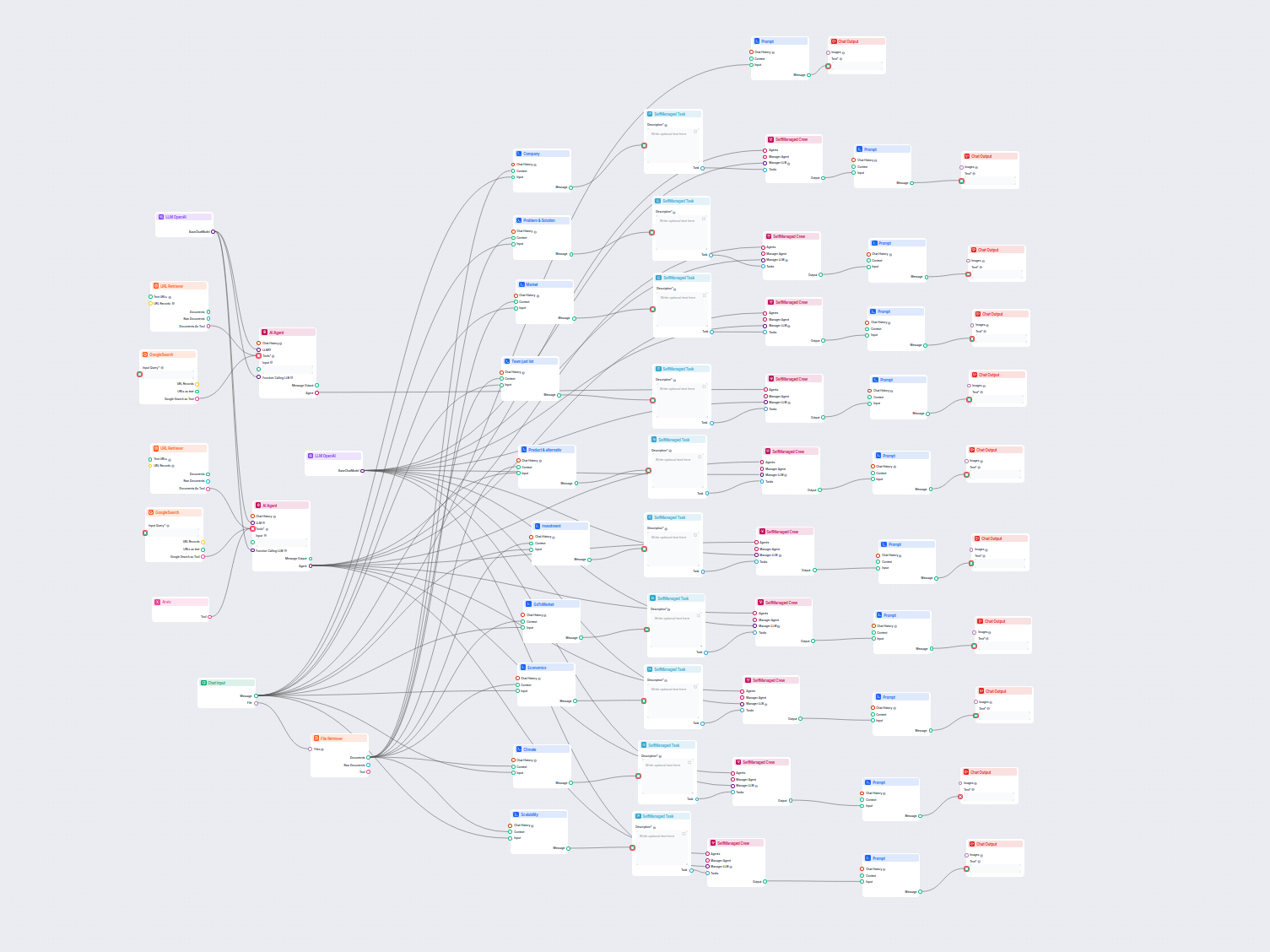
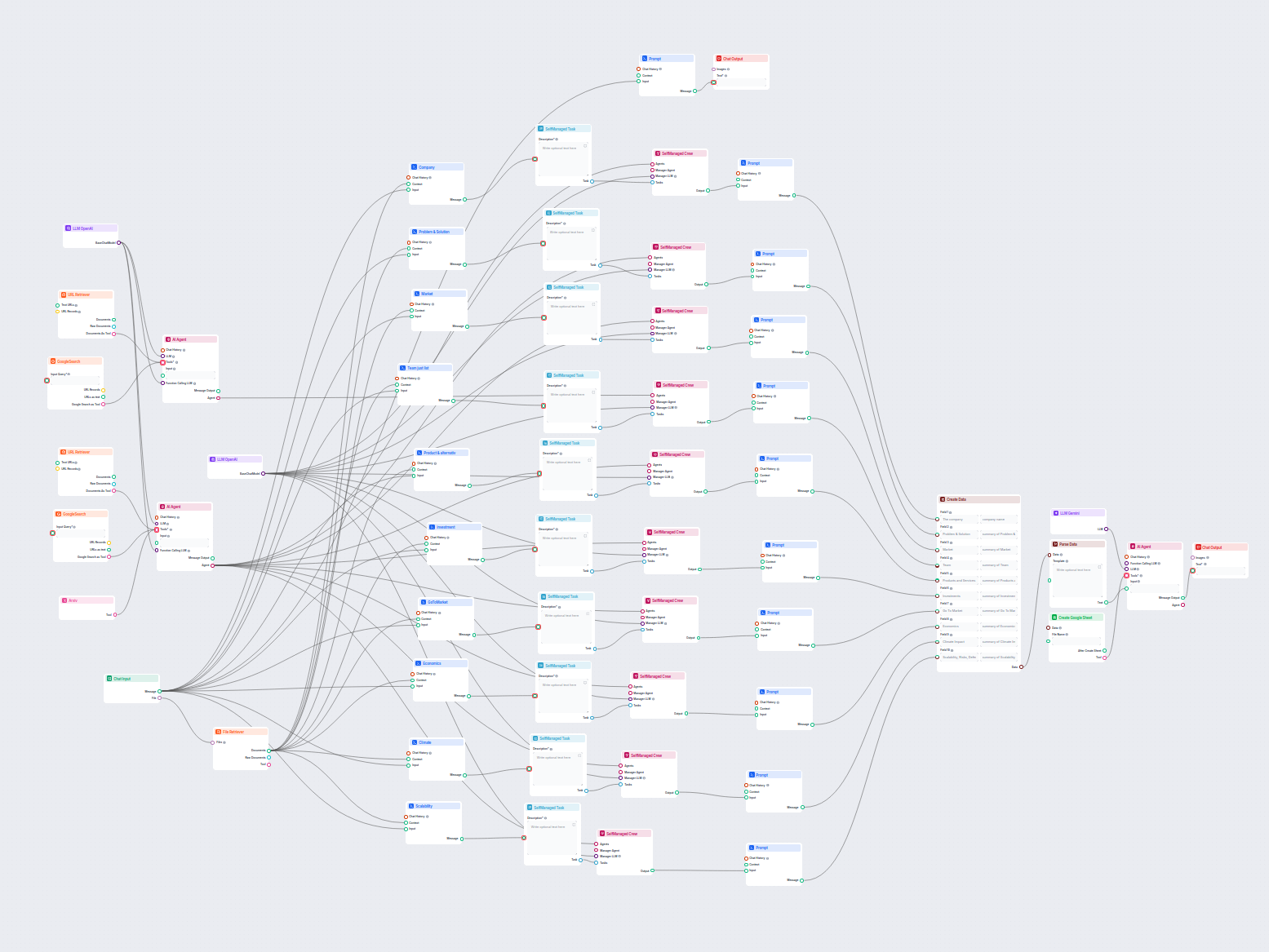
Comprehensive AI-driven workflow for company analysis and market research. Automatically gathers and analyzes data on company background, market position, products, competition, business model, funding, team, and key risks. Integrates AI agents, web search, and document retrieval to provide investors or strategists with in-depth, actionable company profiles and insights.

Flows
A generic prompt template that accepts dynamic input for LLM processing.
Prompt template to format a company's overview for LLM output.
Prompt instructing an LLM to extract company overview, history, and achievements with sources.
Prompt instructing LLM to extract and summarize the company’s problem statement and solution.
Prompt template to format the problem and solution section for LLM output.
Prompt instructing LLM to analyze target market, background, size, opportunities, and competition for a company.
Prompt template to format the market analysis section for LLM output.
Prompt instructing LLM to find and list key team members and roles from web and documents.
Prompt template to format the team section for LLM output.
Prompt for LLM to extract company products/services, alternatives, and comparative advantages.
Prompt template to format products and services section for LLM output.
Prompt instructing LLM to extract funding, investors, investor profiles, and fundraising details.
Prompt template to format the investment section for LLM output.
Prompt for LLM to extract go-to-market strategy, business model, timing, and readiness.
Prompt template to format the go-to-market section for LLM output.
Prompt instructing LLM to extract unit economics, revenue, and traction details for a company.
Prompt template to format the economics section for LLM output.
Prompt instructing LLM to extract a company’s climate impact and emission reduction approach.
Prompt template to format climate impact section for LLM output.
Prompt for LLM to analyze company scalability, defensibility, and key risks.
Prompt template to format scalability, risks, and defensibility section for LLM output.
Below is a complete list of all components used in this flow to achieve its functionality. Components are the building blocks of every AI Flow. They allow you to create complex interactions and automate tasks by connecting various functionalities. Each component serves a specific purpose, such as handling user input, processing data, or integrating with external services.

The Chat Input component in FlowHunt initiates user interactions by capturing messages from the Playground. It serves as the starting point for flows, enabling the workflow to process both text and file-based inputs.

Discover the Chat Output component in FlowHunt—finalize chatbot responses with flexible, multi-part outputs. Essential for seamless flow completion and creating advanced, interactive AI chatbots.

Learn how FlowHunt's Prompt component lets you define your AI bot’s role and behavior, ensuring relevant, personalized responses. Customize prompts and templates for effective, context-aware chatbot flows.

The SelfManaged Task component enables users to define and execute autonomous tasks within a workflow. Specify a clear task description, expected outcome, and assign an agent to manage execution—ideal for building structured, hierarchical automation in your flows.

Unlock advanced collaboration in FlowHunt with the Self-Managed Crew component. Coordinate multiple AI agents under a manager agent to autonomously handle complex workflows and hierarchical tasks, maximizing efficiency and scalability.

The AI Agent component in FlowHunt empowers your workflows with autonomous decision-making and tool-using capabilities. It leverages large language models and connects to various tools to solve tasks, follow goals, and provide intelligent responses. Ideal for building advanced automations and interactive AI solutions.

FlowHunt supports dozens of text generation models, including models by OpenAI. Here's how to use ChatGPT in your AI tools and chatbots.

FlowHunt's GoogleSearch component enhances chatbot accuracy using Retrieval-Augmented Generation (RAG) to access up-to-date knowledge from Google. Control results with options like language, country, and query prefixes for precise and relevant outputs.

Unlock web content in your workflows with the URL Retriever component. Effortlessly extract and process the text and metadata from any list of URLs—including web articles, documents, and more. Supports advanced options like OCR for images, selective metadata extraction, and customizable caching, making it ideal for building knowledge-rich AI flows and automations.

The File Retriever component in FlowHunt lets you bring files into your workflow and convert them into documents for further processing. It supports strategies for handling multiple documents and can use OCR on images within files, making it ideal for extracting and transforming information from a wide variety of file types.

Effortlessly chat with 2.4M scholarly articles using FlowHunt's ArXiv Tool and AI Agents. Revolutionize your research by matching queries with concise responses from the ArXiv database and enhance your chatbot with customizable flows.
Flow description
The AI Company Analysis Tool is an advanced, automated workflow designed to generate comprehensive, structured analyses of any given company. By leveraging AI agents, language models, real-time web search, document retrieval, and templated prompts, the tool delivers deep insights across multiple dimensions—ranging from company history and products to market positioning, financials, team, risks, and climate impact.
This tool is valuable for investors, analysts, consultants, and anyone needing fast, accurate, and scalable company due diligence, especially when researching multiple companies or regularly updating analyses.
Web & Document Search:
Language Model Integration:
Specialized Tools:
The analysis is broken down into modular tasks, each handled by self-managed agents or collaborative agent “crews”. These tasks include:
| Module | Key Insights Produced |
|---|---|
| Company Overview | What the company does, brief history, notable achievements, media mentions, sources |
| Problem & Solution | Market problem the company is addressing and its core solution |
| Market Analysis | Target customer, market size, opportunities, competition, and landscape |
| Products & Alternatives | Main products, features, advantages, alternatives, and competitor links |
| Team Analysis | Key team members (especially C-suite), roles, and brief bios |
| Investments & Funding | Funding rounds, amounts, investors, investor backgrounds, and fundraising status |
| Go-to-Market & Business Model | Technology readiness, distribution strategy, revenue streams, pricing, growth timing |
| Economics & Traction | Unit economics, cost breakdown, revenues, projections, and business traction |
| Climate Impact | Description of how the company impacts climate or reduces emissions |
| Scalability & Risks | Scalability potential, business defensibility, and key risks |
Below is an example of the sections you might receive for each company:
Each section is researched, summarized, and presented with clarity, making it easy for users to understand a company’s position, strengths, opportunities, and challenges at a glance.
The AI Company Analysis Tool is a scalable, AI-powered assistant for company research and due diligence. It automates best-practice analysis, delivers structured, actionable reports, and supports faster, more informed business and investment decisions.
This AI-powered workflow delivers a comprehensive, data-driven company analysis. It gathers information on company background, market landscape, team, products,...
AI company research tools generate complete company profiles automatically. The reports funding history, products, team, market position, and risk flags. Here's...
FlowHunt's Company Analysis Agent delivers comprehensive, decision-ready reports on any company—covering history, products, market position, financials, team, f...
Cookie Consent
We use cookies to enhance your browsing experience and analyze our traffic. See our privacy policy.