



The AI Act
Explore the EU's AI Act, the world's first comprehensive AI regulation. Learn how it classifies AI systems by risk, establishes governance, and sets global stan...
11 min read
AI Act
EU Regulation
+4
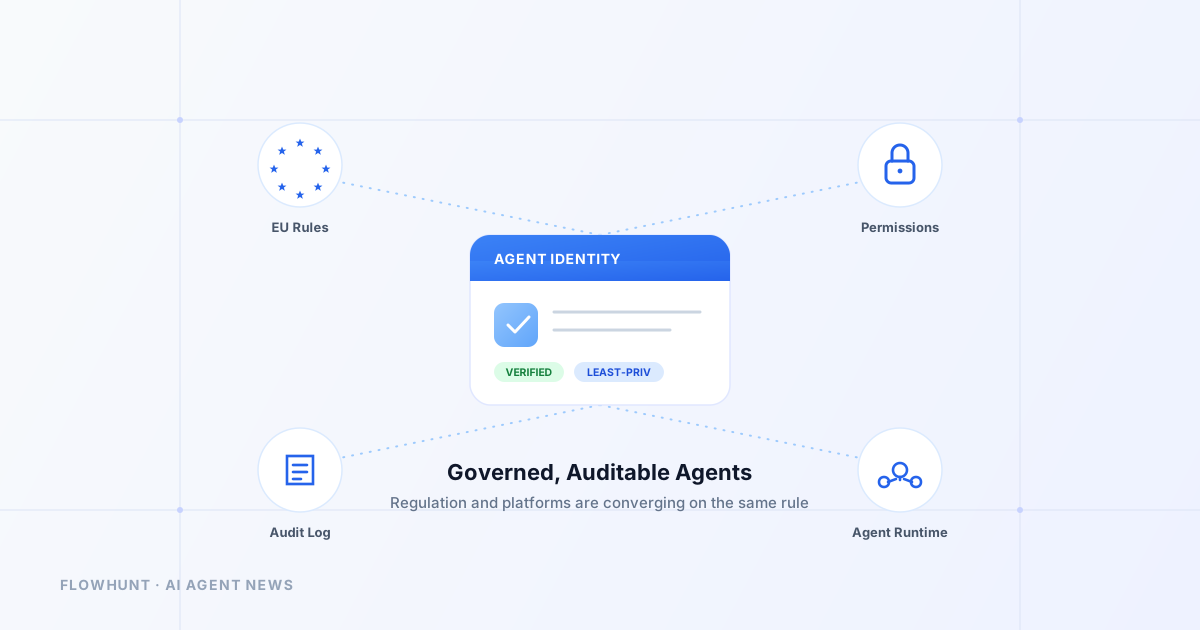
The EU AI Act’s transparency rules are now enforceable, and Google Cloud shipped a native Agent Identity system. Here’s what changed for teams building AI agents.
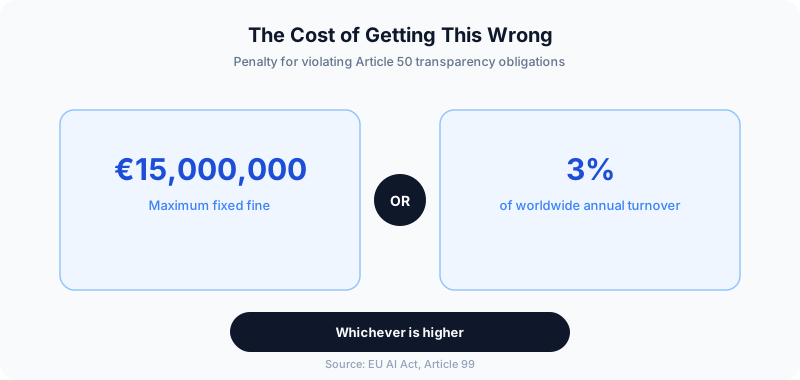
Two announcements from the first week of August 2026 point at the same shift, from opposite directions. On August 2, the EU AI Act’s transparency rules became enforceable law, requiring anyone deploying a chatbot, content generator, or emotion-reading system to disclose it clearly or face fines up to €15 million. Days later, Google Cloud brought its Agent Identity system to general availability — a native permissions layer that tracks exactly what an AI agent can access and logs everything it does. One is a regulator forcing disclosure. The other is a cloud platform selling accountability as a feature. Both are converging on the same conclusion: an AI agent that nobody can identify, audit, or hold accountable isn’t ready for production, whether or not a court says so.
The EU AI Act’s Article 50 transparency obligations became generally applicable and enforceable by national authorities across the EU on August 2, 2026. In practice, this covers four things. Providers must ensure people are “clearly informed they are dealing with an AI system, unless this is obvious from context” — the chatbot-disclosure rule. Providers of systems that generate synthetic audio, image, video, or text must mark that output in a machine-readable, detectable format. Anyone deploying a system that produces deepfakes of real people, places, or events must disclose it. And deployers of emotion-recognition or biometric-categorization systems must inform the people exposed to them and stay within EU data protection law.
None of this is new in concept — the AI Act was signed years earlier. What changed on August 2 is that these specific duties stopped being a future date on a compliance roadmap and became something national regulators can actually enforce today.

Start your free trial today and see results within days.
Not everything in the Act arrived on schedule. Through the Digital Omnibus on AI, signed July 8, 2026, the EU pushed back its high-risk system requirements. Standalone systems under Annex III — think employment screening, education, law enforcement, critical infrastructure — now have until December 2, 2027. AI embedded in already-regulated products under Annex I, like medical devices or lifts, has until August 2, 2028.
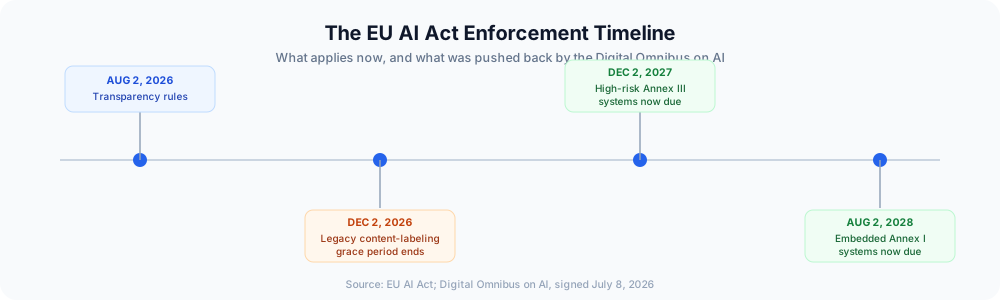
That extension is worth being precise about, because it’s easy to misread as “the AI Act got delayed.” It didn’t. The prohibited-practices list and general-purpose AI model obligations are untouched. What moved is specifically the high-risk classification requirements — the heaviest compliance lift, for the narrowest slice of systems. If your agent talks to users or generates content, you’re inside the part of the law that’s already active.
The transparency requirement sounds modest next to “high-risk system,” but it’s the rule most AI agent builders will actually run into first. A customer-facing support agent, a content-generation workflow, a voice assistant — all of these are systems that talk to people, which means Article 50 applies regardless of whether they’d ever be classified as high-risk. Getting this right isn’t complicated: say clearly that the user is talking to an AI, label generated content, and keep records that show you did. Getting it wrong is where compliance reporting stops being paperwork and starts being a legal exposure with a real number attached.
Get latest tips, trends, and deals for free.
Google Cloud’s answer to the same underlying problem arrived from a completely different direction: infrastructure, not law. The company brought its Gemini Enterprise Agent Platform to general availability with a cluster of new agent-governance primitives — Agent Memory Bank, Agent Runtime, Agent Gateway, Agent Registry, Agent Evaluation, and, most notably, Agent Identity.
Agent Identity is a native IAM credential type built on open standards, designed specifically for autonomous systems rather than adapted from human user accounts. It enforces least-privilege access by binding permissions directly to the agent’s runtime, which closes off a common attack path where a stolen agent token could be replayed somewhere else. It produces non-repudiable logs of every action an agent takes. And it manages the credential lifecycle automatically, so an agent that’s been retired doesn’t leave a dormant, forgotten set of permissions sitting around waiting to be misused.
The practical effect is that “which agent did this, and was it allowed to?” becomes a question with a definitive answer instead of a guess reconstructed from application logs after the fact. That matters more as agents move from answering questions to taking actions — booking things, editing records, moving money, deleting files. An LLM security posture that only worries about prompt injection into the model itself misses this entire surface: the agent’s actual permissions and what it did with them.
This is also where the two announcements connect more than they first appear to. Article 50 asks “did you disclose this was AI?” Agent Identity answers a related but distinct question: “can you prove exactly what this specific agent did, with what permissions, on whose authority?” A system that can answer the second question cleanly finds the first one much easier.
It’s worth naming the pattern directly, because it’s going to keep recurring. Regulators are converging on disclosure and accountability from a legal-risk angle. Cloud platforms are converging on identity and permissions from a security-and-reliability angle. AI agent frameworks used to treat identity as an afterthought — an API key in an environment variable, shared across every agent in the fleet. That model doesn’t survive contact with either regulatory scrutiny or a real security incident, which is exactly why both directions are now pointing at the same fix: know which agent did what, with what access, and be able to show it.
Teams that have already been experimenting with real-world AI agent examples — customer support bots, research assistants, coding agents — are the ones who’ll feel this shift first, simply because they have more agents in production generating more actions to account for. It’s the same pattern we saw when Claude Cowork and its competitors pushed agents from single-session chat into persistent, multi-day tasks: more autonomy always arrives a step ahead of the tooling to govern it.
Retrofitting audit trails onto an agent fleet that was never designed to produce them is a miserable project — every action has to be reconstructed from whatever logs happened to exist, and half the time they don’t. The cheaper path is building on tooling where every step an agent takes is visible and traceable from the start, the same way data governance treats data lineage as a first-class concern rather than something you bolt on after a breach.
This is also where the pace of the underlying models matters. Recent releases like Microsoft’s Orchard framework and the broader shift toward specialized, auditable agents (rather than one enormous general-purpose model doing everything) make it more practical to build agents whose scope — and therefore whose permissions — are narrow and well-defined by design. A narrowly scoped agent is inherently easier to govern than one that can theoretically do anything.
FlowHunt’s approach follows the same logic: as an AI agent platform, every automation is a visible flow, not a black box, so when a compliance question comes in — what did this agent do, why, and under what authorization — the answer is already sitting in the workflow, not something your team has to reconstruct under deadline pressure.
The EU AI Act’s transparency rules and Google’s Agent Identity system didn’t coordinate with each other, and they’re solving nominally different problems — one is legal compliance, the other is cloud infrastructure. But they landed in the same week pointing at the same underlying truth: as AI agents take on more autonomous, consequential work, “we don’t really know what it did” stops being an acceptable answer, whether the person asking is a regulator or your own security team. The teams that treat identity, disclosure, and auditability as core requirements now — not features to add later — are the ones who’ll find both compliance and production incidents far less painful when they show up.
Arshia is an AI Workflow Engineer at FlowHunt. With a background in computer science and a passion for AI, he specializes in creating efficient workflows that integrate AI tools into everyday tasks, enhancing productivity and creativity.

FlowHunt gives every automation a visible, editable flow — so when someone asks what your agent did and why, you have an answer, not a black box.
Explore the EU's AI Act, the world's first comprehensive AI regulation. Learn how it classifies AI systems by risk, establishes governance, and sets global stan...

AI transparency is the practice of making the workings and decision-making processes of artificial intelligence systems comprehensible to stakeholders. Learn it...

Explore the EU AI Act’s tiered penalty framework, with fines up to €35 million or 7% of global turnover for severe violations including manipulation, exploitati...
Cookie Consent
We use cookies to enhance your browsing experience and analyze our traffic. See our privacy policy.