How to Improve Existing Blog Posts with AI Without Starting from Scratch
An AI blog content improver finds thin sections, outdated stats, and weak structure in existing posts and fixes them automatically. Here’s how it works and how to run one with results in under 10 minutes.
Rewriting a blog post from scratch takes almost as long as writing a new one. Same research, same drafting, same editing pass, minus the traffic history you’ve already earned. Not to mention it’s a tedious process that often gets pushed aside in favour of moving forward by producing new content. But research shows updating content it’s just as important, if not more than pushing new content.
That’s where an AI blog content improver can help. It analyzes what’s already published, thin sections, missing keywords, outdated data, weak structure, and fixes it without touching what already works. Here’s how the process works.
Why Blog Posts Decline in Rankings Over Time
No post ranks forever on autopilot. Competitors publish more thorough versions of the same topic, the statistics you cited two years ago quietly go stale, search intent for the keyword shifts, and Google’s ranking systems keep rewarding freshness and depth over whatever earned the top spot when you first published.
The upside is that this decline is reversible, and the data backs it up. HubSpot’s own historical-optimization project found that updating and republishing old posts increased their average monthly organic search views by 106% (HubSpot
). Backlinko went further with a single relaunched article with refreshed content, updated screenshots, and a promotion push. They saw an organic traffic jump of 260.7% in just 14 days (Backlinko
). The pattern consistently shows that the fastest traffic gains often come from fixing what you already have, not from adding another post to the pile.
What AI Blog Content Improvement Actually Does
An AI content optimization approach is different from a rewrite. Instead of generating a new draft from a blank page, it starts by reading the post as it exists today, identifies specifically where it’s falling short, and applies targeted fixes to those exact spots.
It acts as an editorial specialist. It checks facts, creates an SEO strategy, and edits the copy accordingly. It’s this targeted, gap-driven approach that makes it an improvement tool rather than a rewrite engine that happens to reuse your topic.
Ready to grow your business?
Start your free trial today and see results within days.
Step-by-Step: Improve a Declining Post in Under 30 Minutes
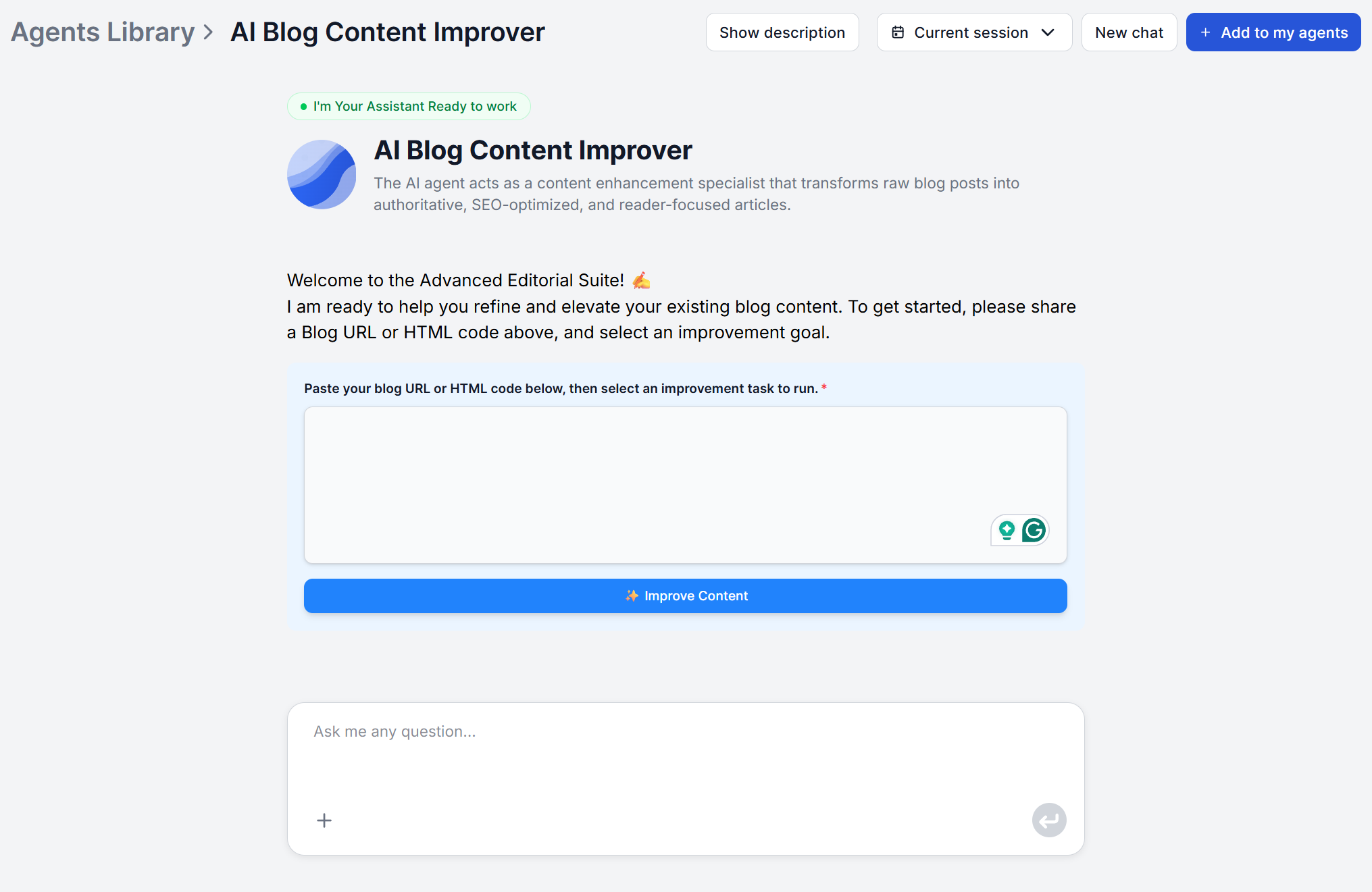
You don’t need to configure anything or decide in advance which sections need work. Open the Blog Improver Agent
and follow this process:
Retrieval (~1 minute): Paste the URL of the post you want to improve, or drop in raw text. The agent fetches the full content for analysis.
Research & Verification (a few minutes): The agent cross-references your existing content against top results from live sources using Google Search and other resources, flagging outdated data, missing context, and factual gaps it finds along the way.
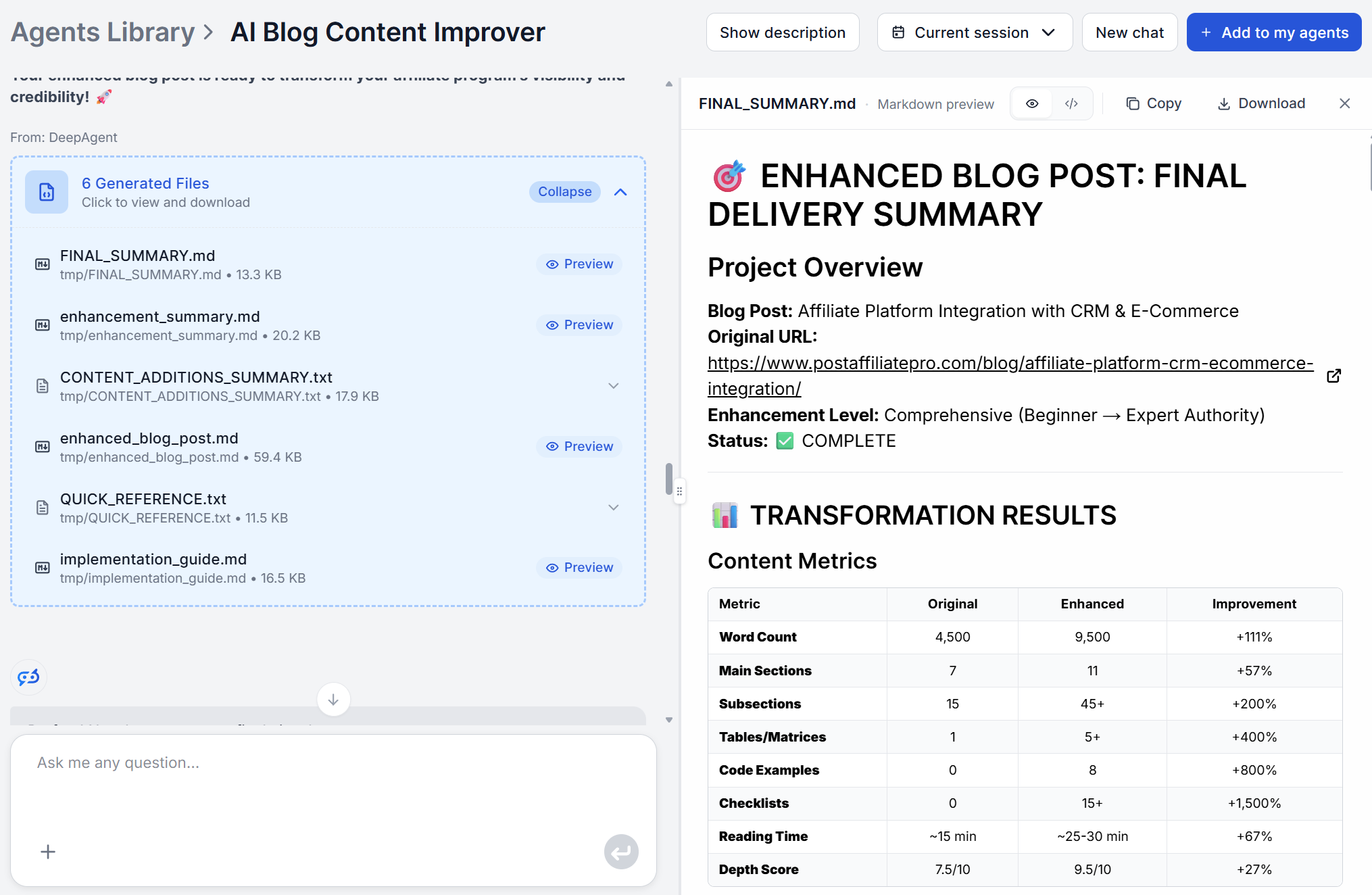
Enhancement: It rewrites and expands the post, filling the information gaps just identified, updating statistics, strengthening weak sections, and improving how ideas flow from one to the next.
SEO & Formatting: It optimizes the heading structure, works relevant keywords in naturally, refines the metadata, and brings the formatting up to modern web standards.
Your review pass (10–15 minutes): Read the output against your brand voice and add anything the agent can’t know. This is where most of the total time goes, and it’s covered in the next section.
Once you’re happy with it, you don’t have to copy-paste it back in by hand. FlowHunt can publish straight to your site through its WordPress integration
, or, since FlowHunt connects to external tools through MCP servers
, route the finished draft into virtually any CMS or publishing stack you already use.
5 Content Issues AI Fixes Automatically
Every run of an AI blog post improver addresses the same five categories of problems:
Thin sections — contextual enrichment adds background, explanations, and depth wherever the original assumed too much or said too little.
Outdated data and references — stale statistics, old studies, and dead references get replaced with current, credible sources found during the research phase.
Weak SEO integration — relevant keywords get woven into the text naturally, alongside optimized headings and meta descriptions, without keyword stuffing.
Poor readability and structure — weak sections are rewritten, tone is tightened, and logical flow is strengthened throughout the piece.
Missing metadata and formatting — absent metadata gets added, internal and external links get cleaned up, and formatting is brought in line with current web standards.
Join our newsletter
Get latest tips, trends, and deals for free.
What to Manually Add After AI Improvement
The workflow closes the research and structure gaps, but a few things still need a human pass before you hit publish:
Proprietary data or customer stories by default, the agent has no access to your case studies, internal benchmarks, first-party survey results. This can be set up once you get an FlowHunt account.
Original screenshots or product visuals reflecting your current UI, not what existed when the post was first written.
Internal links to newer content you’ve published since, since the agent works from the retrieved post and external research, not your full site map.
A final brand-voice pass on anything customer-facing, especially claims that carry legal or financial weight, where human sign-off still matters.
Promotion, if you want Backlinko-style results, remember that their 260.7% traffic jump came from combining the content refresh with outreach and social promotion, not just the rewrite alone.
Most of that list shrinks once the agent has more than public web data to work with. Create a free FlowHunt account
and add your site, docs, or past case studies as a knowledge source
so the agent can pull from your own proprietary data, voice, and product details on every run — less to add back in manually, and a result that sounds like you instead of a generic synthesis of what’s already public.
When to Improve vs When to Start Fresh
Improve an existing post when its core premise still holds and the structure is sound. Improve valuable content that is just a bit thin, stale, or outranked by more thorough competitors.
Start fresh instead when the topic itself has shifted underneath the post. If the product it covers was deprecated, the keyword’s search intent has moved to a completely different angle, or the post was never structured around what ranks for that term. In that situation, an improver has nothing solid to build on. That’s when a tool like the AI Blog Writer
, which researches and writes a new long-form article from a topic rather than an existing draft, is the better starting point.
How to Prioritize Which Posts to Improve First
The larger your blog library gets, the more value is in revisiting and updating old content. But the bigger the library gets, the more daunting the task becomes and the harder it gets to prioritize. Here are a few signals to sort by when deciding which topics to tackle first for the most immediate effect:
Traffic or ranking drop - if you have a staple piece of content that used to rank well, but suddenly dropped of, this is the clearest sign a post has started to decay. What’s more, a post with real ranking power. Tackle these first.
Commercial value — posts tied to high-intent keywords or your primary product pages also deserve a high priority, even if their decline is modest.
Age of cited data — anything leaning on statistics or studies more than a year or two old is a strong candidate regardless of traffic trend.
Competitive gap — run a Webpage Content GAP Analysis
against the page currently outranking you to see exactly which headings and long-tail keywords it covers that yours doesn’t, so you’re prioritizing by evidence rather than a hunch.
If a post scores so poorly on all of the above that it’s effectively starting from zero, treat it as new content instead. Run it through a Content Brief Generator
to build a fresh outline around the keyword before writing, rather than trying to improve something with no usable foundation.
Conclusion
Most content teams still measure progress by what’s new on the calendar, because a published post is easy to point to and a quietly decaying one isn’t. That habit is exactly what’s leaving traffic on the table. A post that already has backlinks, indexing history, and some earned trust behind it will usually out-earn a brand-new one for the same hour of effort.
The teams that pull ahead from here won’t be the ones shipping the most new posts, they’ll be the ones that stop treating everything already published as finished. AI doesn’t make that decision for you, but it does remove the only excuse that ever justified skipping it.
Frequently asked questions
Yes. An AI blog content improver like FlowHunt's Blog Improver Agent works on any existing content regardless of topic, industry, or original post length. Simply paste in a URL or raw text, and it handles the rest. The quality of the result still depends on how much reliable information exists online about your subject, since the research phase pulls from live sources to fill gaps.
It refines rather than replaces. The tool is built to build on what already exists, preserving what works while fixing what doesn't. Weak sections get rewritten or augmented, but the goal is a stronger version of your post, not a complete rewrite.
The automated run itself typically takes a few minutes, but no more than 10. The agent retrieves the post, cross-checks it against live sources, rewrites weak sections, and applies SEO formatting in one pass. Your total time investment depends on how much manual review and brand-specific editing you layer on top afterward.
They often will, because an existing post already has indexing history, backlinks, and sometimes age-based trust signals that a brand-new URL has to build from zero. That's part of why HubSpot found that historically optimizing old posts increased their average organic search views by 106% (see the Sources at the end of this section), and why Backlinko saw a 260.7% traffic jump in 14 days after relaunching one existing article rather than publishing a new one.
Yes. When the research and verification phase finds a gap the original post never addressed, the agent fills it. This means anything from expanding a thin paragraph to adding an entire subsection the post was missing. It's not limited to line edits inside what's already there. Contextual enrichment is one of the five things it fixes on every run.
Maria is a copywriter at FlowHunt. A language nerd active in literary communities, she's fully aware that AI is transforming the way we write. Rather than resisting, she seeks to help define the perfect balance between AI workflows and the irreplaceable value of human creativity.
Maria Stasová
Copywriter & Content Strategist
Improve Your Existing Blog Posts With AI
FlowHunt's Blog Improver Agent retrieves your existing post, fact-checks it against live sources, fills content gaps, and rewrites weak sections into an SEO-optimized, publication-ready article. Try it free on your worst-performing post.
Your Blog Has 500 Posts Sitting on Page 2. Here's How to Fix Them at Scale
AI blog content improvement at scale turns a backlog of page-2 posts into a prioritized, workable roadmap. Here's how to audit, prioritize, and fix them faster ...
6 Types of Blog Posts That Need AI Improvement Most (With Before/After Examples)
Not every blog post needs the same fix. See the six specific post types where blog content optimization AI delivers the fastest results, with before/after examp...
FlowHunt's Blog Improver Agent takes an existing blog post and transforms it into a more comprehensive, authoritative, and SEO-optimized article—filling gaps, u...
3 min read
AI
Content Writing
+4
Cookie Consent We use cookies to enhance your browsing experience and analyze our traffic. See our privacy policy.