Why Developer Documentation Is Always Incomplete (And What Actually Fixes It)
Documentation starts strong at launch and degrades fast, and that’s something most software teams struggle with. Here’s why the traditional approach fails and how AI-assisted documentation breaks the cycle permanently.
Every codebase has a documentation folder that looked great the week it launched. Six months later, half the pages describe a version of the product that no longer exists, and the newest features have no documentation at all.
It’s a structural and time issue, and understanding why manual documentation degrades on a predictable schedule is the first step to actually improving the documentation for good instead of running the same rewrite project every year. Here’s why the traditional approach to developer documentation fails by design, and what actually breaks the cycle.
The Documentation Debt Problem: How Teams Get There
Documentation debt works like its more famous cousin, the technical debt, except it’s harder to see. A shortcut in the code eventually causes a bug someone has to fix. A stale doc just sits there quietly being wrong, and nobody notices until a new hire follows it and breaks something, or a support ticket reveals that the setup guide has described a deprecated flag for four months.
The arc is nearly always the same. At launch, documentation is thorough because the team is motivated and the surface area is small. Three months and five feature releases later, two of those features have been documented, and the other three exist only in the heads of the people who built them. By the time anyone audits the docs, the gap between what’s written and what’s true has grown large enough that fixing it looks like a project instead of a habit.
This isn’t a hypothetical cost either. Stack Overflow’s research
found documentation already consumes roughly 11% of developers’ work hours, and GetDX estimates
that engineers lose 3-10 hours a week hunting for information that should already be written down, hours that show up nowhere on a roadmap but disappear from actual output all the same.
Why Manual Documentation Always Falls Behind Development
Code changes are cheap to make and expensive to document. A one-line fix to a rate limiter might take five minutes to write and ship, but explaining it accurately, what changed, why, and what it means for anyone calling that endpoint, takes real, uninterrupted writing time that won’t exist in a sprint already full of other commitments.
Every commit is a small, quiet decision point. Someone has to notice the change matters enough to document, remember it, and then find the time to do it. Manual documentation depends on all three of those things happening consistently, for every change that matters. It only takes one to fail every now and then, and the debt starts piling up.
The belief that clean code should be self-explanatory doesn’t help. Well-named functions and clear logic explain what the code does to someone already fluent in the codebase. It doesn’t explain why or why this what, how to use it, or how it fits into the broader system. That’s exactly the kind of information manual documentation is supposed to supply and exactly the information that gets skipped when time is short.
Ready to grow your business?
Start your free trial today and see results within days.
Underneath the general complaint of “our docs are bad” are three specific, fixable mechanisms:
Ownership is diffuse. When documentation is “everyone’s responsibility,” it’s effectively no one’s. Without a specific person or trigger accountable for updating a specific document, it defaults to whoever happens to notice it’s wrong, which is often a confused new hire or a frustrated customer. On top of that, this approach propagates inconsistent formatting, language and writing styles.
The cost is asymmetric. Writing a change is faster than writing an accurate explanation of that change for someone else. Under any deadline pressure, the task that competes directly with shipping loses.
There’s no trigger mechanism. Most teams don’t tie a documentation update to a concrete event like a merged pull request or a release. Without that trigger, documentation only gets addressed reactively, after a support ticket or an onboarding failure forces the issue, which means the fix always arrives after the cost has already been paid.
How AI Closes the Gap Between Code and Documentation
An AI documentation writer addresses these three causes directly, because it changes the economics rather than asking people to behave differently under the same constraints.
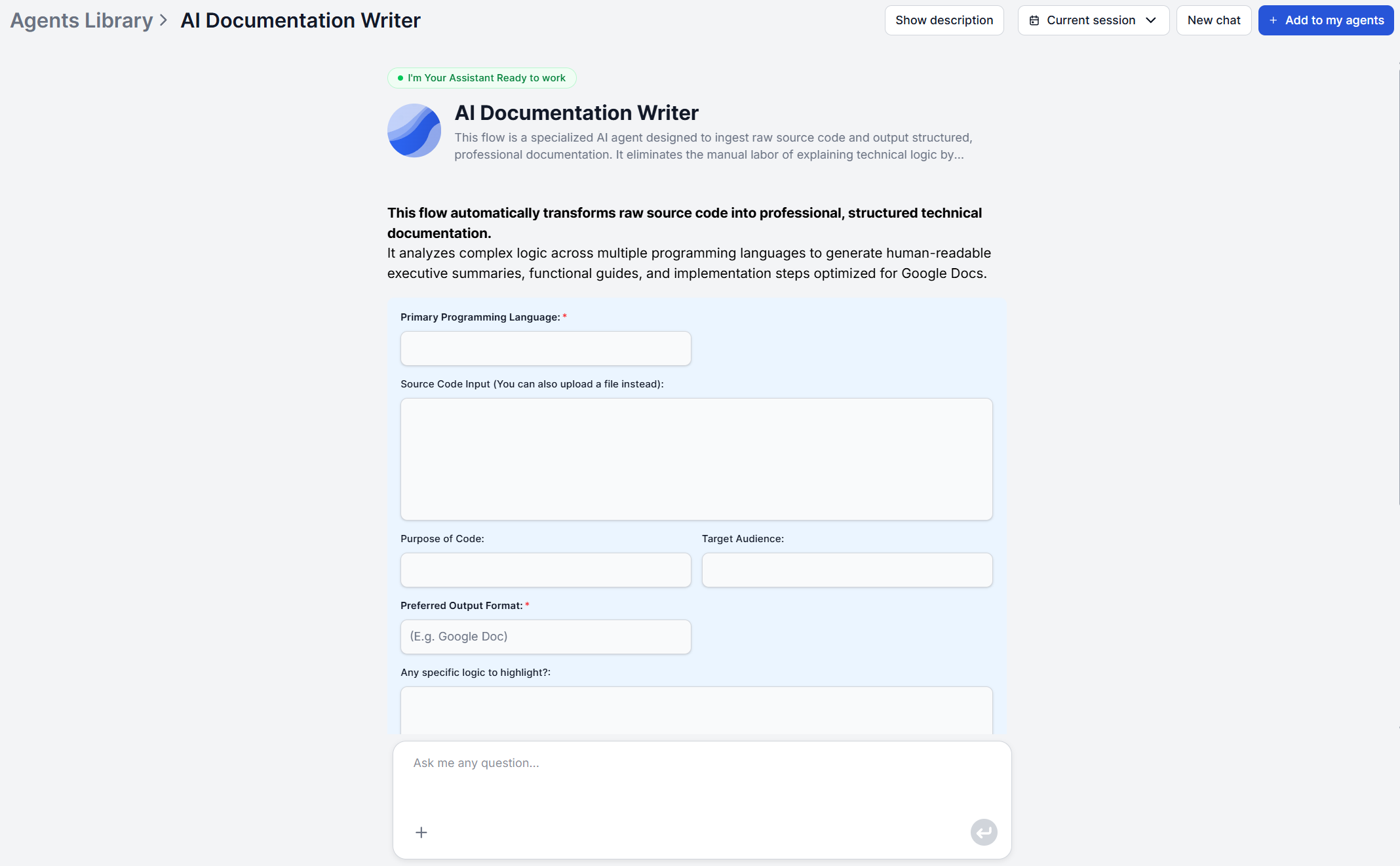
FlowHunt’s AI Documentation Writerworks through three stages
. It first analyzes the code, then translates the logic, and lastly structures the output document. You provide the source code, the primary language, the purpose, your target audience, and any additional information you see fit or the form asks for.
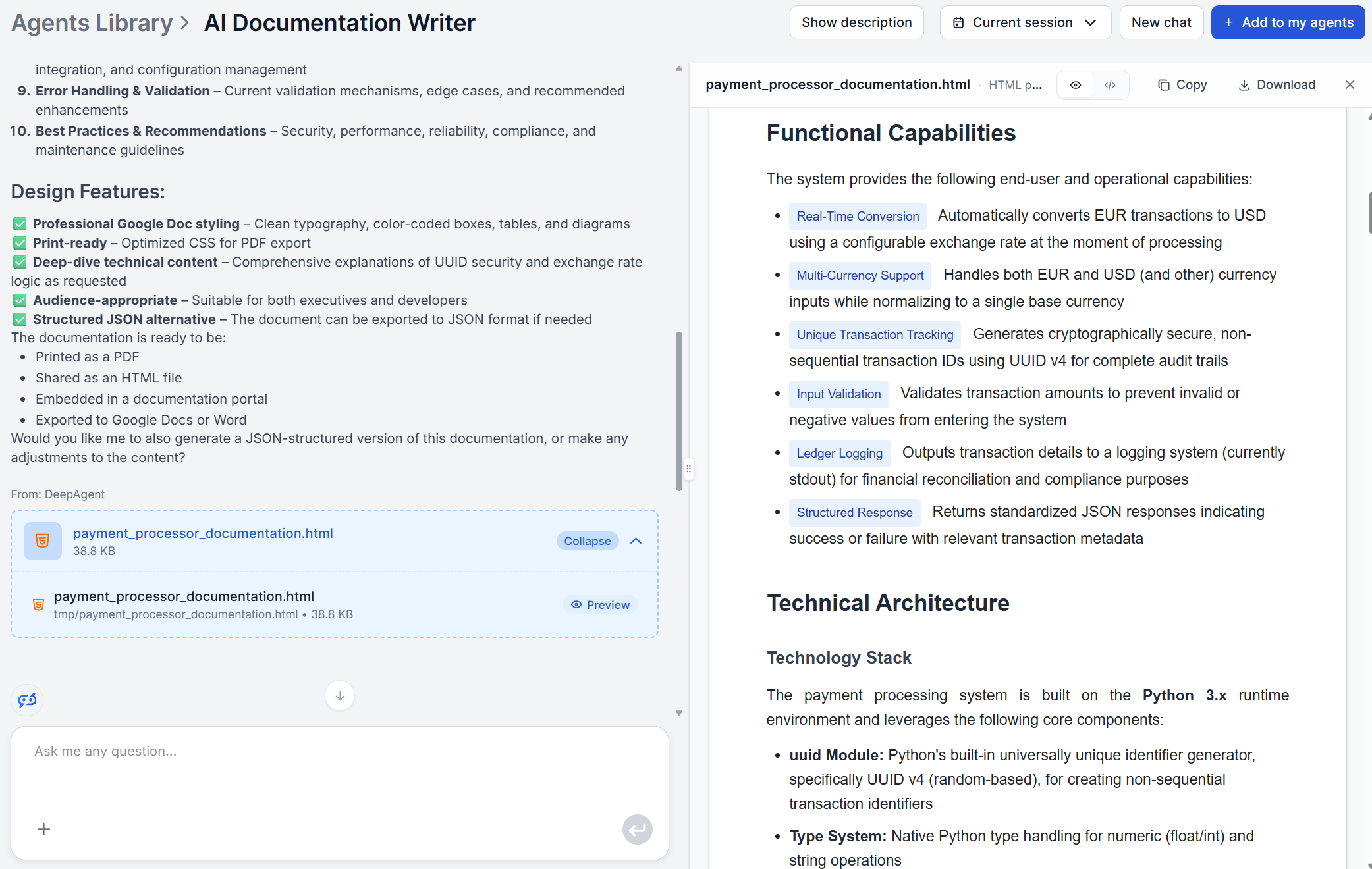
The final generated document covers an executive summary, functional capabilities, technical architecture, logic flow, key functions and components, and usage instructions.
That process fixes the cost asymmetry directly. If regenerating accurate documentation from current code takes a few minutes instead of a half-day of careful writing, it stops losing the priority fight against shipping code.
It also weakens the ownership problem, since a fast, low-effort process is realistic to assign to whoever merges the change, rather than requiring a dedicated writer to be looped in every time. Taking small but time-consuming tasks away from the writers also allows them to give greater care to the high-stake content.
The trigger mechanism still needs to be deliberate. FlowHunt doesn’t watch your repository on its own, but because it’s a workflow automation platform, the flow can be wired to a webhook that fires whenever a pull request touching a documented module gets merged.
Building a Documentation System That Stays Current
A documentation system that survives past the first few months needs more than a fast generation step. A workable loop looks like this:
Trigger. A merged pull request or a release cut sends the relevant source code into the documentation writer, with the audience and purpose set for that specific type of document (an API reference, a user guide, an internal SOP).
Capture what isn’t in the code. Some context never makes it into source, like why a deployment script works the way it does, which usually only exists as one engineer’s spoken explanation. It always helps to feed this information into the tool alongside the code itself. The explanation adds more context and depth, ensuring a more human and specific content gets produced.
Cross-check external context when it matters. Check any industry standards, protocols, or conventions worth verifying against the outside sources. Also re-check proprietary data you’re giving the AI, as this may have gone stale.
Review before publishing. A person who knows the system confirms setup steps actually work, checks that any legacy piece the AI couldn’t infer from code alone is accurate, and verifies the output reads correctly for its intended audience.
Re-trigger on the next change. You can set up regeneration on a schedule or via a custom trigger. For example, you can have the loop repeat on the next merge, which is the best way to keep the gap between code and documentation small.
What Good Developer Documentation Actually Looks Like
Good documentation isn’t defined by length or polish, it’s defined by whether it answers the questions a reader actually has, in the order they’d ask them. A useful structure covers:
What it does — a short summary of the purpose and scope, so a reader can tell in one paragraph whether they’re in the right place.
What it enables — the concrete capabilities and features, not just a restatement of the code.
How it’s built — enough architecture context (stack, components, dependencies) for someone to reason about the system, not just use it.
How it works — the logic flow and key operations, explained as a process rather than a list of function names.
How to use it — setup, configuration, and usage instructions written for whoever the actual reader is, not for the person who wrote the code.
This is also, not coincidentally, close to what a code-grounded generation process naturally produces, since each section maps to a question a real reader asks rather than a section a writer felt obligated to include.
From Documentation Debt to Documentation Asset
Documentation debt and documentation as an asset are the same underlying material, source code and institutional knowledge, at two different levels of maintenance cost. The moment regenerating a document becomes cheap enough to do on every meaningful change, the same information that used to decay into debt starts compounding into something the team can rely on.
The most direct measure is time developers spend searching for information that should already be written down. [GetDX estimates](https://getdx.com/blog/developer-documentation/) this at 3-10 hours per developer per week, which on a 100-person engineering team translates to hundreds of hours of weekly wasted, and the same research puts the annual cost of poor documentation at roughly $500K-$2M for a mid-sized engineering organization once context-switching and delayed productivity are factored in. If you want a rougher but faster proxy, track how many support tickets or Slack questions repeat a question that documentation should have already answered.
At minimum, it should describe what the feature does and how to use it. Architecture details, edge cases, and deeper context can follow later, but a feature with no answer to "what does this do" and "how do I use it" is functionally undocumented, no matter how much other material exists elsewhere.
Event-triggered beats calendar-triggered. Reviewing documentation on a fixed quarterly schedule means it's wrong for up to three months after any change in between. Tying documentation updates to a specific event, a merged pull request that touches a documented module, or a release cut, keeps the gap small regardless of how fast the underlying code moves.
No, and treating it that way is how AI-generated documentation ends up confidently wrong. AI-generated docs are a strong first draft grounded in the actual code, but a human should still confirm that setup steps work in a real environment, that anything the AI couldn't infer from code alone (a legacy component, an operational quirk) is described accurately, and that the tone lands for the intended audience.
Lower the cost until avoiding it takes more effort than doing it. Developers don't skip documentation because they don't value it, they skip it because writing it well takes real time away from work that has more visible, immediate payoff. Tying documentation generation to something they already do, like a pull request, rather than adding it as a separate obligation on top of shipping code, removes the friction that causes avoidance in the first place.
Maria is a copywriter at FlowHunt. A language nerd active in literary communities, she's fully aware that AI is transforming the way we write. Rather than resisting, she seeks to help define the perfect balance between AI workflows and the irreplaceable value of human creativity.
Maria Stasová
Copywriter & Content Strategist
Start Writing Better Documentation with AI
Stop writing documentation from scratch. Provide your source code and context, and FlowHunt's AI Documentation Writer returns a complete, structured technical manual in seconds.
How to Write Technical Documentation Automatically with AI
Technical documentation takes developers away from building. AI documentation writers generate structured, accurate docs from code in minutes. Here's how to use...
5 Documentation Types AI Writes Faster Than Any Technical Writer
From API references to onboarding guides, here are five specific documentation types where AI writing tools consistently outperform manual methods on speed with...
7 min read
AI
Documentation
+3
Cookie Consent We use cookies to enhance your browsing experience and analyze our traffic. See our privacy policy.