


Java Decompiler AI Agent
Integrate FlowHunt’s AI-powered Java Decompiler agent to automate Java bytecode decompilation, streamline reverse engineering, and gain actionable insights into...
3 min read
AI
Java
+5

Decompile Java bytecode to readable source code in your AI-driven workflows with the Java Decompiler MCP Server, compatible with FlowHunt and other MCP clients.
The Java Decompiler MCP Server (mcp-javadc) is a Model Context Protocol (MCP) server designed to decompile Java class files. It enables AI assistants and MCP-compatible development tools to convert Java bytecode (.class files or classes within JARs) into human-readable Java source code. This server streamlines workflows by allowing automated decompilation via API, supporting tasks such as examining third-party libraries, reverse-engineering legacy code, or analyzing compiled Java packages without requiring the original source code. It offers integration through stdio transport and temporary file management, and is compatible with various MCP clients, making it a versatile tool for developers and AI agents working with Java bytecode.
No prompt templates were mentioned in the README or repository files.

Start your free trial today and see results within days.
No explicit MCP resources are mentioned in the documentation or files.
decompile-from-path
Decompiles a Java .class file from a specified file path.
Parameter: classFilePath (absolute path to the .class file)
decompile-from-package
Decompiles a Java class using its package name (e.g., java.util.ArrayList).
Parameter: (not detailed in README)
decompile-from-jar
Decompiles a Java class from within a JAR file.
Parameter: (not detailed in README)
Get latest tips, trends, and deals for free.
Decompiling Standalone Class Files
Quickly convert compiled .class files to readable Java source code for debugging, auditing, or learning purposes.
Reverse Engineering Third-party Libraries
Analyze classes within JAR files or by package name to understand behavior and structure when source code is unavailable.
Integration with AI Development Tools
Allow AI agents or assistants to automatically decompile Java code as part of broader code analysis or migration workflows.
Automated Codebase Exploration
Use as a backend for tools that require on-demand decompilation to assist in navigating and understanding large codebases.
@idachev/mcp-javadc@latest as an MCP server in your Windsurf config.{
"mcpServers": {
"javaDecompiler": {
"command": "npx",
"args": ["-y", "@idachev/mcp-javadc"]
}
}
}
Securing API Keys:
If you need to set environment variables (e.g., CLASSPATH):
{
"mcpServers": {
"javaDecompiler": {
"command": "npx",
"args": ["-y", "@idachev/mcp-javadc"],
"env": {
"CLASSPATH": "/path/to/java/classes"
}
}
}
}
claude mcp add javadc -s project -- npx -y @idachev/mcp-javadc
{
  "mcpServers": {
    "javaDecompiler": {
      "command": "npx",
      "args": ["-y", "@idachev/mcp-javadc"]
    }
  }
}
{
"mcpServers": {
"javaDecompiler": {
"command": "npx",
"args": ["-y", "@idachev/mcp-javadc"]
}
}
}
Note:
Always set sensitive values (like CLASSPATH or API keys) using the env field in your configuration for security.
Example:
{
  "mcpServers": {
    "javaDecompiler": {
      "command": "npx",
      "args": ["-y", "@idachev/mcp-javadc"],
      "env": {
        "CLASSPATH": "/path/to/java/classes"
      }
    }
  }
}
Using MCP in FlowHunt
To integrate MCP servers into your FlowHunt workflow, start by adding the MCP component to your flow and connecting it to your AI agent:
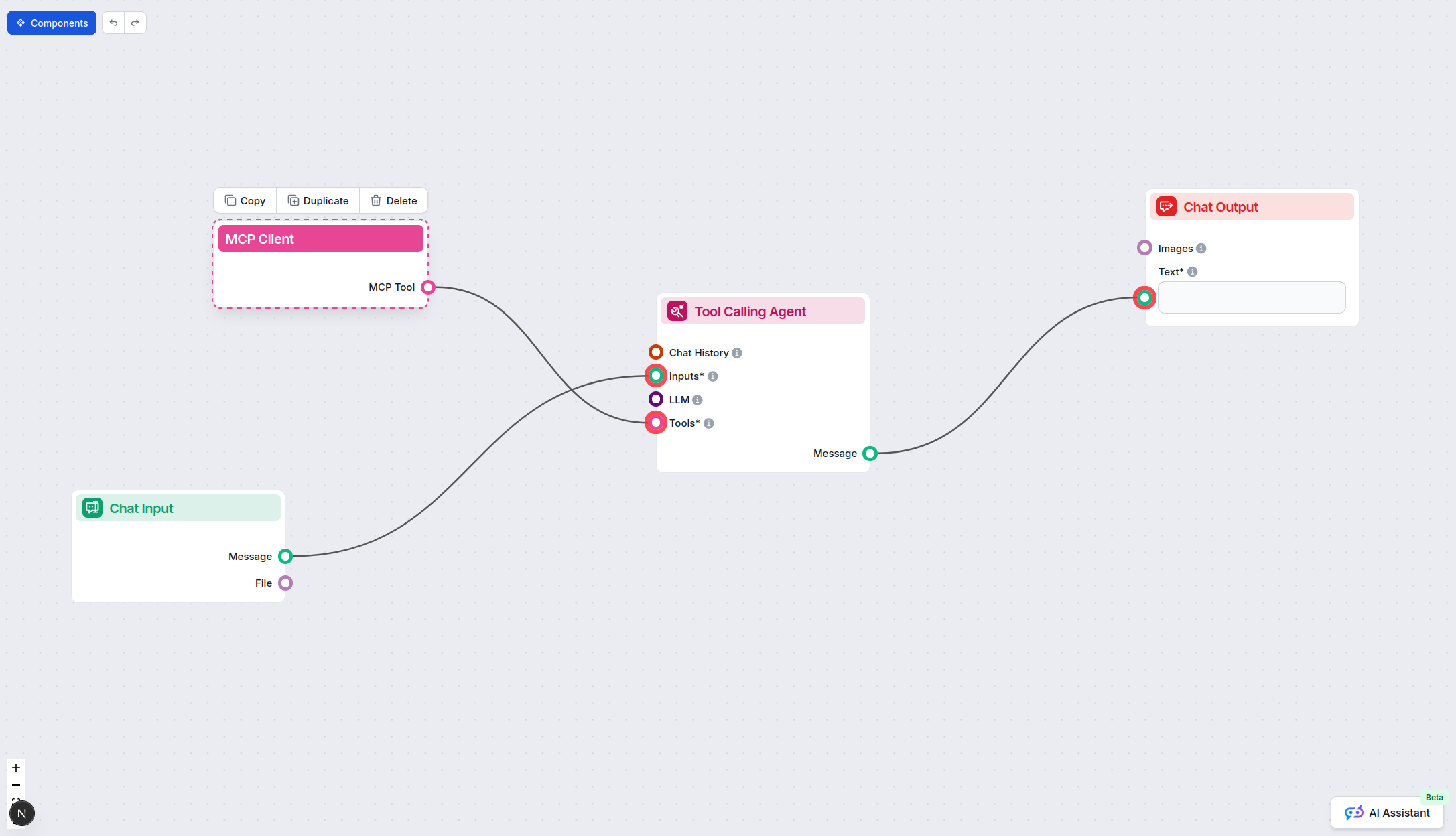
Click on the MCP component to open the configuration panel. In the system MCP configuration section, insert your MCP server details using this JSON format:
{
  "javaDecompiler": {
    "transport": "streamable_http",
    "url": "https://yourmcpserver.example/pathtothemcp/url"
  }
}
Once configured, the AI agent is now able to use this MCP as a tool with access to all its functions and capabilities. Remember to change "javaDecompiler" to whatever the actual name of your MCP server is and replace the URL with your own MCP server URL.
| Section | Availability | Details/Notes |
|---|---|---|
| Overview | ✅ | Java decompiler server for MCP |
| List of Prompts | ⛔ | No prompt templates found |
| List of Resources | ⛔ | No explicit MCP resources listed |
| List of Tools | ✅ | decompile-from-path, decompile-from-package, decompile-from-jar |
| Securing API Keys | ✅ | Via env in configuration |
| Roots Support | ⛔ | Not mentioned |
| Sampling Support (less important in evaluation) | ⛔ | Not mentioned |
Based on the tables, this MCP server is focused and functional for Java decompilation, but lacks advanced MCP features such as prompt templates, resources, roots, or sampling. It provides a clear, practical toolset and secure configuration, but does not cover broader MCP extensibility or integration primitives.
MCP-javadc is well-documented and serves a specific, valuable purpose. However, its utility is limited by the absence of standardized prompts, resources, and advanced MCP features like roots and sampling. For developers needing Java decompilation in an MCP workflow, it is practical and effective, but it does not showcase MCP’s full potential. Score: 5/10
| Has a LICENSE | ✅ (ISC) |
|---|---|
| Has at least one tool | ✅ |
| Number of Forks | 0 |
| Number of Stars | 2 |
Automate Java class and JAR decompilation for analysis, debugging, and reverse engineering. Integrate with FlowHunt for seamless AI workflows.
Integrate FlowHunt’s AI-powered Java Decompiler agent to automate Java bytecode decompilation, streamline reverse engineering, and gain actionable insights into...
The JavaFX MCP Server bridges AI assistants and JavaFX-based applications, enabling LLM-powered workflows to interact with JavaFX UI components, automate app st...
The Spring Initializr MCP Server allows AI assistants to generate and download Spring Boot projects programmatically, streamlining backend development by automa...
Cookie Consent
We use cookies to enhance your browsing experience and analyze our traffic. See our privacy policy.