


Agentic AI: The Definitive Guide to Agentic Intelligence and Its Real-World Impact
Agentic AI and AI agents demystified. Learn what they are, how they work, real-world examples, and how businesses are using them today.
11 min read
AI
Automation
+3
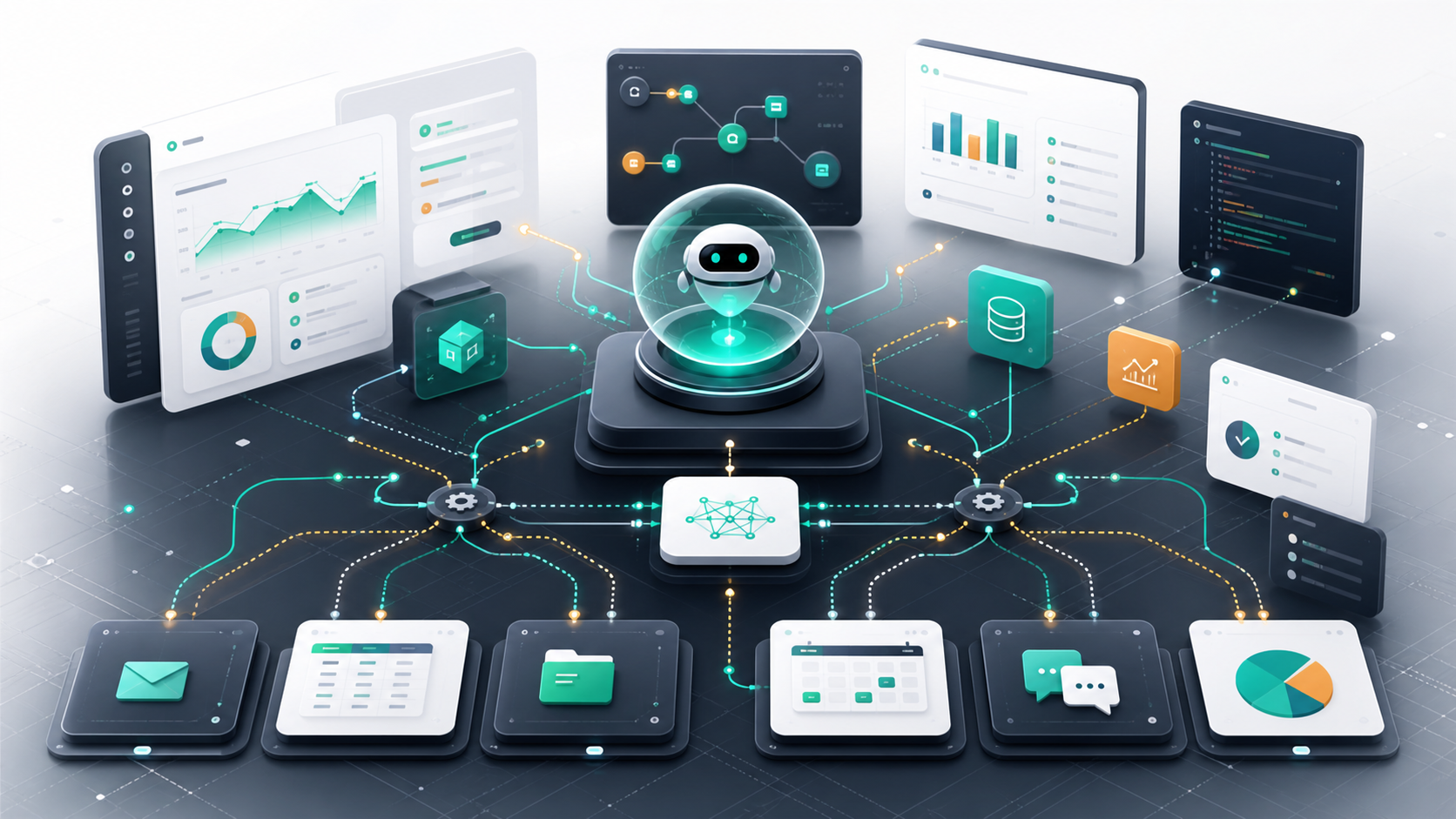
AI agents are becoming a new class of SaaS user. Learn why agent-native products need machine-readable docs, reliable APIs, MCP support, transparent pricing, and audit-ready workflows.
In 2011, Marc Andreessen wrote that software was eating the world. A decade and a half later, the next shift is becoming visible: software is not just being used by people anymore. It is being used, evaluated, and operated by agents.
That changes the shape of SaaS.
For the last twenty years, most SaaS products were built around human adoption. A buyer visited a landing page, booked a demo, clicked through onboarding, invited teammates, and eventually built habits around a dashboard. Product teams optimized page speed, navigation, empty states, tooltips, and conversion funnels because the user was a person sitting in front of a screen.
AI agents do not behave like that.
Agents read documentation. They inspect APIs. They compare schemas. They test authentication, rate limits, latency, and error recovery. They care less about how your dashboard feels and more about whether your system can be called safely, repeatedly, cheaply, and predictably.
That is the agent-native future of SaaS.
The shift is not about replacing every human user with an autonomous system tomorrow. It is about a new class of user becoming important enough that SaaS products need to design for it explicitly.
Gartner has already projected that 15% of day-to-day work decisions will be made autonomously through agentic AI by 2028 , and that 33% of enterprise software applications will include agentic AI by the same year. At the same time, Gartner warns that many projects will fail because of unclear value, weak controls, and poor production readiness.
That combination matters. Agentic AI is real, but the winners will not be the products with the loudest claims. They will be the products agents can actually use in production.
Anthropic’s Model Context Protocol is an early signal of where this is heading. MCP was introduced as an open standard for connecting AI assistants to business tools, data sources, repositories, and development environments. The reason it matters is simple: agents need standardized ways to discover capabilities and act on them.
The SaaS companies that understand this will treat agent access as a core product surface. The companies that do not will slowly become harder for automated systems to choose.
Human users and AI agents have different expectations from the same product.
| Human users | AI agents |
|---|---|
| Visit landing pages | Read API docs, schemas, and MCP definitions |
| Book demos | Evaluate integration points |
| Click buttons | Execute workflows |
| Trust product copy | Verify permissions, limits, and outputs |
| Care about UI and UX | Depend on reliability, latency, and determinism |
| Make emotional and social decisions | Optimize for cost, performance, and fit |
| Use products intermittently | Run workflows continuously |
This difference is not cosmetic. It changes what “good product” means.
A human might choose a project management tool because the board feels intuitive and the onboarding is pleasant. An agent chooses based on whether issues can be created, updated, searched, grouped, and reconciled through reliable APIs. A human might prefer a beautiful analytics dashboard. An agent wants clean event schemas, exportable reports, and dependable query access.
Agents do not convert like humans. They do not admire your homepage. They do not need a webinar. They do not get reassured by vague claims about enterprise readiness.
They need:
If those surfaces are weak, the agent will route around your product.

Start your free trial today and see results within days.
The next decade of SaaS will not simply split into “human products” and “agent products.” Most categories will need both layers.
Payment platforms already depend on APIs, webhooks, idempotency keys, and fraud controls. For agents, these become the main product. An agent does not care whether the dashboard has a polished revenue chart. It cares whether payment events are standardized, whether reconciliation is reliable, whether fees are predictable, and whether high-frequency workflows can run without surprise failures.
Tools like Slack were built for human collaboration, but agents increasingly participate in the same channels. Agent-native communication needs deterministic message threading, reliable event subscriptions, clear bot permissions, and guardrails around what an agent can post, read, summarize, or escalate.
Knowledge tools are valuable to humans because they organize information visually. Agents need a different memory layer: searchable, versioned, permission-aware storage with clean retrieval, conflict handling, and references back to the original source.
Analytics products cannot only expose dashboards. Agents need queryable metrics, exportable data, anomaly detection hooks, and standardized event definitions. A human opens Google Analytics to inspect a trend. An agent may run a daily performance audit, compare traffic segments, summarize movement, and push recommendations into another workflow.
Scheduling tools are built around human booking flows. Agents need conflict-free slot selection, reliable calendar writes, webhook notifications, availability rules, and clean rollback when a downstream action fails.
The common thread is clear: the UI remains useful, but the agent-facing interface becomes strategic infrastructure.
Agent-native SaaS is not just “we have an API.” Many SaaS products have APIs that technically work but are still difficult for agents to use because the contracts are incomplete, ambiguous, or unreliable.
An agent-native product has six practical qualities.
Get latest tips, trends, and deals for free.
The API cannot be an afterthought bolted onto the human interface. It needs to expose the product’s real capabilities with stable resources, predictable pagination, clear authentication, and consistent response formats.
Agents need to know what happened after every call. A vague error message that a human support team could interpret is not enough. Error responses should say what failed, why it failed, whether it is retryable, and what input needs to change.
Human documentation explains. Agent-ready documentation also structures.
That means OpenAPI specs, JSON schemas, field-level descriptions, examples for common workflows, and explicit edge cases. The documentation should answer questions an agent must resolve before acting:
If an agent has to infer too much, the product is not agent-ready.
MCP is becoming a practical interface for agent-tool interaction. It gives agents a structured way to discover tools and understand how to call them. For SaaS companies, MCP servers can make product capabilities visible to AI systems without forcing every agent builder to write a custom connector from scratch.
MCP does not remove the need for API quality. It exposes whether that quality exists.
Agents need predictable behavior. Surprise UI changes are annoying for humans. Surprise API behavior is destructive for automation.
Determinism means stable contracts, explicit versioning, idempotent write operations where possible, and no hidden workflow changes that alter outcomes without notice. If an endpoint sometimes returns different shapes for the same request, an agent will eventually fail.
Agent workflows can run at high volume. That makes pricing clarity a product requirement.
Agents need to estimate whether an action is worth taking before they take it. A human may tolerate a pricing page that says “contact sales.” An agent needs units, thresholds, limits, and expected cost per workflow. If the cost model is opaque, the agent may choose a competitor with a lower integration risk.
Autonomous action requires accountability. Every agent action should be attributable, logged, searchable, and reversible where possible.
This includes:
Without auditability, agent adoption will stall at prototypes.
The most important agent-native advantage is not a better landing page. It is becoming the default integration point.
When a team builds an agent workflow, the agent or the agent builder has to choose tools. That choice will increasingly depend on machine-level criteria:
This is where market share can shift quietly. A product may keep its human customers for a while, but lose new automated workflows because it is harder to integrate. Over time, the products agents choose become the products humans inherit.
If you are a SaaS founder, product leader, or technical owner, start with a direct audit.
Ask:
Then fix the lowest-level gaps first. Agent-native readiness is built from infrastructure upward. A beautiful agent demo will not survive poor authentication, inconsistent APIs, or ambiguous pricing.
For many teams, the fastest path is to prototype agent workflows against your own product. Use an AI agent framework or a visual workflow builder to connect to your API as if you were an outside developer. The friction you feel is the friction your future agent users will feel.
The next wave of SaaS dominance will not only go to companies with the best sales teams or the most polished dashboards. It will go to companies that agents can discover, evaluate, trust, and operate.
This does not mean abandoning human users. It means recognizing that agents are becoming first-class participants in software ecosystems. Humans will still define goals, approve policies, and review outcomes. Agents will increasingly perform the work between those decisions.
Your users are already changing. The strategic question is whether your product is ready for the users that do not click, do not browse, and do not wait for onboarding.
They read your interface at machine speed. Then they decide whether you are worth integrating.
Ready to make your SaaS agent-ready? FlowHunt helps teams build agent workflows, connect tools, and prepare for the agent-native future of SaaS. Start building with FlowHunt or explore our MCP server development services .
Viktor Zeman is a co-owner of QualityUnit. Even after 20 years of leading the company, he remains primarily a software engineer, specializing in AI, programmatic SEO, and backend development. He has contributed to numerous projects, including LiveAgent, PostAffiliatePro, FlowHunt, UrlsLab, and many others.

FlowHunt helps teams build AI agents, MCP integrations, and production workflows that connect reliably to real SaaS tools.
Agentic AI and AI agents demystified. Learn what they are, how they work, real-world examples, and how businesses are using them today.
Explore the most innovative AI agent startups transforming enterprise automation in Q4 2025. Discover autonomous agents, cognitive architectures, and industry-s...
Discover why leading engineers are moving away from MCP servers and explore three proven alternatives—CLI-based approaches, script-based tools, and code executi...
Cookie Consent
We use cookies to enhance your browsing experience and analyze our traffic. See our privacy policy.