


How to Do Market Analysis with AI in Under 30 Minutes
TAM/SAM/SOM calculations, competitor landscapes, market trends, and growth forecasts — AI market analysis tools can cover all of those automatically. Here's how...
8 min read
AI
Research
+3

Most startups skip proper market analysis because it takes too long. Here’s how AI market analysis tools let founders validate market size, competitive intensity, and timing in a single afternoon.
Most startups skip proper market analysis because it takes too long. Traditional research involves pulling analyst reports, running structured interviews, mapping competitive landscapes manually. This can easily absorb weeks that early-stage teams simply don’t have.
The result are founders who build based on assumptions they’ve mistaken for facts. An AI market analysis tool lets you run the same research a firm would spend weeks on in a single afternoon. Read on to see how founders use it to validate market size, competitive intensity, and timing.
First constraint is the time pressure. Traditional research takes weeks and requires skills most founding teams don’t apply consistently. Commissioning a research firm is expensive. Building the analysis internally means a founder spending days pulling data, reconciling conflicting figures, and producing a document that may already be outdated by completion.
Second constraint is the founder conviction, which compounds the time problem. Founders believe in their idea before they analyze the market, and that’s often exactly what makes them willing to start. Market research feels like homework assigned to validate a conclusion they’ve already reached, so it gets deprioritized.
The cost surfaces later, when they enter a market too crowded to differentiate in, build for a customer segment that doesn’t hold the budget, or choose a timing window that’s too early or too late. These are the failure modes that pre-build market analysis exists to prevent. It’s about identifying which specific assumptions are worth pressure-testing before months of product development go into validating them the hard way.
Market validation isn’t a single question. A useful pre-build analysis answers six dimensions:
Missing any one of these produces a blind spot that surfaces at the worst possible moment, usually when pitching investors or when the first product launch lands flat.

Start your free trial today and see results within days.
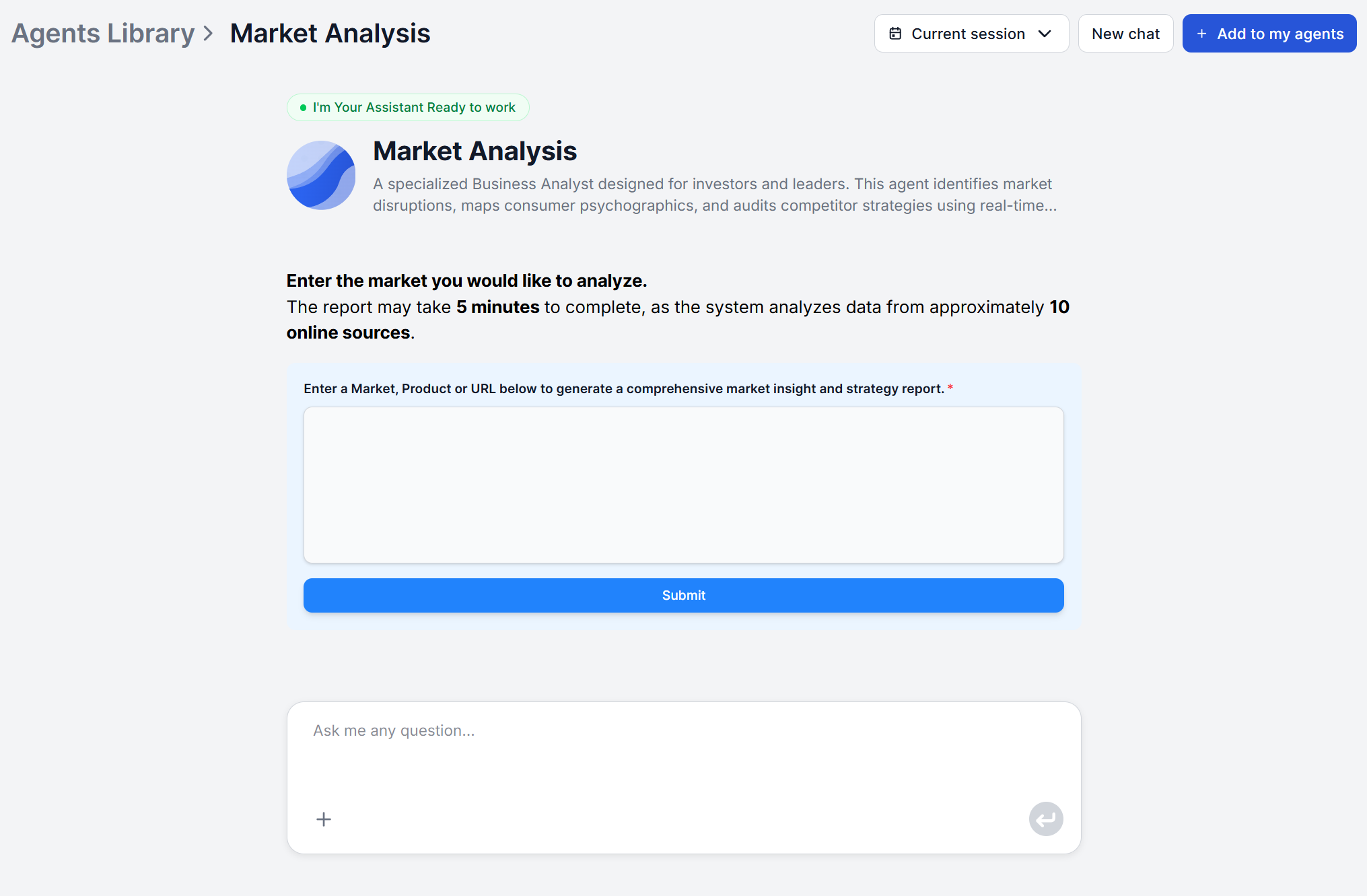
The Market Analysis Agent takes a market, industry, or product as input and returns a comprehensive strategic report in a single run. The agent queries up to 10 credible online sources per run, selecting non-redundant sources to ensure broad coverage.
The output is a structured Markdown document covering:
This is exactly the six-dimension framework a thorough pre-build validation requires. The analyst time that used to go into pulling and synthesizing this data now goes into interpreting it. AI Market Analysis Agent is particularly usable for startups, because early-stage founders need broad, current market orientation, not deep auditable quantification.
For a complete walkthrough of the research process, see how to do market analysis with AI in under 30 minutes .
Each of the five critical pre-build questions maps directly to a section of the Market Analysis Agent output.
1. Is the market large enough and moving in the right direction? The market trends section surfaces growth drivers, emerging opportunities, and macro forces shaping the category — telling you whether you’re entering a rising or declining wave, and what’s driving the movement.
2. Who is the actual buyer and what are they buying for? The customer segments section breaks down demographics, psychographics, purchasing motivations, and unmet needs. For B2B ideas, this often reveals that the economic buyer (who pays) differs from the user (who operates the product).
3. Who else is solving this and how well? The competitor analysis section maps key players, pricing strategies, positioning approaches, and disruption risks. Pair this with AI product analysis on two or three specific competitors to go a level deeper on feature gaps and user sentiment patterns.
4. What structural factors make this market hard or easy to enter? The logistics and distribution sections reveal how the market moves product to customers. What are the channel dependencies, fulfillment dynamics, and supply chain structures that affect competitive moats and switching costs.
5. Is the timing right? The SWOT synthesis in the strategic recommendations section frames the opportunity and threat landscape at the macro level. This is where the timing question lives: is the market in a window where a new entrant can establish differentiation, or has consolidation already narrowed it?
For a deeper breakdown of how AI applies SWOT and other strategic frameworks to market intelligence, see AI market analysis frameworks .
Get latest tips, trends, and deals for free.
Investors expect three things in the market section of a seed or Series A deck: a defensible market framing, a clear competitive landscape, and evidence that the founder understands who they’re selling to and why the timing is right.
The Market Analysis Agent produces structured output across all three. The market trends section feeds the “why now” narrative. The customer segments section builds the ICP (ideal customer profile) slide. The competitor analysis becomes the competitive landscape. The SWOT synthesis anchors the strategic positioning argument.
What AI produces is a solid draft layer. The founder’s job is to layer company-specific assumptions on top of it, particularly around the addressable market wedge and the specific go-to-market approach. When presenting AI-generated analysis to investors, be transparent about the methodology. The analysis is synthesized from public sources, reflects conditions at the time of the run, and is directional rather than auditable. Seed-stage investors are generally comfortable with this framing.
AI market analysis covers what’s knowable from public sources: macro trends, established competitor dynamics, documented customer behavior patterns, and regulatory context.
Primary research covers what isn’t publicly documented. Things like willingness to pay for a specific solution, friction in a buyer’s current workflow, and organizational dynamics that affect purchasing decisions. These require direct conversations.
The most efficient pre-build validation sequence:
This sequence reduces the number of customer interviews needed by giving you a sharper starting hypothesis. Instead of going into discovery conversations with broad exploratory questions, you go in knowing what you need to validate — producing better answers and respecting interviewees’ time.
Not sure which tool to use for the AI market analysis layer? See AI market research tools compared for a breakdown of FlowHunt and three alternatives.
A founder building an AI-powered clinical notes tool for healthcare teams needed to understand whether the market was accessible before committing to a first technical sprint.
They entered “AI clinical documentation tools for healthcare” into the Market Analysis Agent . The report came back covering six structured dimensions:
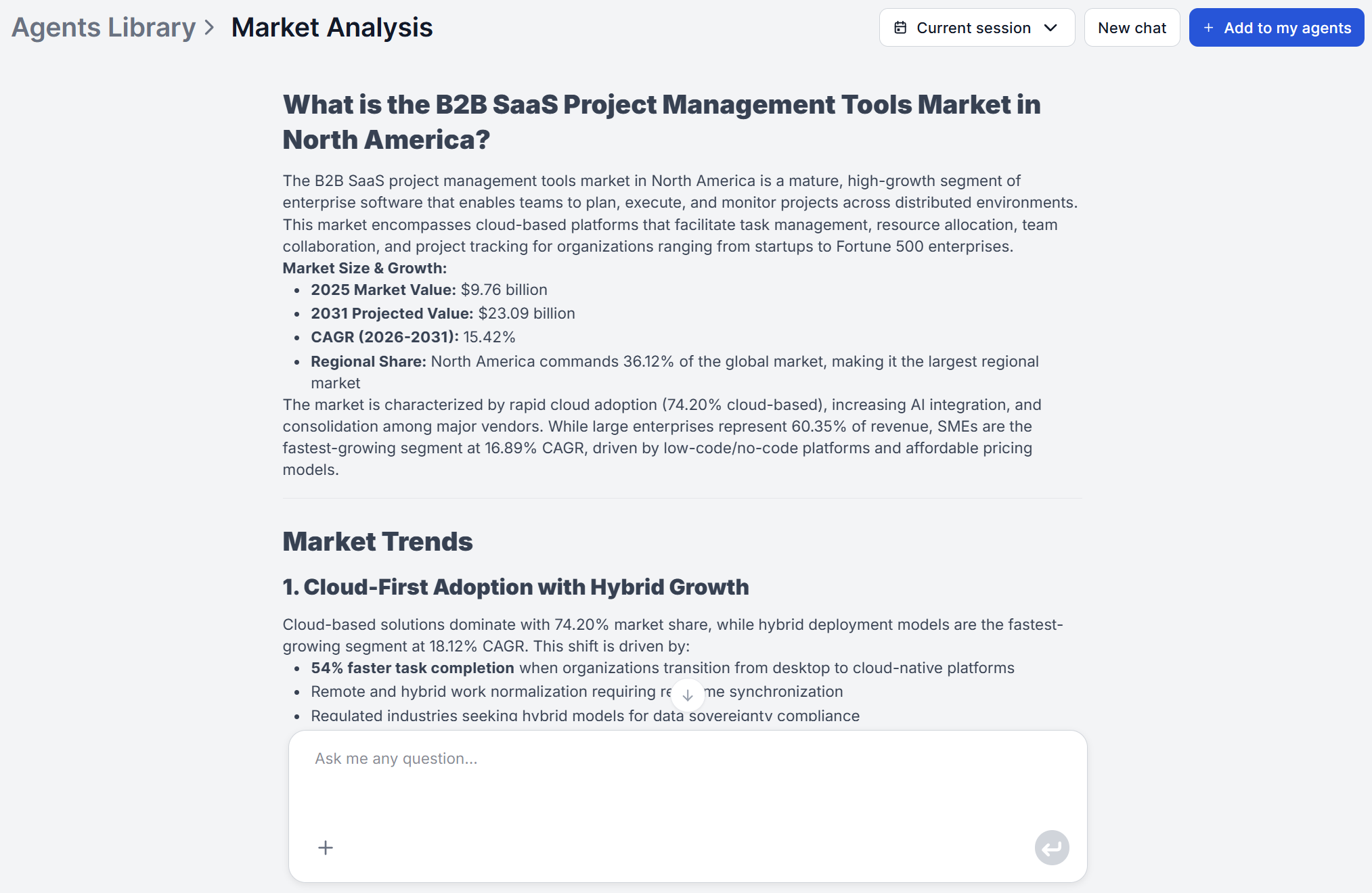
After reviewing the report, two key findings reshaped the founder’s initial assumptions. The competitor concentration in primary care pointed to a specific entry wedge in specialty care. The customer segment breakdown clarified that nurses, not physicians, were most likely to be the user-level product champion even when physicians or administrators held the budget.
Over the next two days, the founder carried out focused customer discovery calls built around those two specific hypotheses. The AI analysis had done the orientation work, the interviews validated the specific bets.
Total research phase before the first sprint was two working days instead of two weeks. The pre-build market analysis gave the founder the orientation to make that decision with significantly more evidence and a clearer hypothesis about where to focus.
For most early-stage teams, spending weeks on a full traditional market analysis simply isn’t viable, which is why so many products used to launch without a validated market picture behind them. Now, with AI, it can be done and analyzed in an afternoon. Even if not perfect, it definitely provides founders a solid base overview and piece of mind before putting all their eggs in one basket.
Run the Market Analysis Agent before the first sprint. Not because it guarantees success, but because the founders who skip it are the ones who find out six months later what the market already knew.
New to the tool? The Market Analysis Tool tutorial walks through your first report step by step.
Maria is a copywriter at FlowHunt. A language nerd active in literary communities, she's fully aware that AI is transforming the way we write. Rather than resisting, she seeks to help define the perfect balance between AI workflows and the irreplaceable value of human creativity.

FlowHunt's Market Analysis Agent delivers a structured strategic report covering market trends, customer segments, competitive landscape, and SWOT synthesis — in minutes. Run your pre-build validation before writing a single line of code.
TAM/SAM/SOM calculations, competitor landscapes, market trends, and growth forecasts — AI market analysis tools can cover all of those automatically. Here's how...
AI product analysis delivers structured reports in minutes. Here's what it covers, how accurate it is, and how to use it for real business decisions.
Product managers spend 20–30% of their time on competitive research. AI product analysis cuts that to minutes. Here are five specific ways PMs use it across dis...
Cookie Consent
We use cookies to enhance your browsing experience and analyze our traffic. See our privacy policy.