How to Do Market Analysis with AI in Under 30 Minutes
TAM/SAM/SOM calculations, competitor landscapes, market trends, and growth forecasts — AI market analysis tools can cover all of those automatically. Here’s how to use them for real business decisions, not just slide decks.
The worst moment in any product cycle isn’t a bad launch. It’s the realization, six months after launch, that the signal was always there. The crowded competitor set, the shrinking category, the customer segment that doesn’t actually hold the budget. It was findable, but nobody looked.
Market analysis exists to prevent that moment. TAM/SAM/SOM, competitive positioning, growth trends, customer behavior don need to take weeks anymore. Here’s how to cover what matters in under 30 minutes, using an AI market analysis tool
that does the research layer automatically.
What AI Market Analysis Covers
The fundamental problem of manual market research is that breadth and depth don’t scale together. You can go deep on one competitor or wide across an industry, but rarely both, and never fast.
A typical market research cycle involves pulling reports from multiple sources, resolving conflicting data, and synthesizing findings into a format someone else can actually use. That process stretches across days and rarely produces a consistent output.
Market intelligence AI enables you to run multiple analytical dimensions simultaneously, not sequentially. A modern AI market analysis tool doesn’t aggregate news headlines or pull from a single static database. It queries multiple credible sources in parallel, strips out noise, and synthesizes findings into a structured format.
The dimensions covered span the full picture you need to make informed business decisions:
Market trends — growth drivers, emerging opportunities, regulatory shifts, and technological disruptions shaping the industry.
Customer segments — demographics, psychographics, purchasing motivations, behavioral patterns, and unmet needs across key buyer groups.
Competitor analysis — key players, pricing strategies, positioning approaches, and disruption risks in the current market.
Logistics & distribution — supply chain structures, fulfillment systems, and distribution network patterns that define how the market operates.
Payment methods — dominant and emerging payment rails, consumer preferences, and fintech trends reshaping how money moves in the market.
Strategic recommendations — a SWOT synthesis and actionable guidance oriented toward decision-makers who need the bottom line.
How to Run a Market Analysis in 30 Minutes
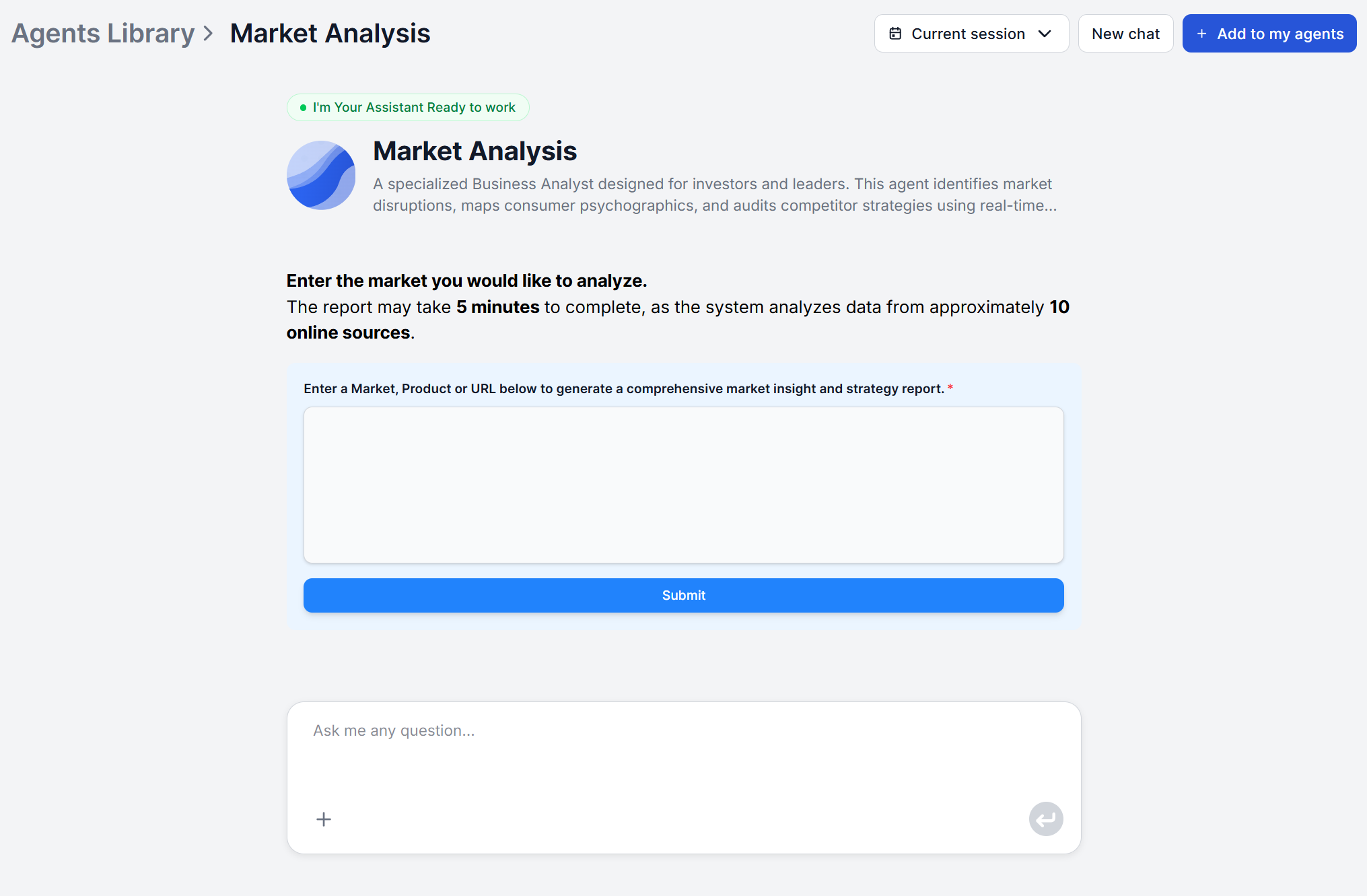
The process is deliberately simple. While many customization options are available, the tool works out of the box without any setup. You don’t need to configure data sources, select databases, or write a research brief. Simply go to your Agent library search for the Market Analysis Agent and add it to your agents.
If you’d like to try the tool free online before committing to a free trial, follow this link
.
Step 1: Define your market
Enter the market, industry, or product you want to analyze. The more specific your input, the more targeted the report. “B2B SaaS project management tools in North America” will produce a more useful output than just “software.” You can also include a geographic qualifier to scope the analysis regionally.
Step 2: The agent researches across sources
The Market Analysis Agent queries up to 10 credible online sources per run, selecting non-redundant sources to ensure broad, diverse coverage. This happens automatically, with no configuration needed on your end.
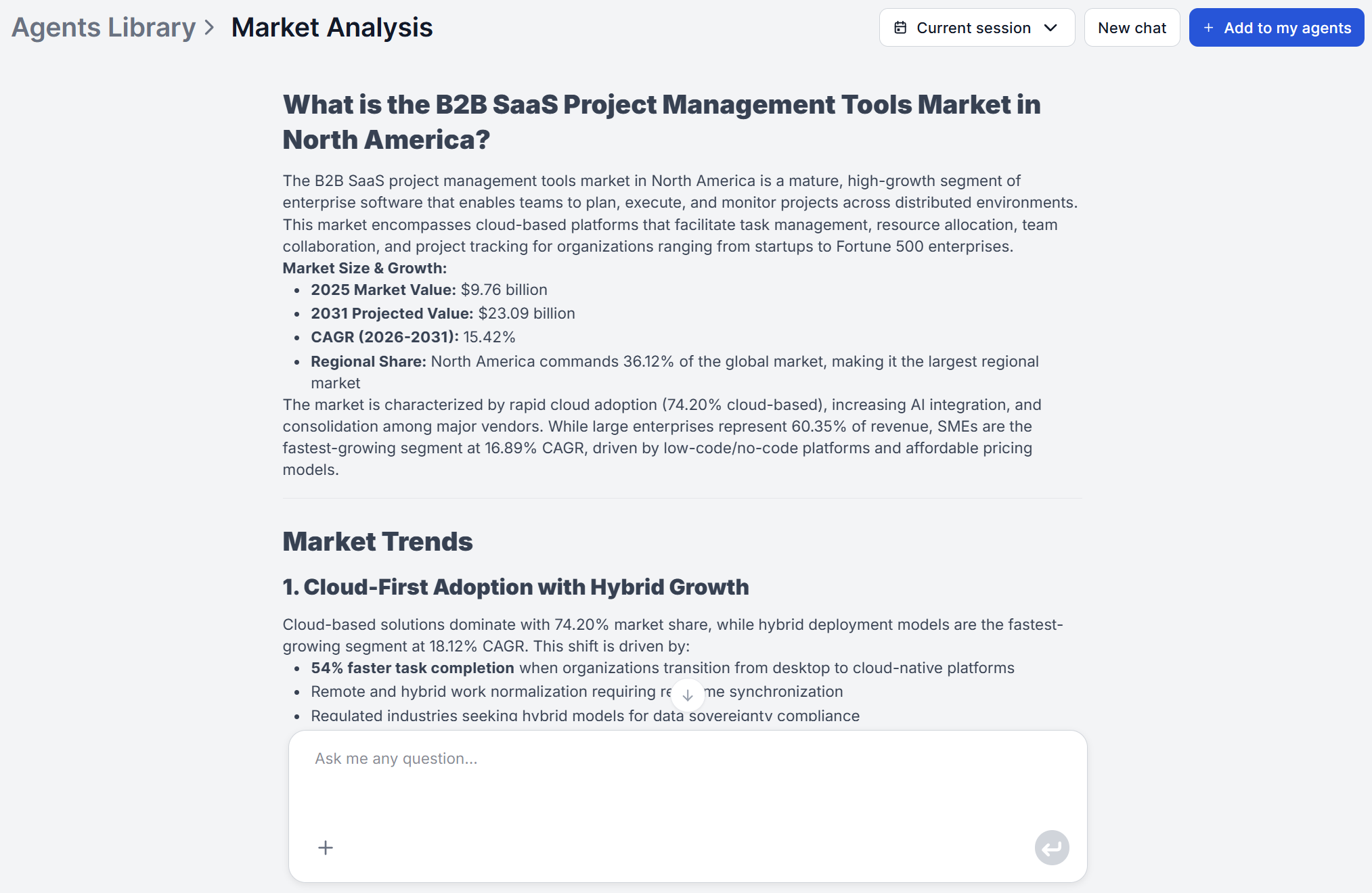
Step 3: Review the structured report
The output is a clean Markdown document organized into the six analytical sections described above. Each section is written for clarity and actionability not raw data to interpret. Every dimension arrives in a decision-ready format that you can hand directly to a stakeholder.
Step 4: Take it into your workflowPaste the Markdown directly into your CMS, strategy document, or presentation. Use it as the research foundation for downstream tasks, such as client briefs, investment memos, product roadmap planning, or competitive positioning work. The underlying flow can be customized directly in FlowHunt if you need to adjust the format or analytical scope to match your organization’s specific needs.
The entire process, from input to a usable, structured AI market report, is finished within 10 minutes. What typically requires a team of analysts is condensed into a single automated run. For a step-by-step annotated walkthrough of each stage, see the Market Analysis Tool tutorial
.
Ready to grow your business?
Start your free trial today and see results within days.
Understanding each section helps you frame the right input and use the output effectively.
Market trends establish the macro context. Where the market is heading, what’s accelerating growth, and which forces are creating instability or opportunity. This is the section investors read first and the section product teams use to validate whether a category is worth entering.
Customer segments break down who buys in this market and why. Demographics, behavioral patterns, purchasing triggers, and the gaps between what buyers say they need and what existing products actually deliver. This is where product-market fit questions get answered at the category level rather than the company level.
Competitor analysis maps the landscape. Which players dominate, how they’re positioned, where pricing pressure exists, and which emerging entrants are reshaping competitive dynamics. Pair this section with a dedicated AI product analysis
for deeper intelligence on specific competitors.
Logistics & distribution covers how the market moves product or delivers services to customers. This section reveals moats and fragilities that aren’t visible from revenue figures or product comparisons alone.
Payment methods maps how the money actually flows. What are the dominant payment rails, emerging alternatives, consumer trust patterns, and fintech disruption risks. Essential context for any market entry strategy involving direct transactions.
Strategic recommendations synthesize all sections into a SWOT framework and actionable guidance. This is the section you hand to a decision-maker who needs the takeaways without reading the full report. For a detailed breakdown of how AI applies SWOT and other strategic frameworks automatically, see AI market analysis frameworks
.
Use Case: Startup Market Sizing and Validation
A founding team preparing a Series A deck needs defensible market size framing and a credible competitive landscape, ideally without paying for analyst reports that may be 12–18 months out of date.
With the manual approach, they would spend a week pulling data from analyst sites and investor databases, running into paywalls, and manually reconciling conflicting market size estimates across sources that use different methodologies and scope definitions. TAM/SAM/SOM slides alone can absorb two to three days.
With an AI market research tool, they would get a precisely defined market, structured report covering market context, growth driver analysis, customer segment breakdown, and competitor mapping within 10 minutes. The founding team would get to focus on interpreting the data and building their specific positioning argument instead of gathering the baseline intelligence that makes that argument possible. For a complete breakdown of how early-stage founders run this workflow, see how startup founders use AI market analysis to validate ideas before building
.
Join our newsletter
Get latest tips, trends, and deals for free.
Use Case: Investor Pre-Investment Research
A venture analyst evaluating a Series B target in climate-tech needs a market overview before the first call with the founding team. Traditional research options are slow, expensive, or too broad, not matching the specific segment the target operates in.
Market intelligence AI solves the specificity problem. The analyst enters the exact segment as “industrial carbon capture in Europe” rather than just “climate technology”, and gets a current, targeted view. They then run a company analysis
on the target itself to layer organizational intelligence on top of the market picture. The result is a more informed first conversation with a fraction of the prep time.
Use Case: Product Team Competitive Landscape
A product team planning a roadmap update needs to know where the category is heading, which customer segments are underserved, and where competitive space exists. But due to lack of time, product teams often decide on emotion only.
Market analysis automation removes these time constraints by handling the category-level picture in under 10 minutes. The team then uses a dedicated AI product analysis
to go deeper on two or three specific competitors, building layered intelligence with market context plus product-level detail.
Use Case: Consultant Client Briefing Preparation
A strategy consultant is onboarding a new client in an unfamiliar industry with 24 hours before the kickoff meeting. A credible industry orientation requires covering market size, competitive dynamics, and key trends, the kind of first-pass analysis that normally takes a full day.
An automated market analysis run delivers all six sections in a single output that functions as both an internal briefing document and an anchor for the client conversation. The consultant goes into the kickoff with a structured market view already in hand, and spends the session on judgment and strategy.
AI vs Manual Market Research: When Each Makes Sense
SWOT synthesis included; final strategy still requires human judgment
Cost
High (analyst time or research firm)
Fraction of traditional cost
The clearest use case for market intelligence AI is the initial research layer. Where human judgment remains essential is in weighting findings for a specific company’s situation, making strategic calls under uncertainty, and filling gaps where public data is sparse.For the majority of market orientation work, market analysis delivers the depth needed in a fraction of the time. If you’re evaluating which platform best fits your research workflow, see AI market research tools compared
.
Frequently asked questions
The Market Analysis Agent queries up to 10 credible online sources per run, avoiding redundant sources to ensure broad, non-repetitive coverage. Sources are selected based on relevance to the specific market or industry being analyzed, drawing from industry publications, news sources, competitor websites, and expert reviews available on the open web.
Accuracy depends on the quality and recency of publicly available data for the market in question. The agent queries live sources at the time of each run rather than relying on static training data, which keeps reports current. For niche markets with limited public data, results reflect what's available online. For high-stakes financial decisions, treat AI-generated estimates as directional intelligence and supplement it with primary research.
Yes. Any market with a meaningful digital footprint can be analyzed. Established sectors with deep coverage deliver more comprehensive output, while emerging markets with limited public data will produce lighter reports.
The Market Analysis Agent can analyze both global and regional markets. Include a geographic qualifier in your input, for example, 'e-commerce logistics in Southeast Asia' or 'electric vehicles in Germany'. Without a regional qualifier, the report defaults to a global perspective.
The default output is a clean Markdown, which can be copied directly into any document, CMS, presentation, or workflow. The underlying flow can be modified directly in FlowHunt if you need to adjust the analytical framework, add custom sections, or change the output format. You can also integrate your tools and automatically output to wherever you need, including Google docs, Slack or legacy and proprietary systems.
Run a Full Market Analysis With AI in Minutes
FlowHunt's Market Analysis Agent delivers a structured, executive-ready strategic report covering trends, customer segments, competitors, logistics, and payment methods — from a single input. Try it free.
5 Market Analysis Frameworks AI Can Apply Automatically (SWOT, PESTLE, Porter's Five Forces)
SWOT, PESTLE, Porter's Five Forces, and TAM/SAM/SOM all take days to complete manually. Here's how AI applies each one automatically and what output quality to ...