


Best AI Competitive Intelligence Tools Compared
We compared five of the best AI competitive intelligence platforms, FlowHunt, Crayon, Klue, Kompyte, and Battlecard, on product analysis depth, data freshness, ...
11 min read
AI
Research
+3
We compared FlowHunt, Crayon, Semrush Market Explorer, and Similarweb on market data depth, ease of use, report customization, and price. Here’s which tool fits which research need.
Not all AI market research tools do the same thing. FlowHunt generates structured strategic reports on demand. Crayon monitors competitors around the clock. Semrush Market Explorer and Similarweb measure digital market share from web traffic data. Each solves a different problem, and choosing the wrong one means paying for capabilities you won’t use.
We compared all four on data depth, report quality, customization, and price so you know which fits your actual research need before committing.
Each tool was used to gather market intelligence for the same task of understanding the competitive landscape and growth dynamics of a B2B SaaS productivity tools segment. The results were meant to reflect a realistic brief for a product manager, strategy analyst, or consultant preparing a market overview.
Evaluation dimensions:
We excluded free tiers from this comparison and evaluated all tools on their paid plans only. Pricing figures are sourced from official pages and third-party procurement aggregators as of mid-2026. Verify current rates on each vendor’s website before purchasing.
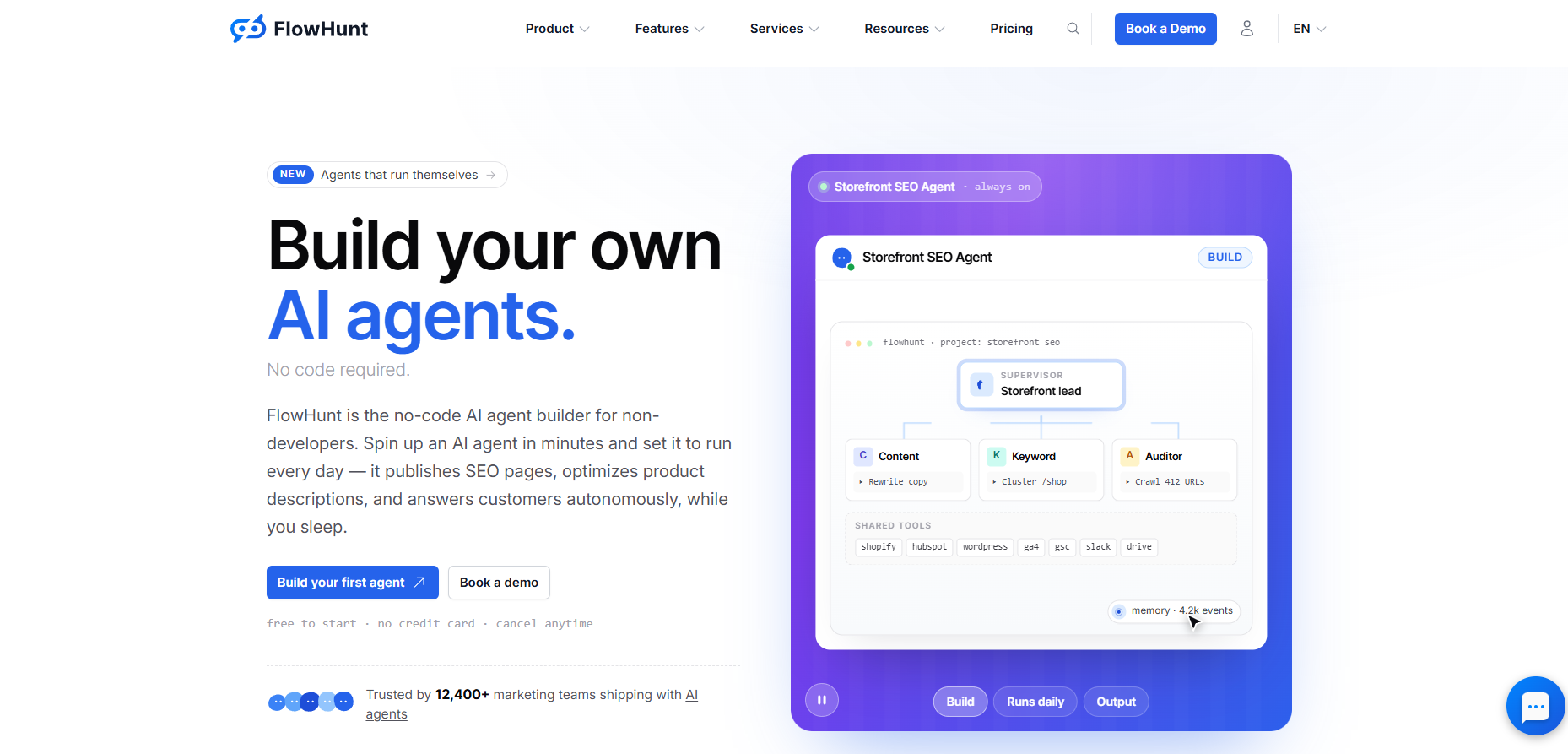
FlowHunt’s Market Analysis Agent takes a market, industry, or product name as input and returns a structured strategic report in a single run.
For the B2B SaaS productivity tools scenario, the output covered six analytical dimensions: market trends, customer segments, competitive landscape, logistics and distribution, payment dynamics, and a SWOT-anchored strategic summary. The agent queries up to 10 credible non-redundant online sources per run. Output is a clean Markdown format.
What it does well: On-demand synthesis across multiple intelligence dimensions in a single run. The strategic recommendations section is the most immediately usable output of any tool in this comparison for a general market brief.
For a breakdown of how the SWOT synthesis and other frameworks work within the report, see AI market analysis frameworks .
Limitations: No real-time monitoring. FlowHunt runs when manually prompted or automatically scheduled to run, running the full workflow each time. No proprietary traffic database for quantitative market share estimation. Accuracy on niche markets is dependent on the volume of publicly available information.

Start your free trial today and see results within days.
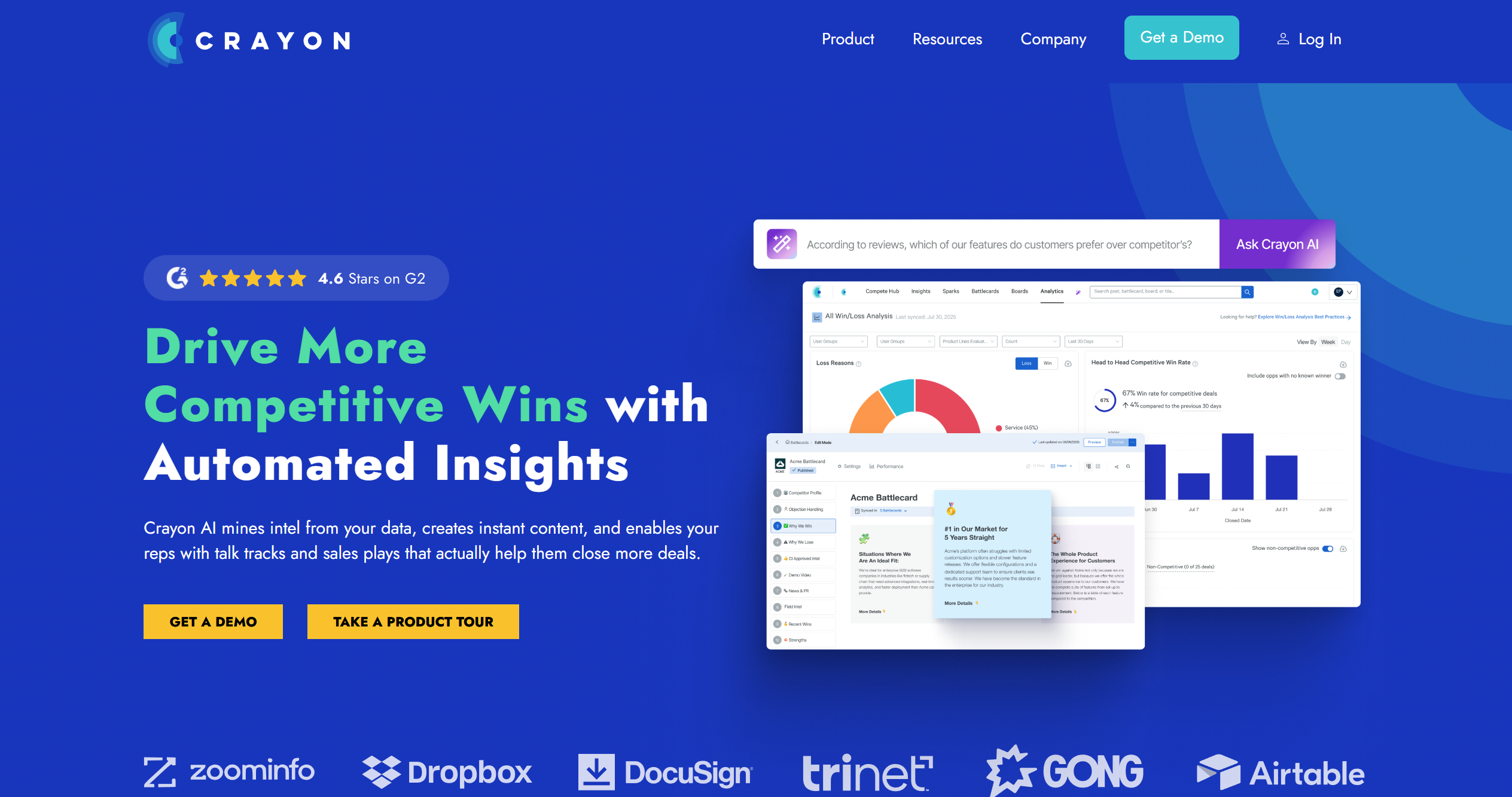
Crayon is built for ongoing competitive intelligence programs. The platform continuously monitors competitor public signals, website copy changes, job postings, press releases, social activity, and more, aggregating them in a central feed. Its primary output is AI-generated sales battlecards designed for integration with Salesforce and Slack.
For the market research scenario, Crayon is most useful to teams that have already defined their competitor set and need to track it continuously. It’s not made for exploring a new market from scratch. It does not answer open-ended questions, synthesize strategic recommendations, or size a market. The intelligence it surfaces is real-time and signal-based rather than synthesized and analytical.
What it does well: Automated always-on monitoring for established competitive intelligence programs. Best-in-class battlecard generation for B2B enterprise sales teams that need current, specific competitive data surfaced at the moment of a deal, delivered into the tools they already use.
Limitations: Requires a near-full-time internal analyst to configure, manage, and distribute effectively. Not designed for ad-hoc research queries, market sizing, or strategic synthesis. Pricing is enterprise-only with a mandatory sales process.
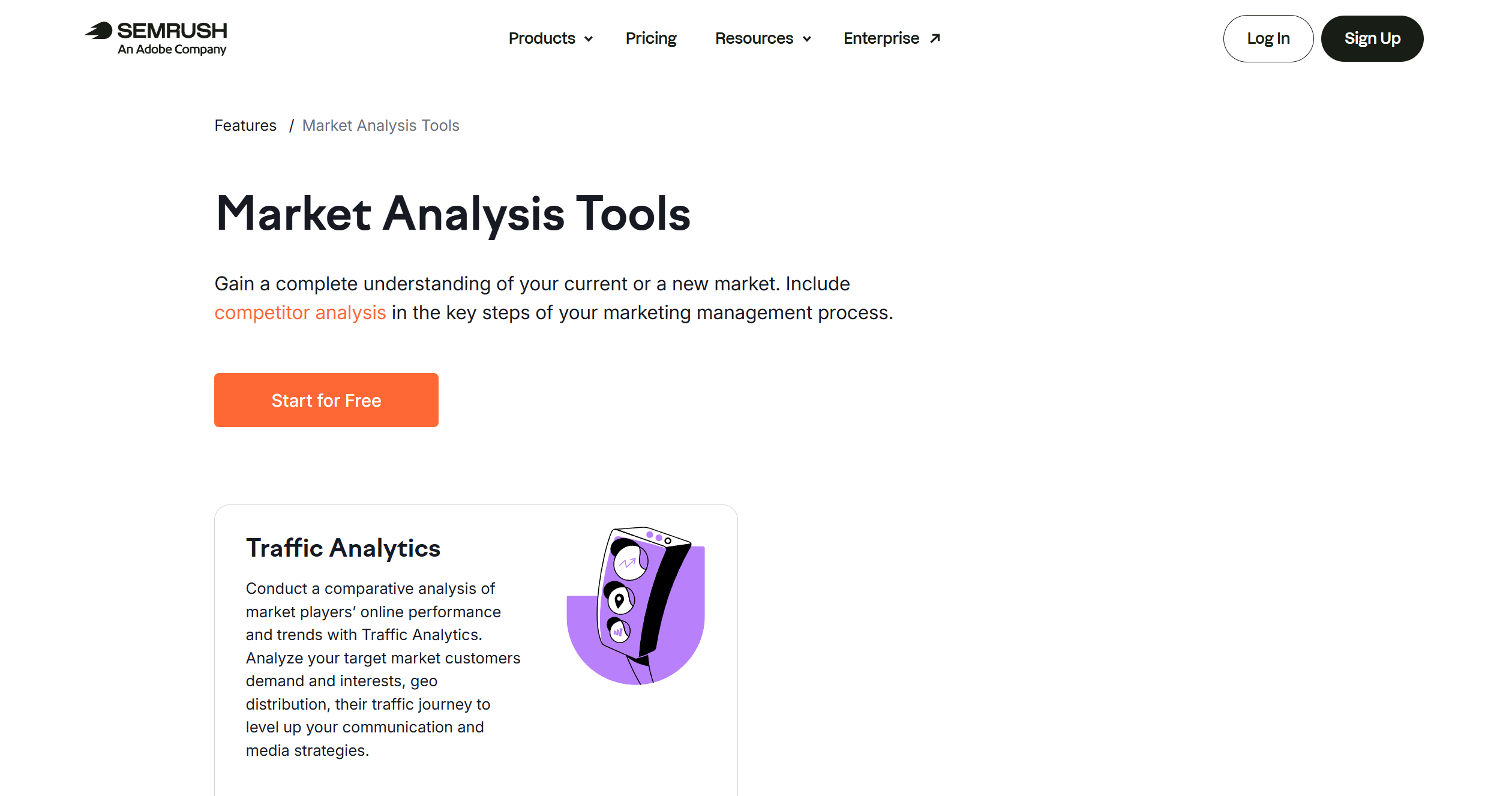
Semrush Market Explorer is part of the Traffic & Market toolkit, a paid add-on to the core Semrush platform. It uses Semrush’s traffic database to produce market share estimates, competitive traffic benchmarking, and audience overlap analysis across 190+ countries.
For the B2B SaaS productivity tools scenario, Market Explorer surfaced competitor traffic volume estimates, engagement metrics, audience demographics, and marketing channel breakdowns. The output is dashboard-based with visual charts and exportable tables rather than a synthesized narrative."
What it does well: Traffic-centric market intelligence backed by a large proprietary database. Strong for digital channel analysis and side-by-side traffic benchmarking. Integrates cleanly into Semrush’s broader SEO and paid search workflows for teams already on the platform.
Limitations: Purely quantitative and traffic-centric. Doesn’t offer qualitative insight, strategic synthesis or trend forecasting beyond traffic curves. Cannot answer research questions in natural language. Requires both a Semrush base plan and the Traffic & Market add-on, making the minimum effective cost relatively high even for a single user.
Get latest tips, trends, and deals for free.
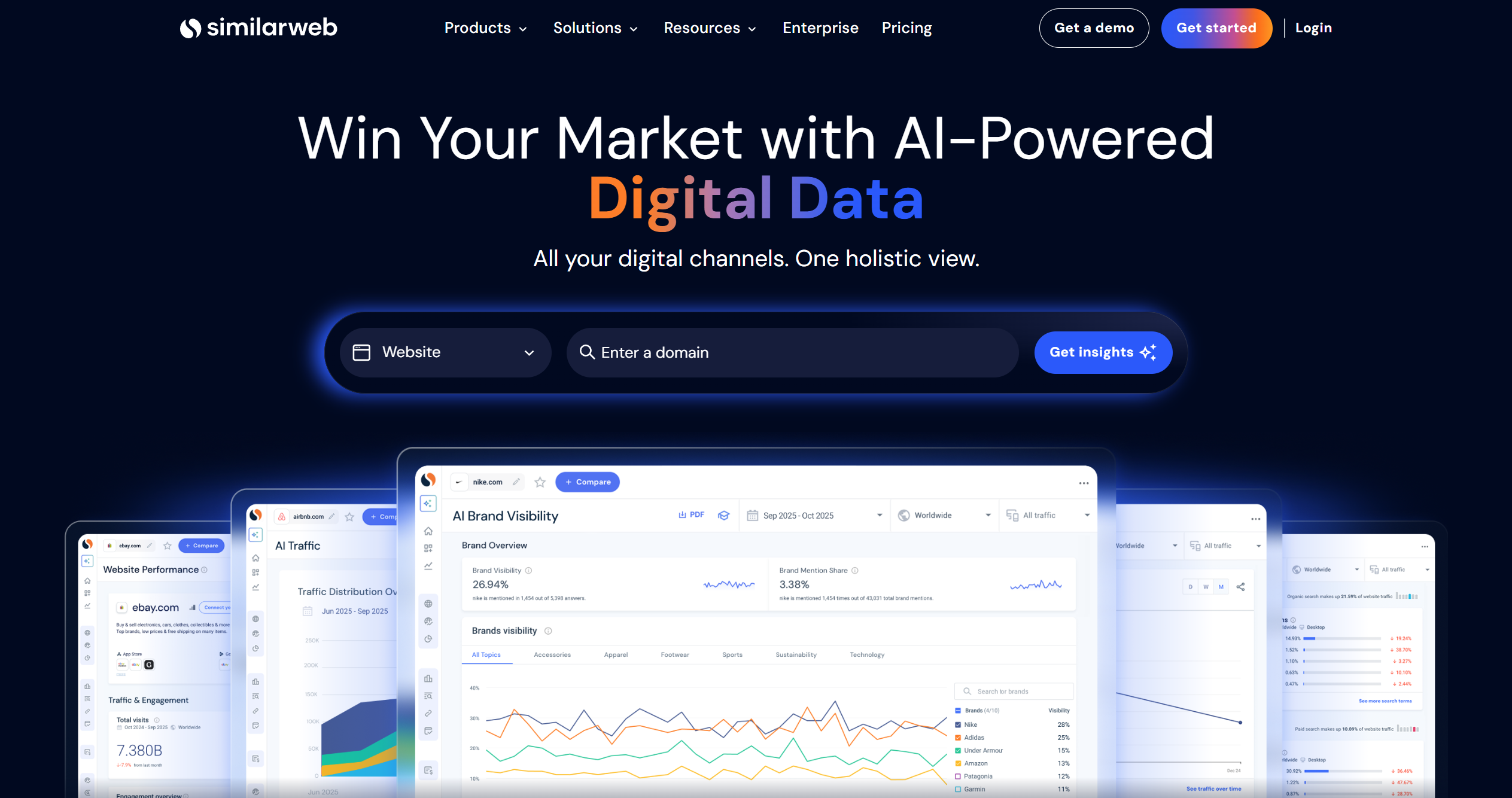
Similarweb is the most direct competitor to Semrush Market Explorer in this comparison. A standalone digital market intelligence platform covering traffic benchmarking, audience analysis, and marketing channel breakdowns. It offers similar core functionality but as a self-serve platform rather than an ecosystem add-on.
A differentiating feature as of 2026 is the AI Brand Visibility tracking, monitoring how often a brand or its competitors appear in AI-generated answers on ChatGPT, Perplexity, Google AI Overviews, and Gemini. Tracking competitive position in AI search environments, is becoming increasingly relevant to any brand-aware market strategy.
What it does well: The most accessible self-serve traffic intelligence platform in this comparison, with granular market share data and the AI Brand Visibility feature that tracks presence in LLM-generated responses. Strong for digital competitive benchmarking and audience overlap analysis.
Limitations: Still traffic-centric at its core, with limited strategic or qualitative market insight. Cannot synthesize research into a narrative or answer open-ended research questions. Historical data window on the entry plan is restricted to three months, limiting deeper trend analysis.
| Capability | FlowHunt | Crayon | Semrush Mkt Explorer | Similarweb |
|---|---|---|---|---|
| Market trends & growth drivers | ✓ | — | Indirect (traffic trends) | Indirect (traffic trends) |
| Customer segment analysis | ✓ | — | Audience demographics | Audience demographics |
| Qualitative competitor analysis | ✓ | ✓ (signals only) | — | — |
| Traffic-based market share | — | — | ✓ | ✓ |
| SWOT / strategic synthesis | ✓ | — | — | — |
| Always-on CI monitoring | — | ✓ | — | — |
| Open-ended natural language queries | ✓ | — | — | — |
| AI brand visibility (AEO/GEO) | — | — | — | ✓ |
| International coverage | Public sources | Competitor footprint | 190+ countries | 100+ countries |
FlowHunt produces structured Markdown with labeled sections. Custom integration options available, enabling you to output directly into your preferred systems. The underlying agent is also fully editable, allowing teams to modify the analytical framework, add custom sections, or change the output format.
Crayon generates battlecards and competitor dossiers in a fixed template. Customization is limited to which signals are tracked and which competitors are in scope.
Semrush Market Explorer outputs data as interactive dashboards and PDF exports. Consistent format, not customizable at the data or structure level.
Similarweb similarly outputs dashboards and downloadable reports. AI Brand Visibility reports are structured but not editable.
All prices are for paid plans as of mid-2026. Crayon pricing is based on third-party procurement data, since the company does not publish a rate card. Verify current rates on each vendor’s website.
| Tool | Entry paid plan | Monthly cost |
|---|---|---|
| FlowHunt Starter | Full platform, 50 credits, 5,000 interactions | €50/month |
| Similarweb | Competitive Intelligence: traffic, market share, audience data | ~$125/month (annual billing) |
| Semrush Market Explorer | Requires base plan + Traffic & Market add-on | ~$340–$490+/month combined |
| Crayon | Enterprise only, custom quote required | ~$1,250–$3,300+/month (est. $15K–$40K+/yr) |
The right choice depends on what market research means for your team’s actual workflow. For a practical overview of the full market research process before committing to a platform, see how to do market analysis with AI in under 30 minutes .
Choose FlowHunt if you need on-demand strategic market research with comprehensive reports covering trends, segments, competitive dynamics, and strategic recommendations. It’s a good fit for founders, consultants, product managers, and analysts running research across multiple markets or on an irregular cadence. The market analysis tool entry tier is the most cost-effective path to structured strategic market intelligence in this comparison.
Founders validating a market before building will find a dedicated walkthrough in how startup founders use AI market analysis . New to the tool? The Market Analysis Tool tutorial walks through generating your first report step by step.
Choose Crayon if you run a dedicated competitive intelligence program at a B2B enterprise company with an internal CI analyst, an established competitor set to monitor continuously, and a sales team that needs battlecards integrated into their CRM. Budget must support $15,000–$40,000+/year and a procurement process.
Choose Semrush Market Explorer if your team already pays for Semrush and needs traffic-based market sizing to complement an existing SEO and content workflow. The add-on cost is more justifiable when absorbed into an active Semrush subscription.
Choose Similarweb if digital market share benchmarking and AI brand visibility tracking are your primary research needs. The most accessible self-serve traffic intelligence platform in this comparison, and the best option for teams tracking competitive position in AI search environments.
Maria is a copywriter at FlowHunt. A language nerd active in literary communities, she's fully aware that AI is transforming the way we write. Rather than resisting, she seeks to help define the perfect balance between AI workflows and the irreplaceable value of human creativity.

FlowHunt's Market Analysis Agent delivers structured, executive-ready strategic reports — market trends, customer segments, competitive landscape, and SWOT synthesis — from a single input. No analyst required.
We compared five of the best AI competitive intelligence platforms, FlowHunt, Crayon, Klue, Kompyte, and Battlecard, on product analysis depth, data freshness, ...

Step-by-step from entering your market or industry to downloading a complete market intelligence report, including how to customise focus areas and interpret ea...
FlowHunt's Market Analysis Agent delivers executive-level strategic reports covering market trends, customer segments, competitive landscape, logistics, and pay...
Cookie Consent
We use cookies to enhance your browsing experience and analyze our traffic. See our privacy policy.