5 AI News Monitoring Use Cases: How Teams Stay Ahead Without Drowning in Content
From executive briefings to subscriber newsletters, these are five real AI news monitoring use cases teams rely on to stay informed without hours of manual curation.
From daily executive briefings to weekly subscriber newsletters, these are five real AI news monitoring use cases teams rely on to stay informed without spending hours on manual curation. Each one uses the same underlying workflow, search, extract, structure, applied to a different team’s problem.
Use Case 1: Morning Executive Briefings
The problem: Leadership wants to start the day aware of what happened in their market, their competitors, and their industry overnight, without anyone on the team spending thirty minutes assembling that picture by hand.
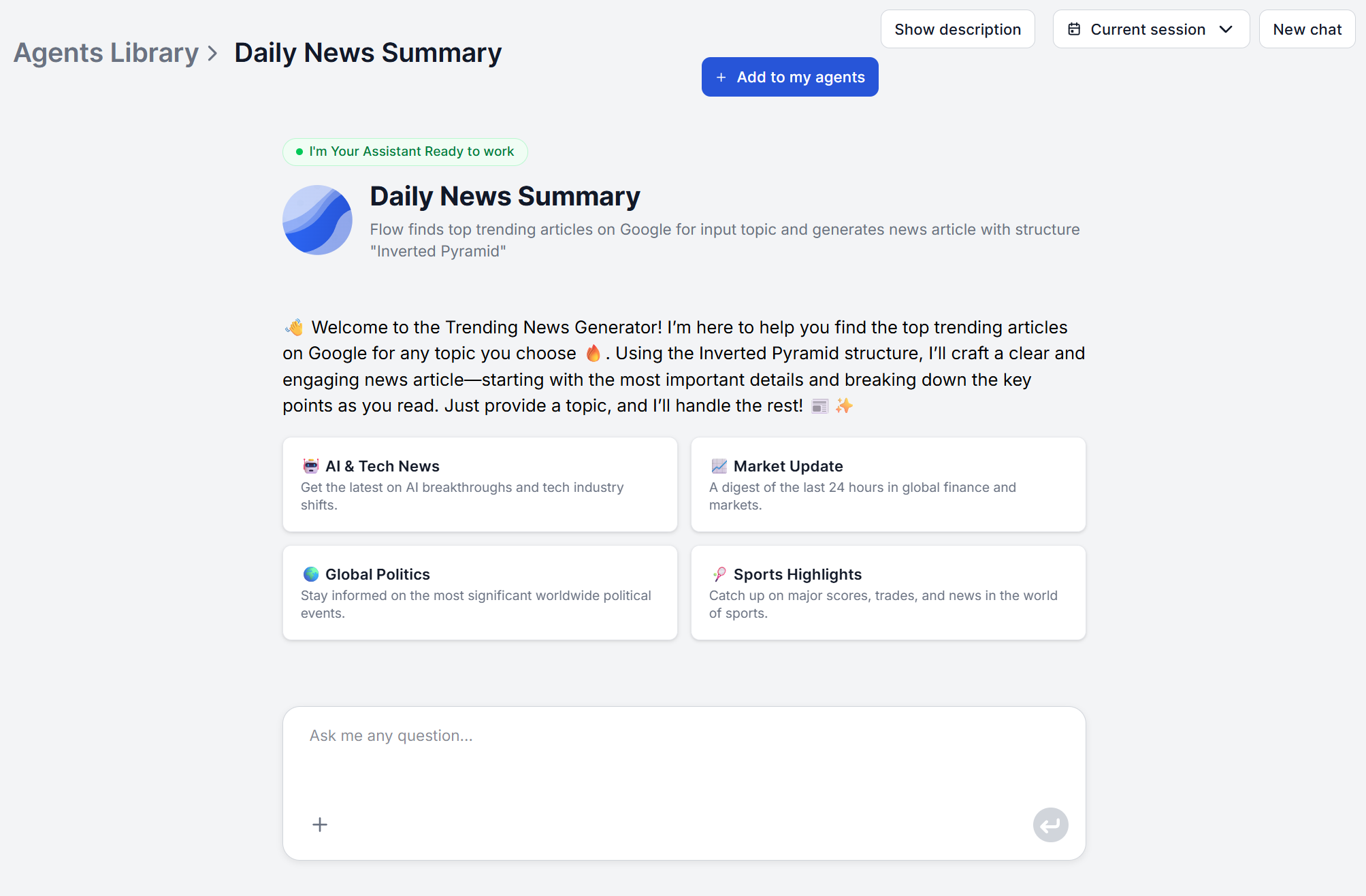
How it works: Running a Daily News Summary
against a handful of standing topics, the company name, its main competitors, its core industry, produces a set of structured digests in seconds. This is team news briefing AI in its simplest form.
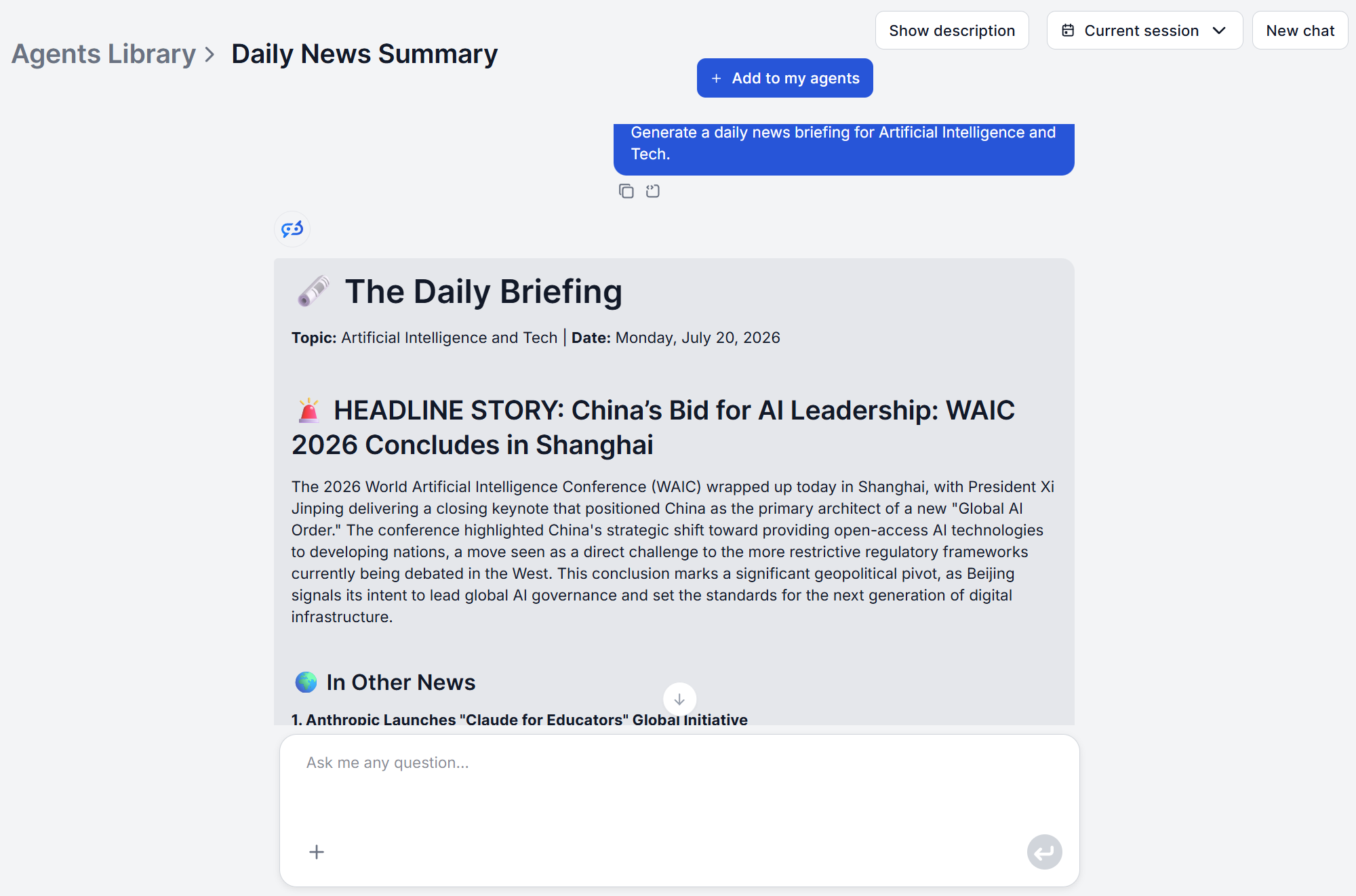
The outcome: Instead of a briefing that depends on whoever remembered to check the news, leadership gets the same structured overview every day, with the most important developments up front rather than buried in a scroll of headlines. Here’s what that actually looks like: we ran a digest on July 20, 2026, the same day this article was written, for an “AI and Tech” briefing.
Use Case 2: Industry Newsletter for Subscribers
The problem: A newsletter covering one industry needs a reliable first draft of “what happened this week”, the hardest and most time-consuming part of the writing process, before any editorial voice gets added.
How it works: A digest run against the newsletter’s core topic turns the research and triage phase, deciding what’s worth including and in what order, into a task that takes seconds instead of hours. The writer’s time shifts to framing, analysis, and the parts of the newsletter that need a human perspective.
The outcome: Once drafted, the digest can be routed into Gmail
or Notion
as part of the production workflow, rather than living in a chat window until someone remembers to copy it out.
Ready to grow your business?
Start your free trial today and see results within days.
The problem: Reps are walking into deals without knowing about a competitor’s recent pricing change, product launch, or leadership shake-up, information that shapes how a deal should be handled but that nobody on the team is actively tracking.
How it works: Running a digest per competitor catches these developments as they’re reported, an example of competitive news monitoring AI applied directly to deal prep. Where the picture needs to include how a competitor is being discussed, not just what they’ve announced, the AI Social Listening Tool
adds the sentiment and conversation layer across social platforms and forums.
The outcome: Battlecards and objection-handling notes get built on current information instead of a static document that goes stale the moment a competitor ships something new.
Use Case 4: PR and Comms Media Monitoring
The problem: A comms team needs to know quickly when their organization, a spokesperson, or a sensitive topic starts appearing in coverage, before it turns into a bigger story that needs a response.
How it works: A daily digest on the company or topic name functions as a lightweight early-warning layer. For the fuller picture, sentiment, key influencers, and where the conversation is concentrated, the AI Social Listening Tool
covers the social and forum layer that pure news monitoring doesn’t reach.
The outcome: Comms teams catch developing narratives closer to when they start, rather than after a story has already gained momentum elsewhere.
Join our newsletter
Get latest tips, trends, and deals for free.
Use Case 5: Research and Analyst Teams
The problem: Analysts tracking a sector need a daily pulse on developments, but a headline-level digest alone isn’t enough when a topic deserves a properly sourced, structured deep dive.
How it works: The daily digest handles ongoing awareness, catching what’s new each day, while the AI Research Assistant
takes over when a specific theme from that digest warrants a full research document, complete with an overview, synthesized insights, and an annotated bibliography of sources.
The outcome: Analysts spend their time on judgment and interpretation instead of the groundwork of finding, reading, and organizing sources from scratch.
How to Build a News Intelligence System for Your Team
None of these use cases require a different tool for each team. The pattern that works across all five is the same. Start with a Daily News Summary
on the topics that matter most, whether that’s a competitor, an industry, or the company’s own name, and layer in the AI Social Listening Tool
or AI Research Assistant
only where a use case specifically calls for the social layer or the sourced deep-dive.
From there, the only real decision is delivery. Keep the digest in chat for a quick personal check, or connect it to Slack
, Gmail
, or Notion
so it lands automatically wherever the team already works. Either way, the setup for each use case above takes minutes, not a dedicated project.
You don't need special configuration for niche topics. The Daily News Summary accepts any topic, even a narrow subject or a small company name, and searches and summarizes whatever is currently being reported on it, the same way it handles a broad, mainstream query.
The standard tool returns one structured digest format built for fast reading. If different teams need different structures, for example a sales team wanting a battlecard-style layout versus an executive wanting a one-paragraph summary, that requires heading over to the visual editor and adjusting the underlying flow.
Run narrower, more specific topic queries rather than one broad catch-all query, a digest on "Company X pricing" surfaces different results than one on "the SaaS industry." For anything with a social or community dimension, forums, Reddit threads, or video commentary, pair the news digest with the AI Social Listening Tool, since that's the layer a news-focused search doesn't fully cover.
The Daily News Summary itself is focused on news-style coverage. For social platforms specifically, forums, Reddit, TikTok, and video commentary, the AI Social Listening Tool is built for that layer, pulling from social media, forums, news, and video platforms in one report.
Rather than copying and pasting the digest into another tool, FlowHunt connects to Slack, Gmail, and Notion, among others, through MCP integrations, so a digest can be routed directly into a channel, an inbox, or a shared workspace page as part of the same workflow.
Maria is a copywriter at FlowHunt. A language nerd active in literary communities, she's fully aware that AI is transforming the way we write. Rather than resisting, she seeks to help define the perfect balance between AI workflows and the irreplaceable value of human creativity.
Maria Stasová
Copywriter & Content Strategist
Put AI News Monitoring to Work for Your Team
FlowHunt's Daily News Summary searches recent sources and delivers a structured digest on any topic in seconds — the same workflow behind every use case below.
How to Automate Your Daily News Monitoring With an AI News Summarizer Tool
An AI news summarizer tool turns daily news monitoring into a five-minute task. Here's how automated summary generation works and how to set up your first diges...
Get a concise, structured summary of the latest news on any topic with FlowHunt's Daily News Summary. AI searches recent sources and delivers a clear, readable ...
Step-by-step: from your first topic query to an automated daily news digest delivered where your team already works. A FlowHunt news summary setup tutorial for ...
6 min read
AI
Tutorial
+3
Cookie Consent We use cookies to enhance your browsing experience and analyze our traffic. See our privacy policy.