


5 Ways Product Managers Use AI Product Analysis
Product managers spend 20–30% of their time on competitive research. AI product analysis cuts that to minutes. Here are five specific ways PMs use it across dis...
7 min read
AI
Research
+3
AI product analysis delivers structured reports in minutes. Here’s what it covers, how accurate it is, and how to use it for real business decisions.
Whether you’re evaluating a competitor, validating your own positioning, or preparing for a board meeting, manual product research is a time sink that rarely scales. The time requirements and no immediately visible ROI often lead teams to forego product analysis.
The answer to making product analysis worth the investment even for smaller teams is performing an AI product analysis . AI can deliver structured, multi-dimensional reports on any product in minutes. Here’s how it works, what it actually covers, how accurate it is, and how different teams are using it for real business decisions.
A Google search returns a list of links. You still have to open each one, read past the marketing copy, extract what’s relevant, and stitch it all together manually. For a thorough competitor review, that process easily takes four to six hours per product.
An AI product analysis tool removes the need to manually sift through all that. It queries across multiple sources simultaneously, such as the product’s own website, third-party review platforms like G2 and Capterra, press coverage, community forums, API documentation, and pricing pages. It removes all the fluff and synthesizes the finding into a structured report.
A complete AI product analysis typically covers:
This is the kind of structured intelligence that previously required a dedicated analyst or a market research firm. An AI product research tool compresses that effort to minutes.
Product, sales, and investment teams all run into the same core problem. There’s always too many products to track and not enough research hours. Here’s how each role puts AI product analysis to work.
The scenario: A product team four weeks from launch needs to understand how five competitors are positioned before finalizing their messaging.
Manually: A product manager spends two days on competitor websites, G2 reviews, and comparison spreadsheets, then repeats the process as products update.
With AI product analysis: Five reports in under thirty minutes, each covering the same dimensions. The team spots that three competitors have consistent gaps in their reporting features and adjusts their launch messaging to lead with that capability. Work that used to take two days now happens before the morning standup.
The scenario: A venture analyst needs a competitive landscape brief for a Series B target in HR-tech.
How it fits: Structured reports handle the public intelligence layer. The analyst layers proprietary data (financials, customer references) on top and focuses on the higher-judgment work: what the competitive picture means for the target’s growth trajectory. The result is a more thorough brief in less time.
The scenario: An enterprise sales team is consistently losing late-stage deals to the same two competitors and needs current, reliable battle cards.
The problem with static battle cards: They go stale. A pricing change or feature launch makes them actively misleading.
AI product comparison tools solve the maintenance problem. The team re-runs analyses quarterly, or before any high-stakes deal, feeding current intelligence directly into battle card templates. Sales reps go in knowing exactly where they win, where they’re vulnerable, and what objections to expect. For product managers specifically, 5 ways product managers use AI product analysis covers PM-specific workflows from roadmap planning to launch preparation.

Start your free trial today and see results within days.
| Dimension | Manual Research | AI Product Analysis Tool |
|---|---|---|
| Time per product | 3–6 hours | 3–10 minutes |
| Sources covered | Depends on researcher | Dozens, simultaneously |
| Output consistency | Varies by researcher | Structured, uniform format |
| Scalability | Linear with headcount | Runs as many as needed |
| Recency | Reflects researcher’s search session | Live retrieval at time of query |
| Pricing accuracy | As current as the page visited | Requires manual verification |
| Depth of sentiment analysis | Depends on review site sampling | Aggregated across platforms |
| Suitable for strategic decisions? | Yes | Yes, with verification on time-sensitive data |
For most strategic purposes, AI product research delivers the depth needed. For legal or financial decisions where individual data points carry significant consequences, human verification remains essential. In any case, running an AI analysis will help you cut your research time significantly, or at least get the general idea.
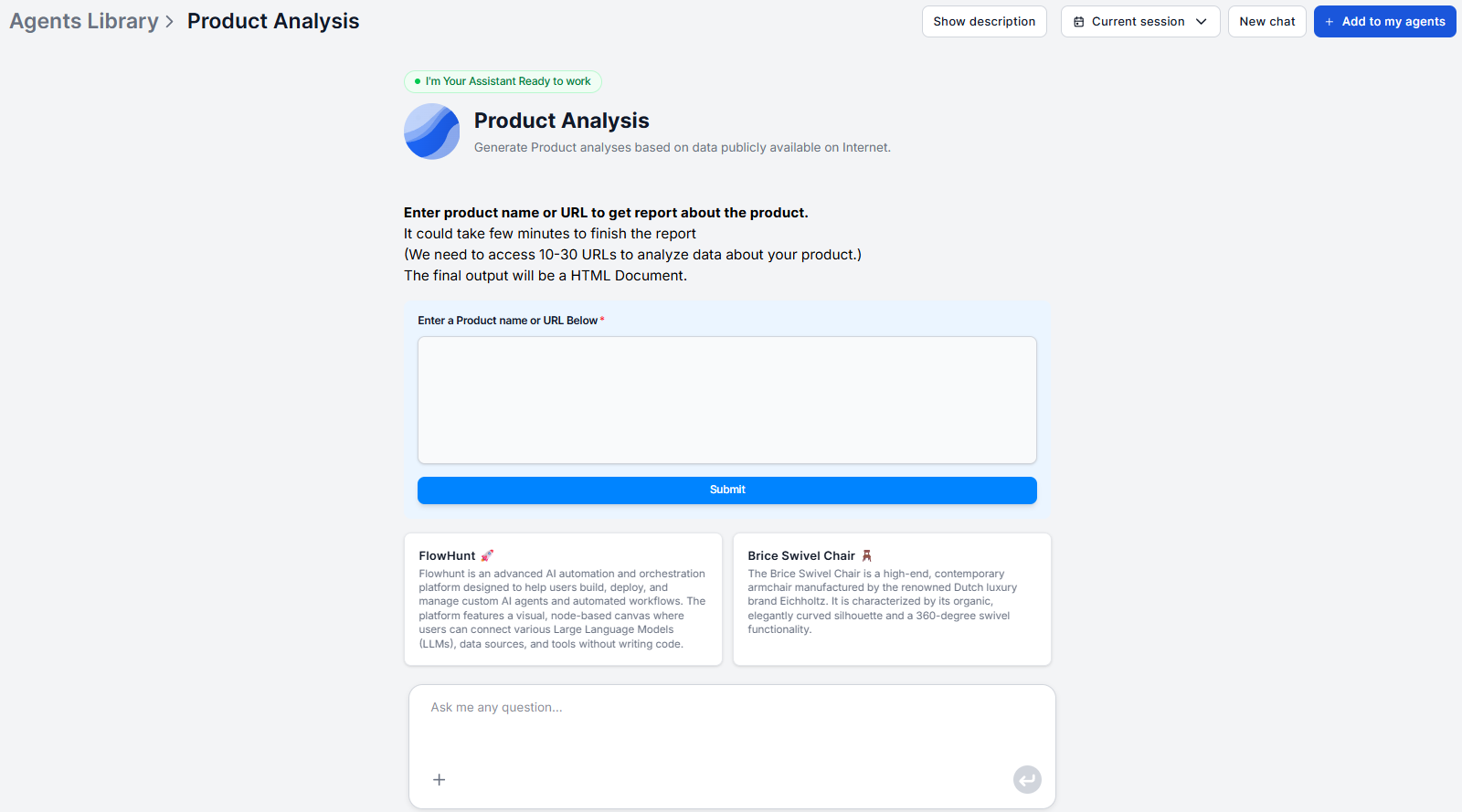
The workflow is intentionally simple. You don’t need to configure search parameters or know which databases to pull from. The tool handles that layer automatically. Just open the AI Product Analysis tool and follow these four steps. For a complete step-by-step platform walkthrough with screenshots of each interface step, see the AI Product Analysis tutorial .
Step 1: Enter the product name Type the product name into the chat interface or a short description if the name alone is ambiguous. No URL, no configuration, no research brief to write first.
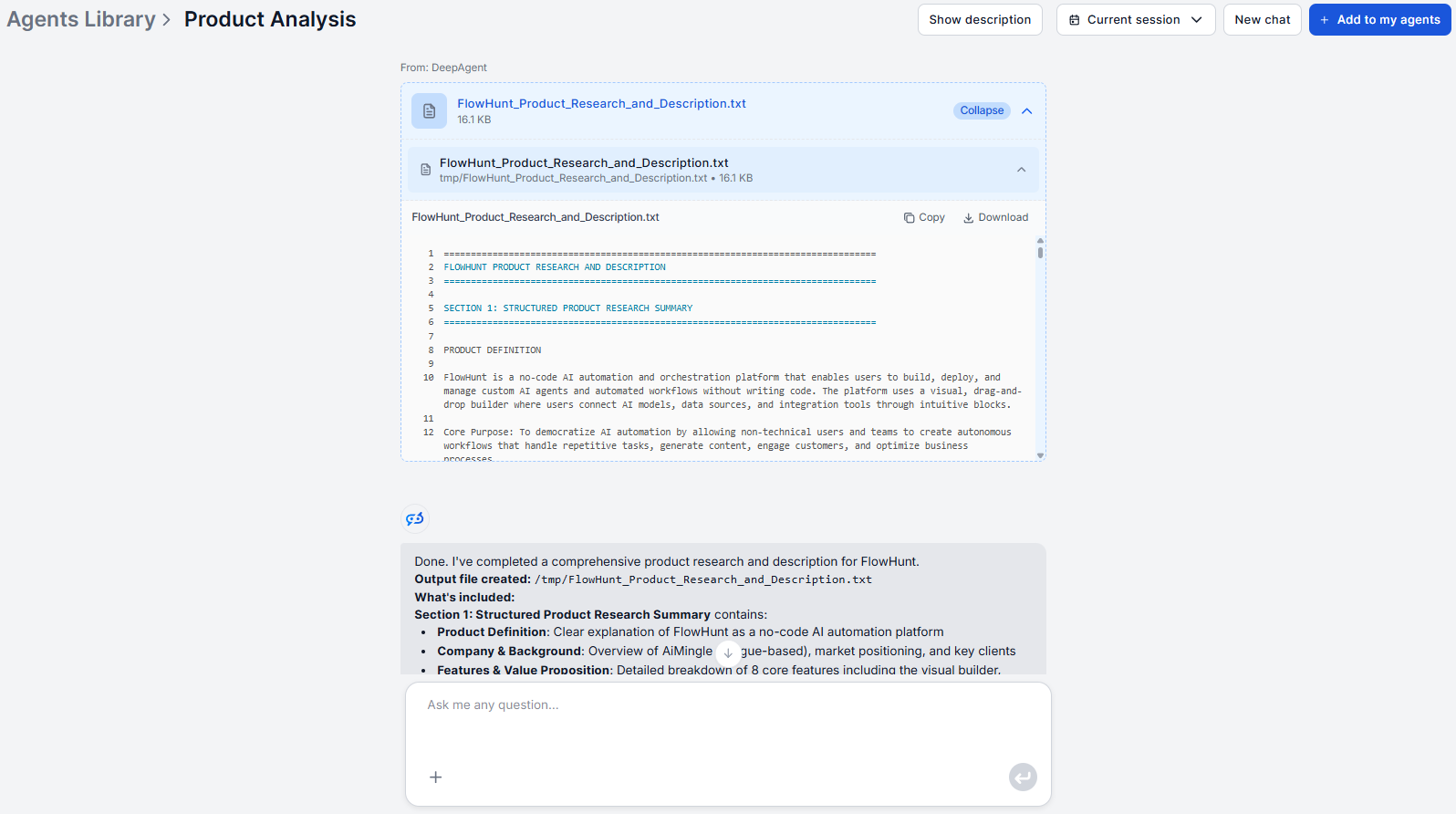
Step 2: The tool researches across sources FlowHunt queries 5–10 credible sources, such as the product’s official site, expert reviews, and reputable platforms to synthesize findings across multiple domains. This takes a few minutes with no input needed on your end.
Step 3: Review the two-part HTML output The result is a single HTML document with two sections: a structured research summary (including a full SWOT table) and a ready-to-publish product description article under 600 words. Both sections are consistently formatted and usable as-is.
Step 4: Drop it into your workflow The HTML is clean and structured paste it into a CMS, attach it to a client report, or use it as the research layer for a follow-up task like drafting a battle card or a competitive brief. If you need to adjust the output (research categories, article length, structure), the underlying flow can be modified directly in FlowHunt.
Ready to run your first report? Try the AI Product Analysis tool and get a full competitive brief in under five minutes.
Get latest tips, trends, and deals for free.
Product analysis rarely happens in isolation. These tools cover the surrounding research layers — so you can go from a single product brief to a full competitive picture without switching workflows.
Together, they cover the full arc from a single-product deep-dive to market-wide competitive intelligence. If you’re evaluating which AI competitive intelligence platform fits your team, see our comparison of FlowHunt vs Crayon vs Klue vs Kompyte vs Battlecard .
AI product analysis removes the information-gathering bottleneck that slows down decisions. Whether you’re a product manager benchmarking competitors, a sales rep preparing for a high-stakes evaluation, or an analyst building an investment brief, the practical ceiling of what one person can cover in a day has shifted considerably. For real examples of what happens when competitive research is skipped at launch, see 5 products that failed because they skipped competitive analysis .
Maria is a copywriter at FlowHunt. A language nerd active in literary communities, she's fully aware that AI is transforming the way we write. Rather than resisting, she seeks to help define the perfect balance between AI workflows and the irreplaceable value of human creativity.

FlowHunt's AI Product Analysis tool delivers structured feature breakdowns, pricing intelligence, and competitor comparisons — without hours of manual research. Try it free and see what your competitors don't want you to know.
Product managers spend 20–30% of their time on competitive research. AI product analysis cuts that to minutes. Here are five specific ways PMs use it across dis...
TAM/SAM/SOM calculations, competitor landscapes, market trends, and growth forecasts — AI market analysis tools can cover all of those automatically. Here's how...
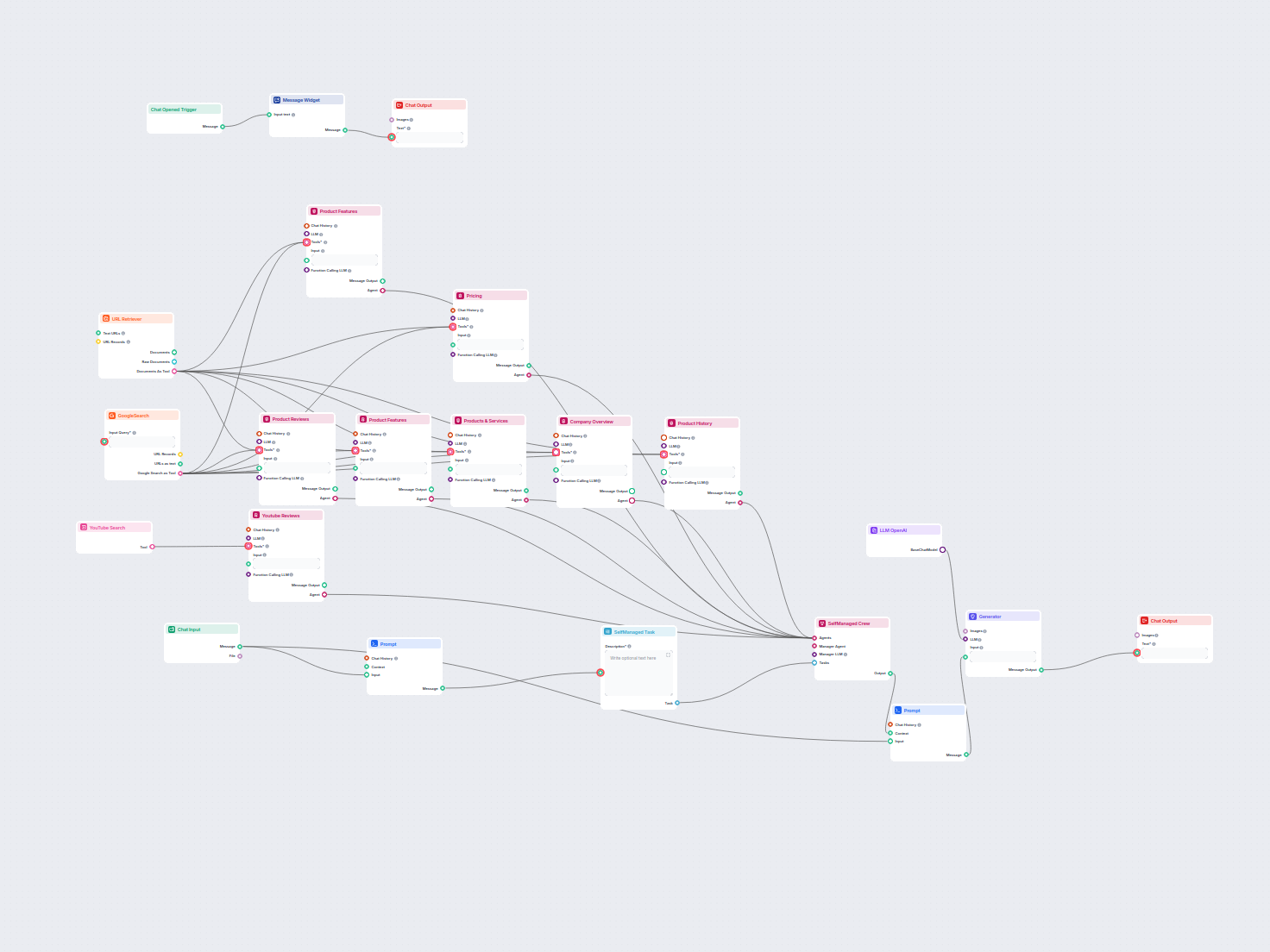
Generate comprehensive product analyses using AI agents that gather and summarize product information, pricing, features, reviews, alternatives, and more from p...
Cookie Consent
We use cookies to enhance your browsing experience and analyze our traffic. See our privacy policy.