We compared five of the best AI competitive intelligence platforms, FlowHunt, Crayon, Klue, Kompyte, and Battlecard, on product analysis depth, data freshness, ease of use, and price. Here’s which one fits which team size and budget.
If you’ve searched for an AI competitive intelligence tool recently, you’ve probably landed on the same short list headed by the impressive but insanely expensive Crayon and Klue. But there are also newer, more accessible AI options like Kompyte, Battlecard, and FlowHunt being on the rise. All five promise to reduce the time it takes to understand competitors, but they differ significantly in how they do it, who they’re built for, and what they cost. Not sure why competitive intelligence matters in the first place? 5 products that failed because they skipped competitive analysis
shows what can happen when teams launch without it.
This comparison evaluates all five on product analysis depth, data freshness, ease of use, and price. The goal it to help you pick the right tool for your team’s size and budget.
What We Compared and How
The evaluation criteria for this comparison:
Product analysis depth: How much structured intelligence does each tool produce? Features, pricing, sentiment, positioning, recent developments — or just one layer?
Data freshness: Is data retrieved live at query time, or pulled from a periodically updated database?
Ease of use: How much setup, onboarding, or ongoing administration is required?
Integrations: What CRM, messaging, and workflow tools does each connect to natively?
Pricing and accessibility: What does it cost, and can teams without enterprise budgets realistically use it?
Best-fit team type: Who actually gets the most value from each tool?
FlowHunt AI Product Analysis: Strengths and Limits
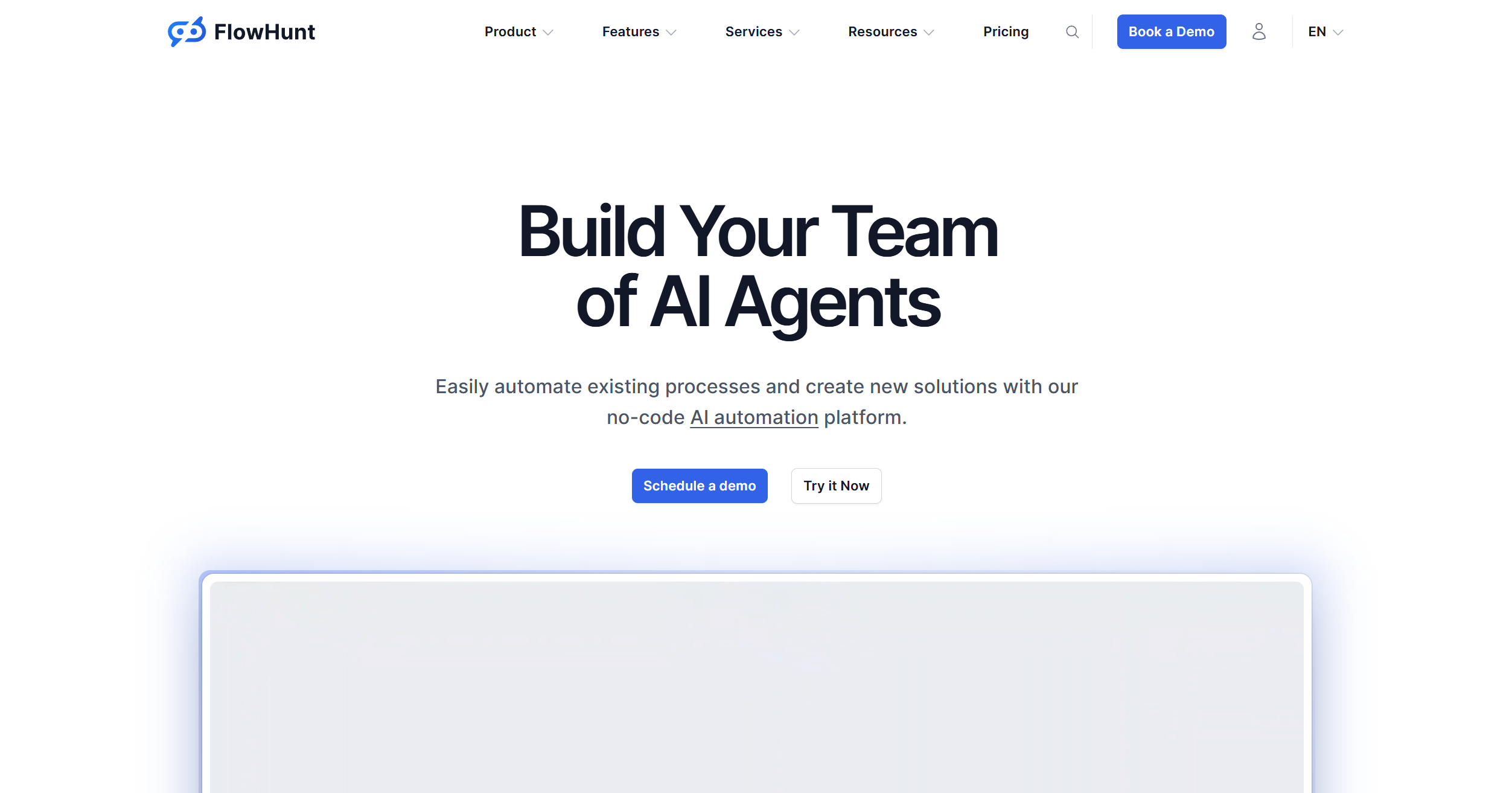
FlowHunt’s AI product analysis
is an on-demand tool. You enter a product name, and it queries live sources. It grabs the product’s website, review platforms, community forums, press coverage, and pricing pages to return a structured multi-dimensional report in minutes.
The make it or break it point is the fact that FlowHunt isn’t a competitive intelligence tool by nature. It’s an AI workflow platform. This means you’re getting so much more than just competitor insights, but the competitive intelligence related features might be lagging behind more niche-centric competitors.
Strengths:
Zero setup, immediate value: No configuration, no integration, no training. Enter a product name, get a report. The learning curve is minutes.
Multi-dimensional structured output: Every report covers features, pricing model, target audience, user sentiment, competitive landscape, and recent developments in a consistent format that makes side-by-side comparisons easy.
Live data retrieval at query time: Each analysis pulls from current public sources rather than a periodically synced database.
Credit-based pricing: FlowHunt runs on a credit model where each credit costs roughly $1 and a full AI product analysis consumes a few credits per run, meaning up to 50 detailed competitor reports a month for a fraction of the cost of any annual contract.
Extends to company and market intelligence: Pair with company analysis
for organizational context and market analysis
for segment-level trends.
Limits:
No passive monitoring: FlowHunt doesn’t run in the background and alert you when a competitor changes their pricing or launches a feature. You set up scheduled runs or the analysis when you need updated data.
No native CRM push: You need to integrate your CRM platform and set the tool up to output to it.
No built-in battlecard templates: Out of the box, the tool outputs a structured report. Mapping it into a specific sales battlecard format needs manual step.
Best fit: Product managers, founders, analysts, and sales strategists looking for a versatile set of tools without the enterprise overhead. For a step-by-step walkthrough of running an analysis in FlowHunt, see how to do AI product analysis
or the AI Product Analysis tutorial
.
Ready to grow your business?
Start your free trial today and see results within days.
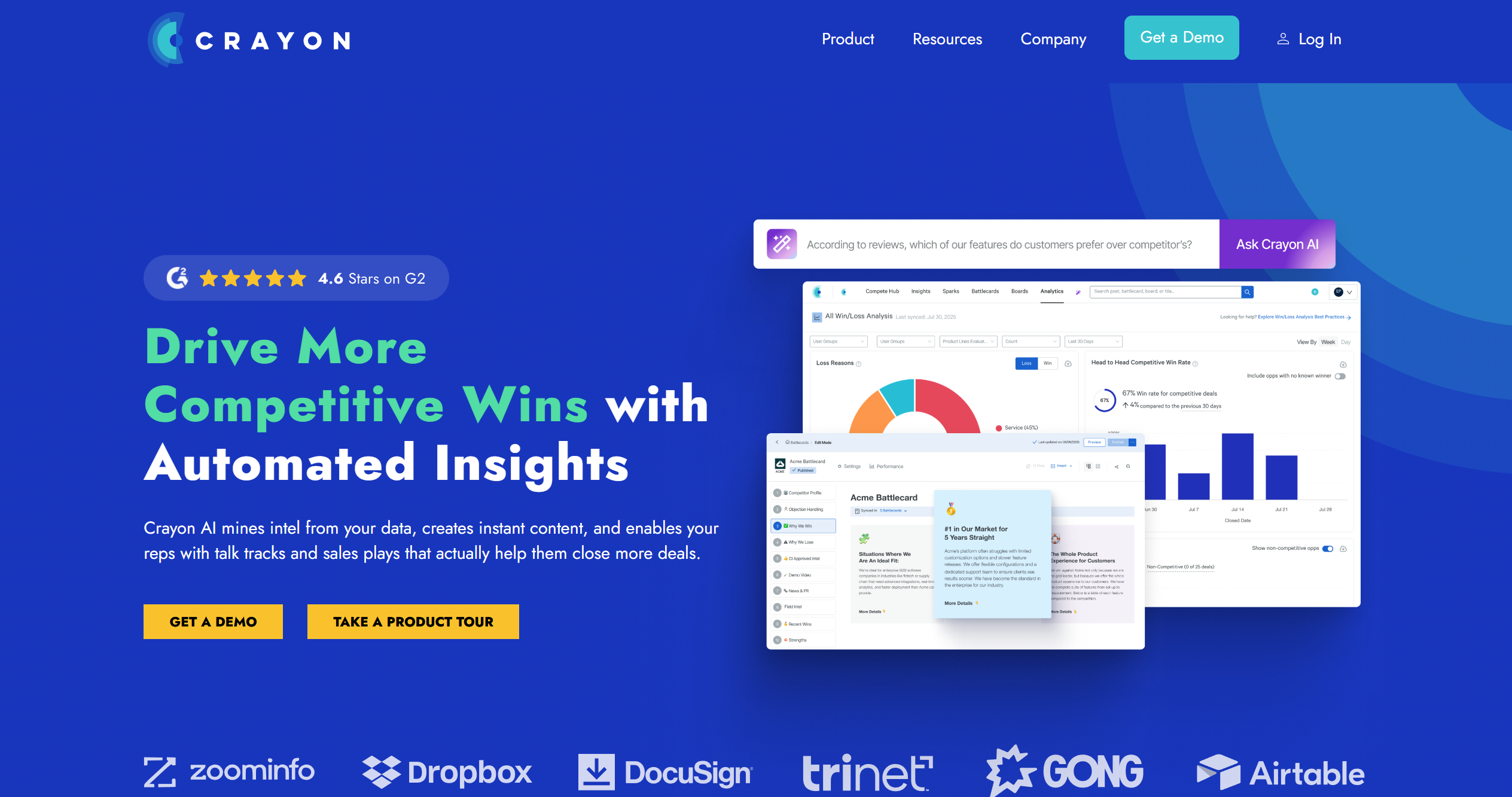
Crayon is one of the most established enterprise competitive intelligence platforms. It runs continuous background monitoring across competitor websites, social profiles, job postings, patent filings, app store reviews, press releases, and pricing pages, detecting changes and classifying signal from noise with AI.
It sounds beyond this world until you realize it comes with a hefty price tag, way beyond what most small and mid-sized teams can justify. In fact, Crayon#s pricing is inquiry-only and usually doesn’t drop below $25,000.
Strengths:
Deepest monitoring breadth: Crayon tracks more data source types than any other dedicated CI platform. It tracks websites, social, jobs, patents, reviews, and more.
Automatic change detection: AI classifies what’s a meaningful competitive signal versus routine content updates, reducing noise for the team.
Battlecard builder with CRM distribution: Creates and updates battlecards that can be synced to Salesforce, HubSpot, and Slack.
Strong enterprise track record: Three consecutive PMA Pulse awards (2021–2023) for best competitive intelligence software; well-established in enterprise sales organizations.
Limits:
Enterprise pricing: Crayon’s contracts typically run from $25,000 to over $100,000 per year depending on team size and the number of competitors tracked. That is well above what most small or mid-market teams can justify.
Requires a dedicated CI admin: Capterra reviewers consistently note that Crayon requires highly manual daily curation to stay useful. Without someone actively filtering signal from noise, reps tune out the feed within weeks.
Heavy onboarding: Getting full value requires configuring tracking sources, integrating with CRM, and building out battlecard workflows, a process measured in weeks.
Disproportionate for ad-hoc analysis: If you need to research a competitor before a specific meeting rather than monitor all competitors continuously, Crayon’s scope and cost don’t match the need.
Best fit: Enterprise marketing and sales teams with dedicated competitive intelligence roles, CRM-integrated deal workflows, and a budget to match.
Klue: Strengths and Limits
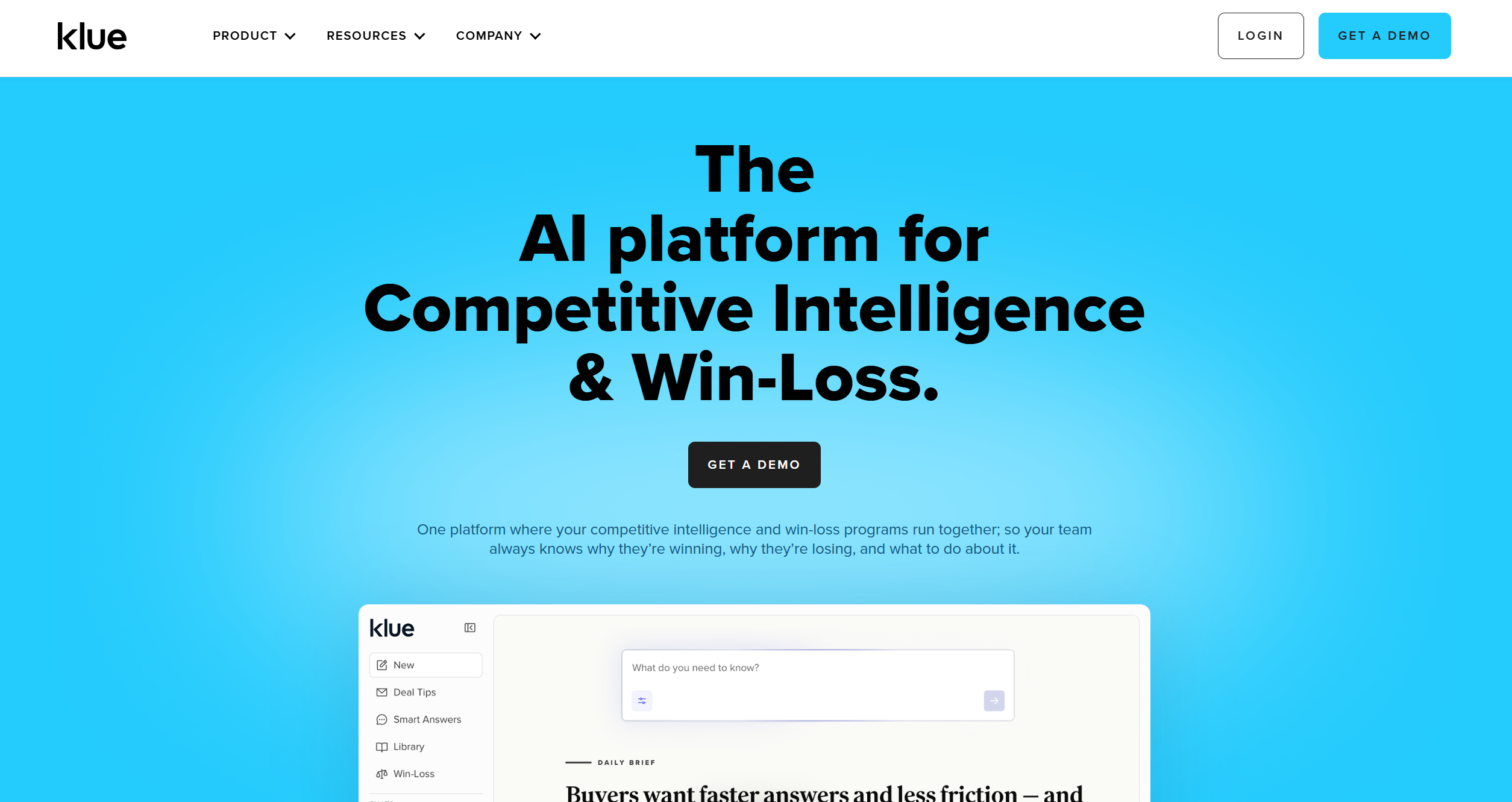
Klue is an enterprise CI platform with a particular focus on deal-level intelligence. Its Compete Agent (launched in 2026) delivers AI-powered competitive answers directly into active deal workflows. On G2 comparisons, Klue scores 9.5/10 for battlecard quality, which is the highest among dedicated CI tools. And the price for these quality battlecards is similarly steep to Crayon’s.
Strengths:
Highest-rated battlecard quality: Klue’s battlecards are consistently rated the most actionable among dedicated CI platforms in G2 comparisons.
Compete Agent for deal intelligence: Sales reps can ask competitive questions in natural language during live deals and get answers pulled from the entire intelligence library in real time.
Auto Insights: Automatically generates competitive insights from CRM data, call recordings, and win/loss information.
Win/loss analysis integration: Klue connects CRM outcomes with competitive data to surface which competitors you’re losing to, where, and why.
Limits:
Premium enterprise pricing: Klue pricing is quote-based across Essentials, Professional, and Enterprise tiers. Contracts typically run $15,000–$40,000+ per year depending on team size and feature scope.
Significant setup investment: Connecting to CRM, configuring intelligence sources, and training the team typically takes weeks.
Requires dedicated administration: To maintain battlecard quality over time, someone owns the intelligence library. That works at enterprise scale, but it impractical for small teams.
Best fit: Enterprise B2B sales organizations with complex deal cycles, existing CRM infrastructure, and the budget and headcount to run a mature competitive intelligence program.
Join our newsletter
Get latest tips, trends, and deals for free.
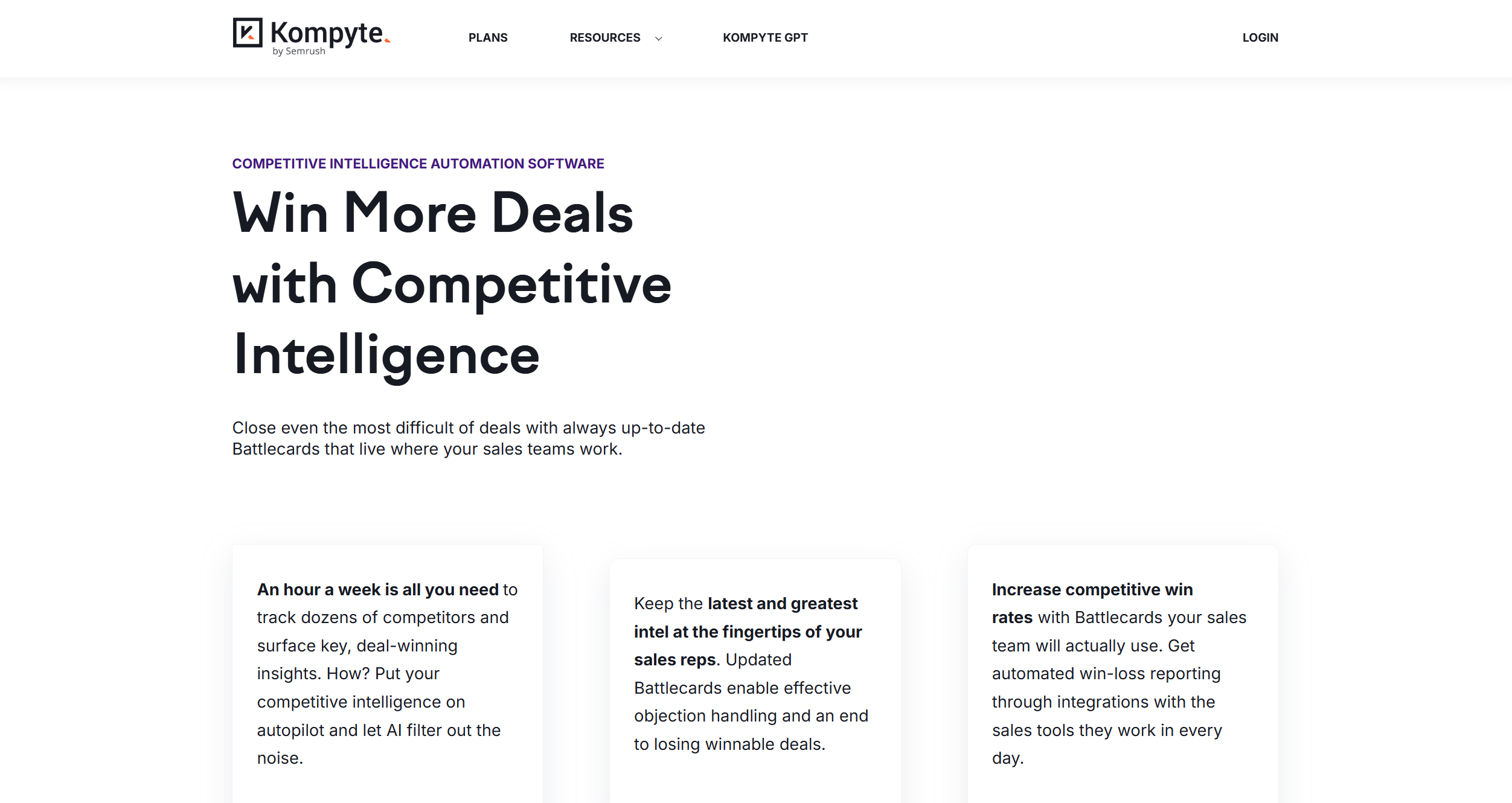
Kompyte: Strengths and Limits
Acquired by Semrush in 2022, Kompyte sits in the middle of the market. It’s more accessible than Crayon or Klue, but more capable than lightweight tools. It automates competitor tracking across websites, social, ads, review sites, job postings, and more, with AI-generated battlecards and Slack alerts. Being inside the Semrush ecosystem is a meaningful advantage for teams already using Semrush for SEO and digital marketing intelligence.
Strengths:
Mid-market pricing: Kompyte starts at around $300/month. Plans are structured by competitor and user count, Essentials covers up to 10 competitors and 25 users; Professional covers up to 20 competitors and 100 users; an Unlimited tier is available for larger programs. Existing Semrush subscribers get a discount.
Automated tracking with AI battlecard generation: Kompyte has been training its AI on competitive data since 2014; its signal filtering is mature and its battlecard auto-generation reduces manual work.
Semrush integration: For teams already using Semrush for SEO and traffic intelligence, Kompyte adds the competitive intelligence layer in the same ecosystem, reducing tool sprawl.
Unlimited battlecards on all plans: No per-battlecard charges and no extra fees for integrations.
Broad data source coverage: Tracks competitor websites, ads, social posts, app stores, job postings, review sites, and financial data.
Limits:
Pricing still requires a budget commitment: While cheaper than Crayon and Klue, Kompyte isn’t a pay-per-use or self-serve tool. You’re committing to an annual contract.
Requires onboarding: Configuring competitor tracking rules and integrating with your stack still takes time, though less than the enterprise platforms.
Not independent of Semrush ecosystem: The strongest value comes if you’re already a Semrush customer, otherwise you’re paying for the broader platform integration without using it.
Best fit: Mid-market teams already in the Semrush ecosystem, or companies that need automated competitive tracking and battlecards at a price point below the enterprise platforms.
Battlecard: Strengths and Limits
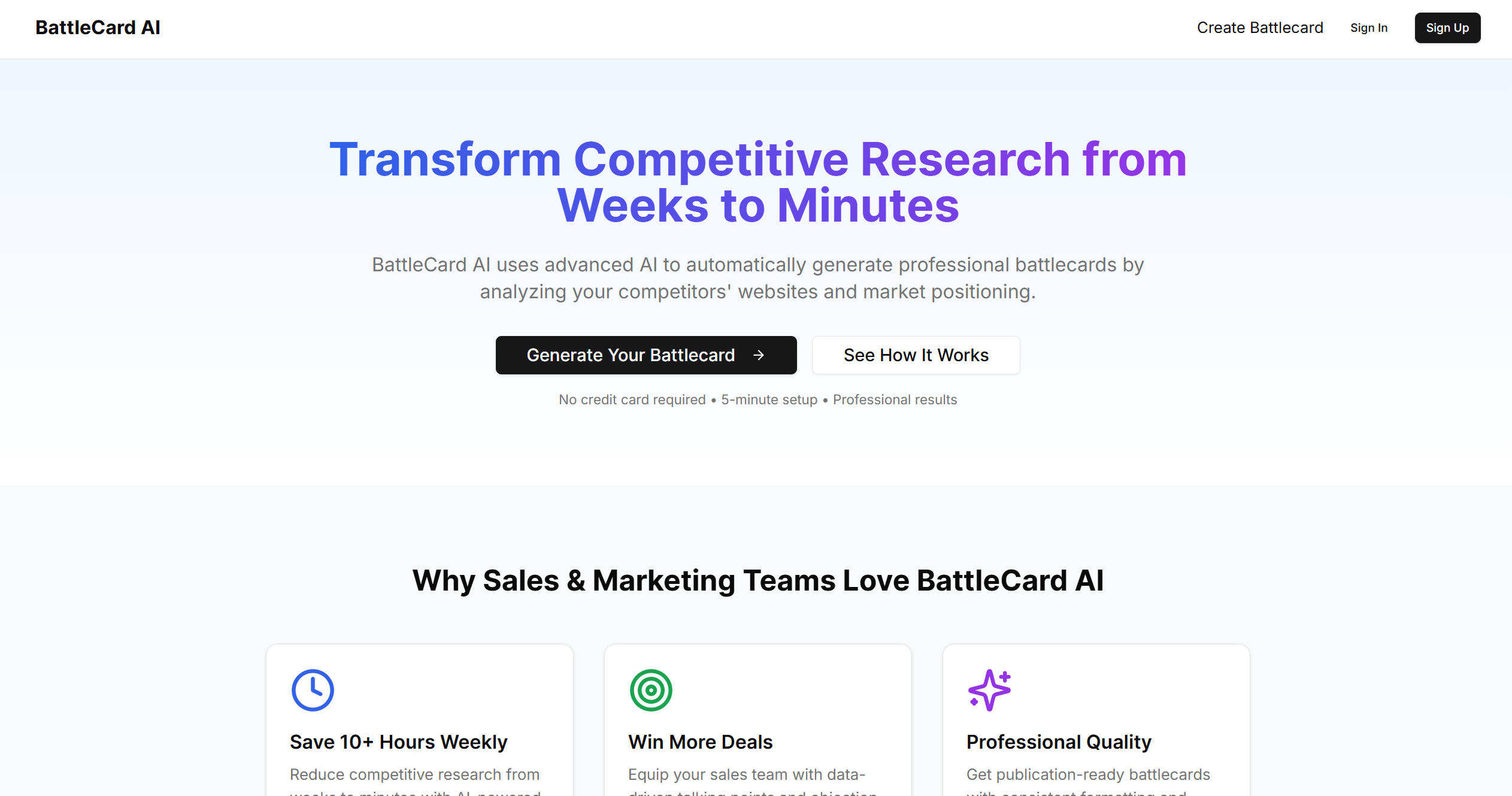
Battlecard by northr.ai is the most narrowly focused tool on this list, and deliberately so. It doesn’t try to be a full competitive intelligence platform. It generates sales battlecards and runs AI-powered sales simulations. A complete battlecard, covering strengths, weaknesses, objection handlers, positioning strategy, and pricing comparison, is ready in 60 seconds.
Strengths:
Fastest time to a usable battlecard: A complete battlecard in 60 seconds from live data, not a stale template.
AI sales simulations: Reps speak to an AI prospect that responds with real competitive objections. The full session is scored and debriefed. This feature doesn’t exist in any other tool on this list.
Genuinely accessible pricing: Free tier for one competitor and paid plans from $49/user/month. No annual contract, no sales call required.
No setup or administration overhead: Self-serve from day one. No integration configuration, no intelligence library to maintain.
Limits:
Not a full CI platform: Battlecard doesn’t do continuous monitoring, company intelligence, market analysis, or win/loss tracking. It does battlecards and simulations well and stops there.
Limited CRM integration: Battlecard is not designed to push intelligence into Salesforce or HubSpot the way Klue or FlowHunt do.
Single-product focus: If you need structured product analysis that goes beyond a sales battlecard, such as feature inventories, pricing intelligence, user sentiment, competitive positioning, you’ll need a different or complementary tool.
Best fit: SMB and mid-market sales teams that need fast, high-quality battlecards and want to train reps on competitive objection handling, without the overhead or cost of an enterprise CI platform.
Feature Comparison Table
Feature
FlowHunt
Battlecard
Kompyte
Klue
Crayon
On-demand product analysis
Yes
Partial
No
No
No
Continuous background monitoring
No
No
Yes
Yes
Yes
AI battlecard generation
No
Yes
Yes
Yes
Yes
AI sales simulations
No
Yes
No
No
No
Win/loss analysis
No
No
No
Yes
Partial
Live data at query time
Yes
Yes
Continuous
Continuous
Continuous
CRM integration (native)
No
Limited
Yes
Yes
Yes
Slack integration
No
No
Yes
Yes
Yes
Setup time
Minutes
Minutes
Days–weeks
Weeks
Weeks
Free tier or trial
Free trial
Free tier
Demo only
Demo only
Demo only
Suitable for small teams
Yes
Yes
Partial
No
No
Price Comparison
Tool
Pricing model
Starting price
Contract
FlowHunt
Credit-based (~$1/credit)
$50/month
Monthly/Annual
Battlecard
Per user/month
Free (1 competitor); $49/user/mo paid
Monthly/Annual
Kompyte
Annual contract
From ~$300/month
Annual
Klue
Enterprise contract (quote-based)
~$15,000–$40,000+/year
Annual
Crayon
Enterprise contract (quote-based)
~$25,000–$100,000+/year
Annual
Kompyte, Klue, and Crayon don’t list pricing publicly. All three are sales-led, and final contracts scale with team size and number of competitors tracked. The ranges above are based on publicly reported figures from Vendr, Capterra, and third-party review data as of mid-2026; verify current pricing directly with each vendor before budgeting.
Which Tool Is Right for Your Team?
Choose FlowHunt if: You want a full competitive intelligence stack without the enterprise price tag. Unlike the other FlowHunt is not a single-purpose tracker, but rather a versatile AI workflow platform. Beyond AI product analysis
, it covers the full intelligence picture with company analysis
for financials, leadership, and strategic context, market analysis
for segment-level trends, and AI social listening
for real-time brand and competitor monitoring across platforms.
Choose Battlecard if: Your primary need is fast, usable sales battlecards and rep training. Battlecard’s AI simulation feature is unique, and no other tool on this list offers it. The free-to-$49 pricing means there’s no reason not to evaluate it if your team handles competitive objections. Pair with FlowHunt if you need deeper underlying research.
Choose Kompyte if: You’re mid-market, already in the Semrush ecosystem, and need automated competitor monitoring with battlecard generation at a price point below the enterprise platforms. The best entry point for teams stepping up from manual tracking to a dedicated CI tool without committing to Crayon or Klue pricing.
Choose Klue if: You need the highest battlecard quality on the market and deal-level AI intelligence that surfaces competitive context inside active CRM workflows. The right call for mature enterprise sales organizations with dedicated CI ownership, a complex deal process, and the budget to support it.
Choose Crayon if: Breadth of monitoring is the priority, you need to track competitor websites, social, job postings, patent filings, and more in a single platform, with the deepest signal classification on the market. Built for enterprise teams with dedicated competitive intelligence roles and a multi-tool sales stack to integrate with.
FlowHunt and Battlecard are the practical choices for early-stage startups. FlowHunt covers deep on-demand product and competitor research at a usage-based price with no commitment. Battlecard offers a free tier and $49/month plans for generating sales battlecards instantly. Crayon, Klue, and Kompyte are all built for teams with dedicated competitive intelligence budgets — their pricing starts at thousands of dollars per year and requires onboarding investment that most early-stage teams can't justify.
Crayon, Klue, and Kompyte all run continuous background monitoring, meaning they detect changes to competitor websites, pricing pages, and social profiles as they happen. FlowHunt and Battlecard both retrieve live public data at the time you run an analysis, so each report is current — but you need to re-run it to see changes. For passive, real-time change detection, the enterprise platforms have the edge. For up-to-the-minute accuracy at the moment of analysis, FlowHunt and Battlecard are comparable.
Crayon and Klue both track competitor social profiles continuously as part of their monitoring stack. Kompyte also covers social posts and online media in its data sources. FlowHunt incorporates public social sentiment — community discussions, forum feedback, and platform reviews — into its structured product analysis reports, but does not provide a live social monitoring feed. Battlecard focuses on battlecard generation and does not include social monitoring. If real-time social alerts are a requirement, Crayon, Klue, or Kompyte are better fits.
Crayon, Klue, and Kompyte all offer native integrations with Salesforce, HubSpot, and Slack — competitive intelligence surfacing directly in the tools your sales reps already use. Battlecard has limited CRM integration; its primary channel is in-platform simulations and battlecard delivery. FlowHunt produces portable HTML output that can be pasted into any tool, shared via Slack, or attached to a CRM record manually, but does not offer native CRM push integrations.
FlowHunt offers a free trial with no credit card required — you can run actual product analyses before committing. Battlecard has a permanent free tier covering one competitor with no time limit. Kompyte, Klue, and Crayon all require a sales conversation to access a trial or demo, reflecting their enterprise pricing model. If you want to evaluate a tool independently without a sales process, FlowHunt and Battlecard are the most accessible starting points.
Maria is a copywriter at FlowHunt. A language nerd active in literary communities, she's fully aware that AI is transforming the way we write. Rather than resisting, she seeks to help define the perfect balance between AI workflows and the irreplaceable value of human creativity.
Maria Stasová
Copywriter & Content Strategist
Try the AI Product Analysis Tool
FlowHunt's AI Product Analysis tool delivers structured feature breakdowns, pricing intelligence, user sentiment, and competitor comparisons in minutes — no setup, no enterprise contract. Try it free.
AI Market Research Tools Compared: FlowHunt vs Crayon vs Semrush vs Similarweb
We compared FlowHunt, Crayon, Semrush Market Explorer, and Similarweb on market data depth, ease of use, report customization, and price. Here's which tool fits...
AI Product Analysis: Complete Step-by-Step Walkthrough for First-Time Users
Step-by-step: from entering the product URL to interpreting the competitive report and sharing it with your team. Includes tips for getting the most detailed ou...
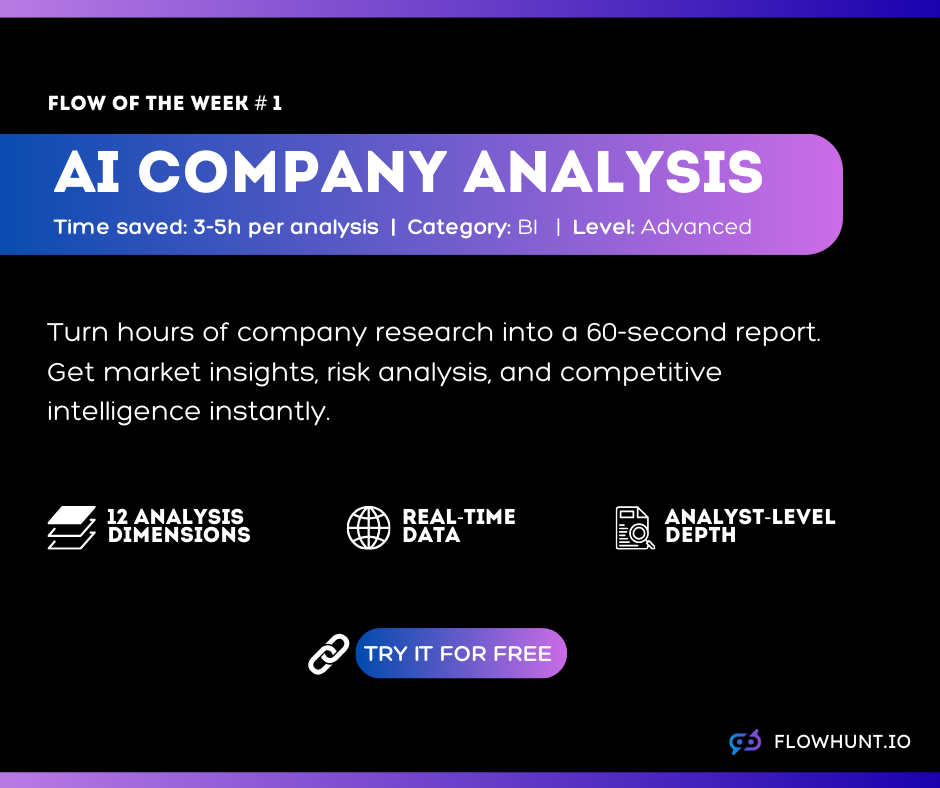
Flow of the Week #1: AI Company Analysis — Competitive Intelligence in Minutes
Introducing Flow of the Week, a weekly series highlighting our top workflows. Our first pick is the AI Company Analysis tool — the fastest way to generate compe...
3 min read
AI
Competitive Intelligence
+3
Cookie Consent We use cookies to enhance your browsing experience and analyze our traffic. See our privacy policy.