Somewhere between 2023 and now, AI stopped being a mindless hype, and became a truly usable technology for all marketing professionals. Since then, the teams doing the best work don’t have to be the biggest anymore, but they do have to be the ones who figured out which parts of their workflows can AI overtake.
This guide aims to help your marketing team do the same. It covers what artificial intelligence in marketing actually means in practice. You’ll see how real use cases work across content, automation, lead generation, and advertising, which tools are worth knowing, how to build an AI marketing strategy that sticks, and where the technology is headed. If you’re a marketing manager or team lead who wants to understand this space and act on it, this is written for you.
What Is AI in Marketing?
AI in marketing is the use of machine learning, natural language processing, and predictive algorithms to automate decisions, personalize experiences, and improve performance across the marketing funnel.
That definition is useful but a bit abstract. In practice it means that instead of a marketing team manually segmenting a list, writing five email variants, testing them over two weeks, and reporting on results, an AI-enhanced workflow does most of that automatically. It will do it faster, with more variables than any human team could reasonably manage.
The Difference Between AI Automation and Traditional Marketing Automation
Another important distinction is between traditional marketing automation and AI-powered marketing automation. Both automate marketing tasks, but traditional automation only follows the rules you write. For example, “if a user visits the pricing page, send email X after 24 hours.” On the other hand, AI can learn which users are most likely to convert, generate personalized content for each segment, send them out at appropriate times, and adjusts strategy as patterns change.
In practical terms, the overlap between automated marketing and AI-powered campaigns is now large. Most modern marketing automation platforms have AI baked in at least for predictive scoring, smart send times and dynamic content.
How Is AI Used in Marketing? Key Use Cases
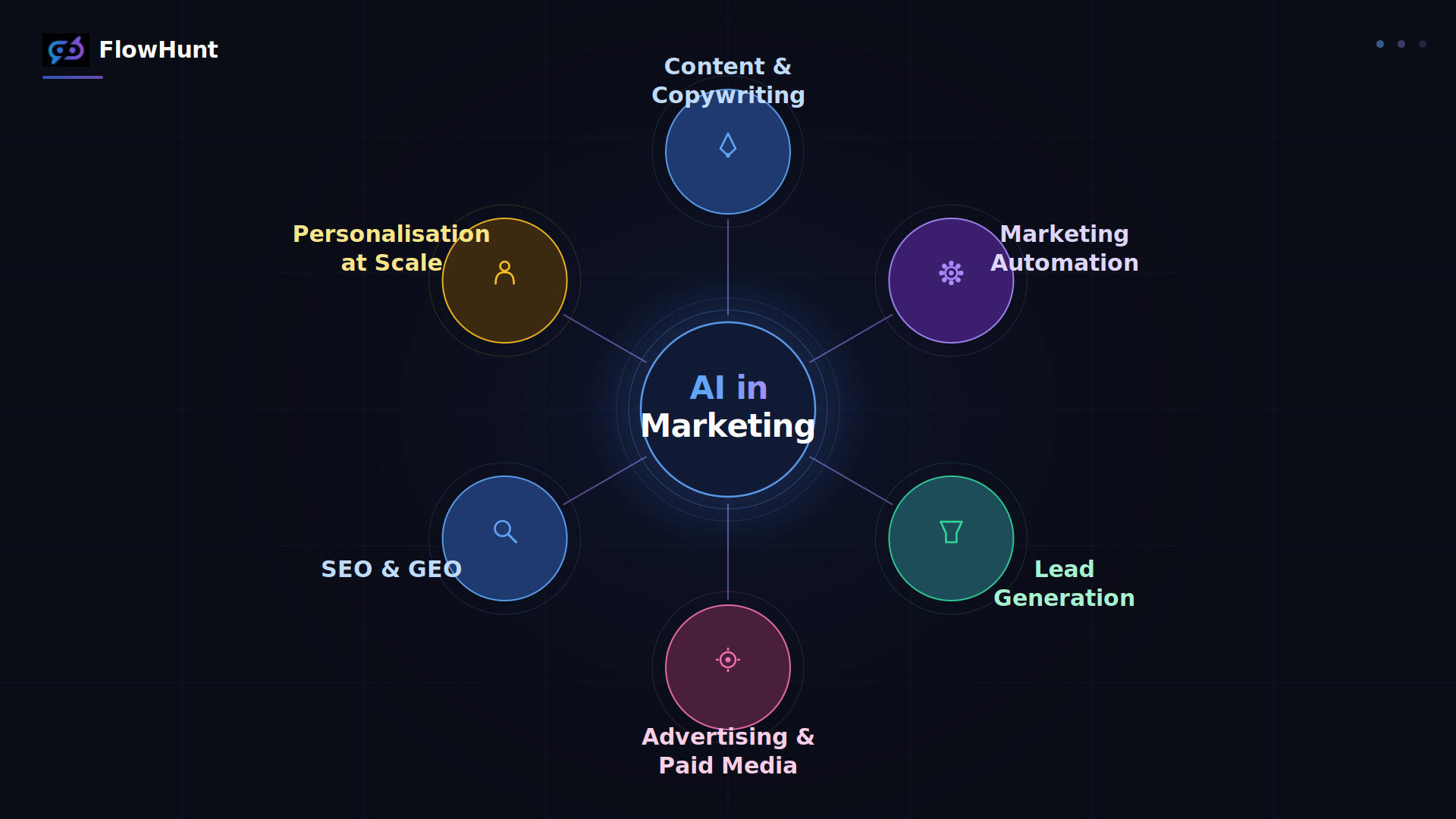
The use cases below are where the practical impact of AI in digital marketing is most visible right now. Each one represents an area where AI handles the repetitive, data-heavy layer.
Content Creation and AI Copywriting
AI copywriting tools can now draft blog posts
, email subject lines
, product descriptions
, social captions
, and ad copy
at a speed no human team can match. The quality gap has narrowed considerably over time. With a solid brief, smart prompting and the right model choice, the output often requires only light editing.
Tip:We find that ever since Sonnet 3.7, Claude has been consistently outperforming ChatGPT and other popular LLMs in terms of tone, language cohesion, natural idiom usage and other classic areas AI tends to struggle with. What’s more, Sonnet 4.6 started outperforming human output quality with plenty of good writers reporting so.
Still, the real value isn’t replacing writers, but rather removing the boring parts at scale and making decisions faster. A content team that previously shipped four blog posts a month can use AI to generate first drafts and ship eight, spending their time on editing, positioning, and strategy instead of the mechanical production work.
Tools like FlowHunt
cover the full range, from long-form article workflows that research, outline, and draft in sequence, to short conversion-focused copy generated on demand.
Marketing Automation and Campaign Management
AI-powered marketing automation
goes well beyond scheduled sends and basic segmentation. Modern platforms can optimize send times individually per recipient (not per campaign), dynamically re-segment audiences as behavior changes, trigger personalized workflows based on predictive signals rather than rule-based triggers, and surface underperforming segments.
The marketing automation benefits are measurable, with higher open rates from better send-time logic, higher click-through rates from dynamic content personalization, and less time spent keeping campaigns running well. The automation works better the more data it has, which means teams that have been collecting clean CRM data for years tend to see the largest gains.
A practical starting point is reviewing your current automation setup and identifying where fixed rules are doing work that a predictive model could do better. That’s usually lead scoring and send-time optimization. For concrete examples of how teams across different industries have structured this, see our roundup of marketing automation examples
.
AI Lead Generation
Predictive lead scoring is where AI changes the economics of lead generation most directly. Traditional lead scoring assigns point values to actions based on assumptions about what correlates with intent. AI-powered lead scoring learns from your data, identifying which patterns in behaviour actually predict conversion for your specific business.
The result is that sales teams stop chasing the same volume of leads and start focusing on a smaller, higher-probability set. AI chatbots
add another layer by qualifying leads in real time, routing high-value prospects to sales, and nurturing the rest through automated sequences.
Intent data platforms extend this further by identifying prospects who are actively researching solutions in your category — not just people who fit your ICP on paper, but people showing behavioural signals that suggest they’re in-market right now.
Smart bidding in Google Ads and Meta’s advantage+ campaigns are the most widely-used examples of AI advertising in practice. The platforms use machine learning to adjust bids in real time based on conversion probability. They pull in signals around device, time, audience behaviour, and historical performance that no human bidding strategy could process at the same speed.
Beyond bidding, AI now handles creative testing at scale. Rather than running one or two ad variants, you can generate dozens of headline, image, and copy combinations and let the algorithm identify which combinations perform best for each audience segment. It means that this creative iteration cycle now runs in days instead of weeks.
SEO and GEO: Organic Visibility in the Age of AI Search
AI SEO tools identify content gaps against competing pages, surface keyword clusters that aren’t covered in your existing content, suggest on-page optimization changes, and track which opportunities are growing or declining in search demand.
But traditional SEO is only half the picture now. Generative Engine Optimization (GEO) is the emerging practice of optimizing content to appear in AI-generated answers on Google’s AI Overviews, Perplexity or ChatGPT search. When a user asks an AI assistant which marketing automation platform to use, or what AI lead generation looks like in practice, the sources it cites and summarizes are determined by signals that don’t map cleanly onto classic SEO ranking factors.
For marketing teams, this means the content strategy conversation has expanded. It’s no longer enough to target keywords with good search volume. The question is also: would an AI assistant cite this page when answering a question in our category? For a practical breakdown of how to apply AI to organic growth, see our guide on driving SEO success with AI
.
Personalisation at Scale
Personalization used to mean putting a first name in an email subject line. AI-powered personalization means delivering different product recommendations, different landing page content, different email messaging, all based on each user’s behavioral data, purchase history, and predicted next action.
The customers who receive relevant messaging convert at higher rates, generate higher average order values, and churn at lower rates. Mailchimp’s research on segmented campaigns
found 14.3% higher open rates and over 100% higher click rates versus non-segmented sends, and that’s before AI personalization is applied on top.
The AI layer makes it possible to run this kind of personalization across a database of hundreds of thousands of contacts without a proportionally larger marketing team.
Ready to grow your business?
Start your free trial today and see results within days.
The AI marketing tools landscape has expanded rapidly, and it’s worth thinking in categories rather than individual products.
Full AI workflow automation platforms — Tools like FlowHunt
let teams build end-to-end AI workflows for any use case without writing any code. These are most useful when you need to connect multiple tools and automate handoffs between them. For a broader look at agent-based options, see our roundup of the best AI marketing agents
.
Content and copy tools — Platforms like Jasper, Writesonic, and Claude-based writing workflows handle drafting at scale. The distinction is between general-purpose writing tools and tools tuned for specific marketing formats like ad copy, landing pages, or product descriptions. FlowHunt
sits in this category too, with the added benefit that generated copy can feed directly into a publishing queue or CRM without a manual handoff.
Marketing automation platforms — HubSpot, Salesforce Marketing Cloud, Marketo, and ActiveCampaign all have AI capabilities built in for lead scoring, send-time optimization, and audience segmentation. The native AI in these platforms is often the easiest starting point because it works with data you already have. See our full comparison of the best marketing automation software
if you’re still evaluating platforms.
AI SEO tools — Ahrefs, Semrush, and Surfer have added AI layers for content briefs, gap analysis, and optimization suggestions. Standalone tools like Clearscope focus on on-page content scoring specifically. These sit in a sweet spot of low KD and practical utility.
AI ad optimisation tools — Google’s Performance Max, Meta Advantage+, and third-party platforms like Smartly.io handle bidding and creative optimization at the campaign layer. The manual work here is setting up clean conversion tracking and defining goals clearly — the AI does the rest.
Analytics and personalization tools — Amplitude, Mixpanel, and Segment provide the behavioral data layer that makes personalization possible. Dynamic Yield and Optimizely handle the on-site personalization execution. These matter more as you scale and need to go beyond email into website and product personalization.
The right stack depends on your goals. A 5-person marketing team and a 50-person team have very different integration requirements. There’s no single platform that does everything well. The most effective implementations tend to combine a strong automation backbone — a CRM-native platform, or a dedicated workflow tool like FlowHunt
— with specialist AI tools for content and analytics.
AI Marketing Strategy: How to Actually Get Started
Most AI marketing adoption fails not because the tools don’t work, but because teams try to do too much too fast. The marketing automation strategy that scales is the one that starts narrow, measures carefully, and expands from a working base.
Start With One Use Case, Not a Full Overhaul
Pick the highest-leverage area first. For most teams, that’s either content creation (where volume constraints are immediately visible) or email automation (where the training data is already in your CRM).
The goal of the first use case is simply to demonstrate that AI can produce usable output in your specific context. You don’t need to focus on performance just et. That proof point makes it easier to get buy-in for the next use case, and gives your team the hands-on experience.
Content is often the easiest entry point because the feedback loop is fast. You draft with AI
, a human edits, you publish, you see whether the output meets your quality standards.
An AI email assistant
is another fast win. It will allow you create subject line variatons, draft responses, and follow-up sequences with minimal setup.
Last but not least, lead scoring is often the highest-impact choice. But remember that it takes a bit longer to validate, because you need time to see how predictions track against actual conversions. Our guide to lead scoring tools
covers what to look for when choosing one.
Audit Your Current Marketing Automation Setup
Auditing your existing processes before you add anything new is crucial. A broken lead scoring rule doesn’t get fixed by adding AI to it. AI is only as good the underlying data and logic. If it gets spoiled data and wrong logic, it makes it worse, faster and at scale.
The audit has two goals. First, map what’s already running. This tells you what AI would actually be layering onto, and flags anything that needs cleaning up before you do. Second, identify where your team is still doing simple things manually at volume. That’s your best signal for where AI will have the clearest ROI — not because those tasks are technically the hardest, but because the time savings are immediately visible and measurable.
Data quality is the third thing to check, and the one most teams skip. AI models learn from your data, so if your CRM has duplicate contacts, missing fields, or inconsistent lifecycle stage tagging, the AI output will reflect that. A clean CRM isn’t a prerequisite for exploring AI, but it is a prerequisite for trusting what the AI produces.
Choose Tools That Fit Your Stack
Integration with your existing CRM, CMS, and ad platforms matters more than any individual feature. A content generation tool that doesn’t connect to your CMS creates the need to copy everything manually. A lead scoring model that doesn’t write back to your CRM creates a reporting gap.
When evaluating tools, ask where does the output land? What data does this tool need to work? How does it connect to what we already have? The answers to those three questions will eliminate more options than any feature comparison matrix.
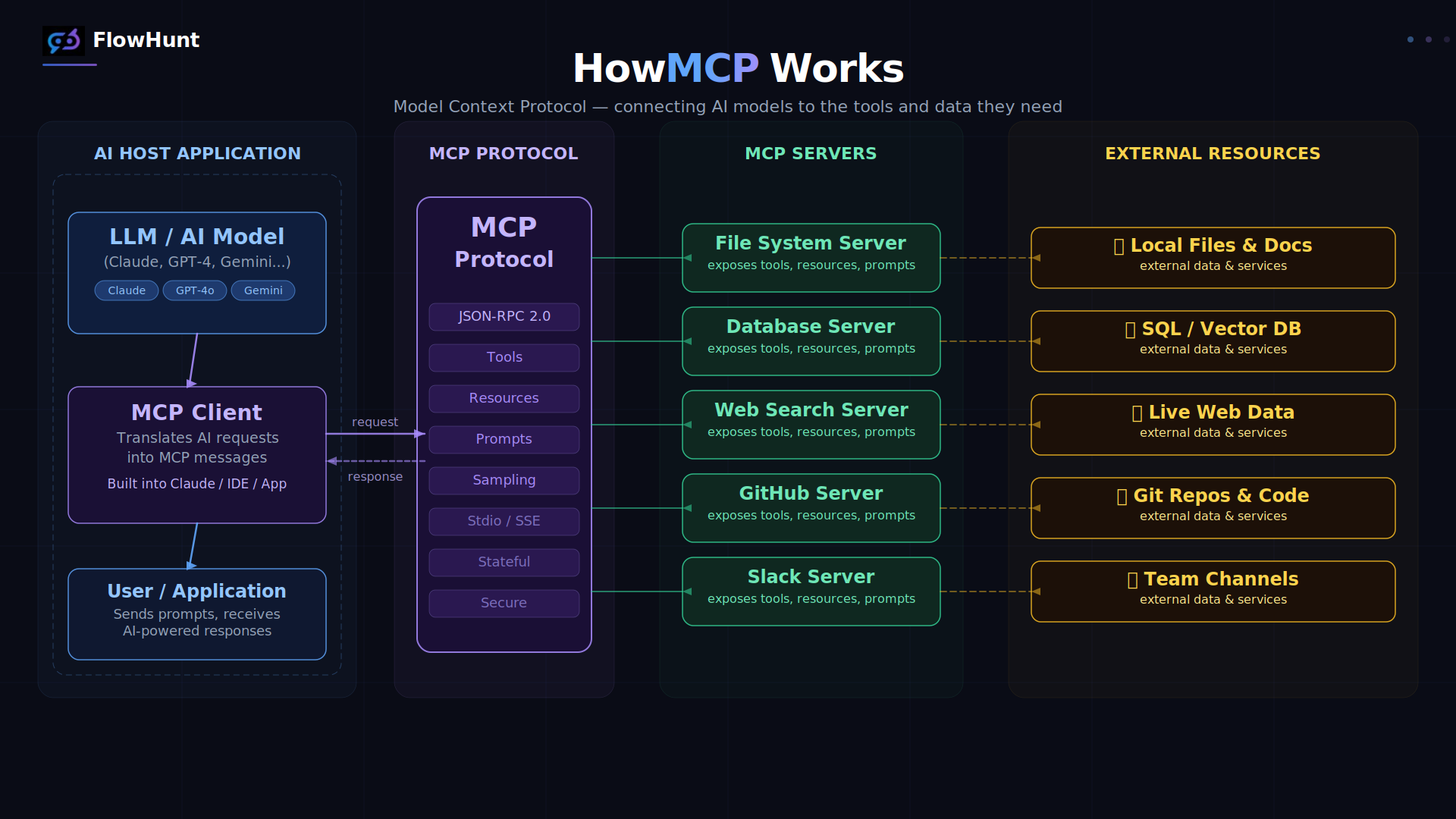
The good news is that connecting tools has gotten significantly easier. MCP servers (Model Context Protocol) have become a common standard for letting AI models talk directly to external services without custom API work. Many AI platforms and tools now ship with MCP support out of the box, which means the integration layer that used to require a developer can often be configured in minutes.
FlowHunt supports MCP natively, so if the tools in your stack already have MCP servers available, wiring them together is mostly a matter of pointing and connecting rather than building.
Measure What Changes
Define your KPIs before you launch the first AI-assisted workflow, not after. The metrics you care about depend on the use case. The reason to define them in advance is simple. It’s easy to retrospectively find metrics that look good. Deciding upfront what success means keeps the evaluation honest and gives you a clear signal on whether to scale the use case or adjust the approach.
Join our newsletter
Get latest tips, trends, and deals for free.
AI Marketing Trends Shaping the Next Few Years
AI-generated content is becoming table stakes. Everyone can already generate a vague AI article. That’s why the differentiation is shifting from whether your team uses AI, to whether your brand voice and data assets give you a content advantage that AI alone can’t replicate.
Scale alone doesn’t cut it anymore. Teams investing in original research, proprietary data, and strong editorial voice are building moats. Teams generating generic AI content at volume are racing to the bottom with Google increasingly penalizing vague and mindless scaling tactics.
Conversational AI is moving deeper into the buyer journey. AI chatbots are no longer just a top-of-funnel tool for answering basic questions. They’re handling complex product queries, running qualification conversations, and connecting directly to CRM systems to create and update leads in real time.
The future of AI in sales and marketing alignment is largely a conversational AI story. If you want to know more, see how teams are automating sales prospecting with AI
.
Predictive analytics is replacing gut-feel campaign planning. The teams that get this right are deciding which channels to invest in, which segments to prioritize, and which content to produce based on predictive models rather than assumptions.
Multimodal AI is expanding what automated marketing can produce. Text was first. Now video, images, and audio are becoming part of the AI-generated content stack. This changes the economics of creative production significantly, particularly for teams running paid social where creative refresh rate is a major performance driver.
AI in sales and marketing alignment is becoming a competitive moat. The organizations where marketing AI and sales AI share data are compounding advantages faster than those where the two functions run separate AI stacks.
Conclusion
AI in marketing is still far from replacing the creative, strategic work that makes marketing effective, maybe even further than a few years ago. The days where simply using AI before anyone else was the advantage are gone. Today, it’s all about being the most creative and strategic about using it, and to keep your data clean and organized.
The practical starting point is smaller than most teams expect. You just need to pick one workflow, measure what changes, and build from there. One AI-written draft per week becomes the norm faster than it sounds. One smarter lead scoring model
changes what the sales team prioritizes within a quarter. One better-targeted email sequence changes your open rate metrics within a month.
The competitive pressure from artificial intelligence in marketing is immense, but the good news is that the advantage isn’t necessarily going to the large teams with the largest AI budgets. It’s going to the teams that figure out which use cases actually move their specific numbers and execute those first.
If you’re looking for a single platform to connect all of your workflows from simple rules to complex multi-agent projects, FlowHunt
is built for exactly this kind of phased approach. Start with one use case, automate the handoffs, and scale from there. Try it for free here
.
Frequently asked questions
AI is used across nearly every area of modern marketing, from scaling all types of content, personalizing emails, optimizing paid media & SEO, all the way to predictive analytics. The common thread is that AI handles the data-heavy, repetitive work so marketing teams can focus on strategy and creative direction.
No, AI only makes existing marketing teams faster and more productive. It handles the repetitive tasks, like for example list segmentation, content drafts, or and performance reporting. Human marketers still own the strategy, brand voice, and relationship-building that drive long-term growth.
Start by picking one high-leverage use case rather than overhauling everything at once. Audit your existing marketing automation setup to understand what's already running and where the gaps are. Then choose tools that integrate with your existing CRM and ad platforms. Define your KPIs before you start (open rates, cost per lead, content output volume) so you can measure what changes. Scale to additional use cases once you have a working baseline.
Marketing automation uses rules you define, for example, sending an email 24 hours after a form fill. AI marketing uses machine learning to make decisions without preset rules, learning from data over time. In practice, most modern platforms combine both an automation handles the workflow execution with AI to determine the timing, content, and targeting.
Start with high-volume, low-judgment tasks: email send-time optimization, lead scoring, content drafts, and audience segmentation. These deliver fast, measurable results with minimal risk. Complex decisions — campaign strategy, brand voice, creative direction — should stay with humans.
The main risks are data quality problems (AI amplifies bad data), over-automation (removing human judgment from decisions that need it), and generic output (AI-generated content without strong editorial oversight tends to blend into the noise). Privacy and compliance are also real concerns if personalization relies on customer data collected without proper consent.
Yes. Many AI marketing tools are priced for small teams or have free tiers. Good entry points include AI writing assistants, email send-time optimization in tools like Mailchimp, and basic chatbot builders. FlowHunt can help you build all of these and more regardless of the size of your business.
Maria is a copywriter at FlowHunt. A language nerd active in literary communities, she's fully aware that AI is transforming the way we write. Rather than resisting, she seeks to help define the perfect balance between AI workflows and the irreplaceable value of human creativity.
Maria Stasová
Copywriter & Content Strategist
Automate Your Marketing with AI-Powered Workflows
FlowHunt lets you build AI workflows for content creation, lead generation, and campaign automation — without writing a single line of code. See what it can do for your team.
AI Integration with Marketing Automation Tools: A Complete Guide to Modern Marketing
Discover how to integrate AI with marketing automation platforms to enhance personalization, predictive analytics, and customer engagement. Learn the best tools...
AI-powered marketing leverages artificial intelligence technologies like machine learning, NLP, and predictive analytics to automate tasks, gain customer insigh...
Best AI Marketing Agents in 2026: 12 Tools That Actually Run Your Marketing
Ranked and reviewed: the 12 best AI marketing agents in 2026. From content pipelines and SEO automation to ad optimization and email personalization — find the ...
16 min read
AI Agents
Marketing
+3
Cookie Consent We use cookies to enhance your browsing experience and analyze our traffic. See our privacy policy.