10 Best Lead Scoring Software Tools in 2026 (Ranked & Reviewed)
The 10 best lead scoring software tools in 2026 — from AI-powered predictive scoring to rule-based CRM scoring. Find the right lead scoring solution for your sales and marketing stack.
Lead scoring is a methodology for ranking prospects against each other to determine which leads are most likely to convert — and therefore which ones sales reps should contact first. A well-implemented lead scoring system is essentially a prioritization engine: it takes your entire pipeline and sorts it by conversion probability, so reps spend their limited time on the opportunities most likely to close.
The business case is straightforward. Most B2B sales teams are overwhelmed with more leads than they can meaningfully engage. Inbound demand generation, SDR outbound, partner referrals, and event lists all funnel into the CRM simultaneously. Without scoring, reps treat all leads roughly equally — wasting time on poor-fit contacts while high-intent, high-fit leads go cold waiting for a callback.
Companies with formal lead scoring systems report significant improvements:
25-40% higher close rates (reps spend time on leads that actually convert)
Better marketing-sales alignment (a shared definition of what a “good lead” looks like)
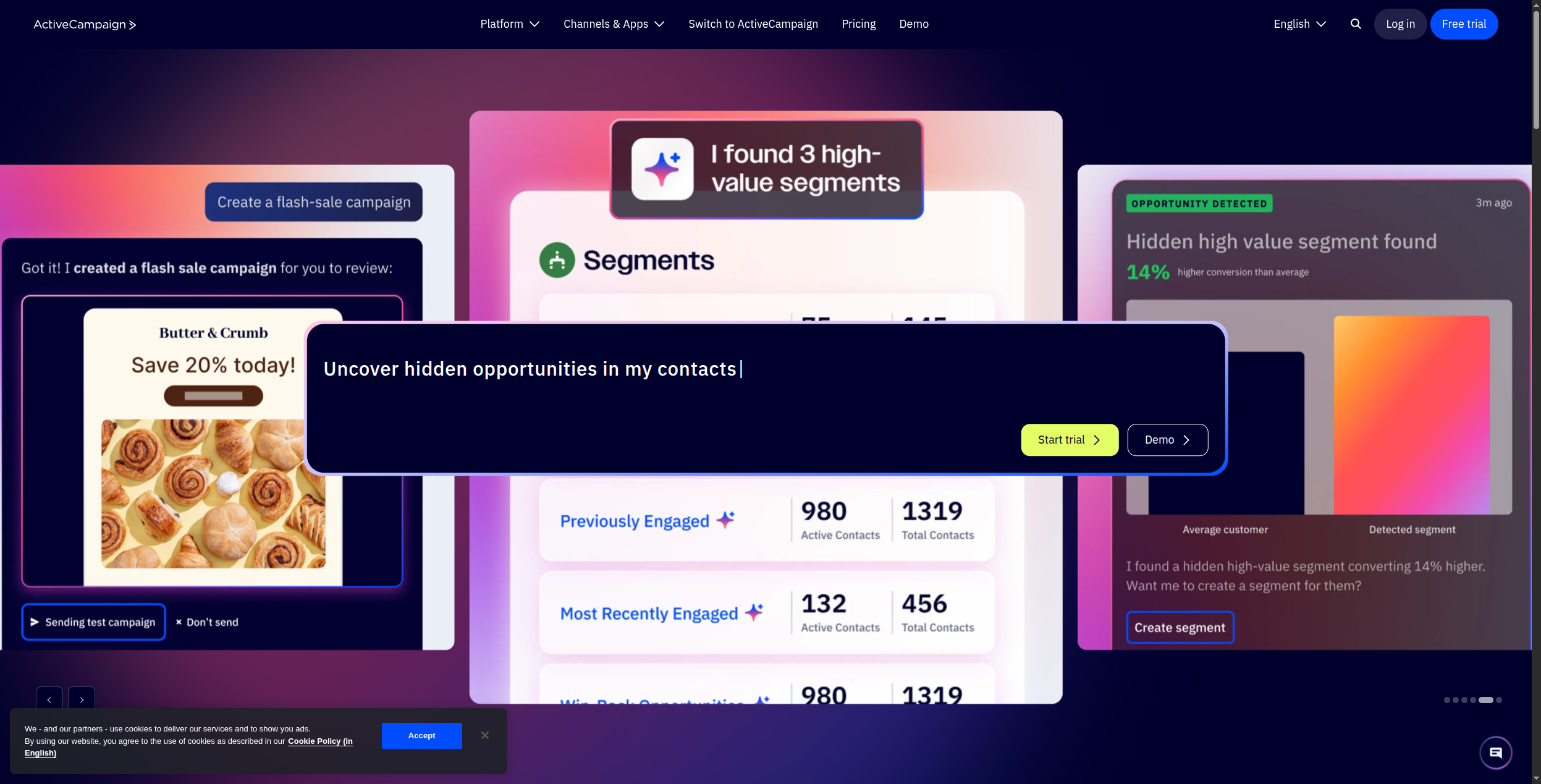
In 2026, the best teams are moving from basic demographic scoring to AI-powered predictive models that combine firmographic fit, behavioral engagement, intent signals, and qualitative assessment through LLMs.
The Two Fundamental Approaches: Rule-Based vs. Predictive
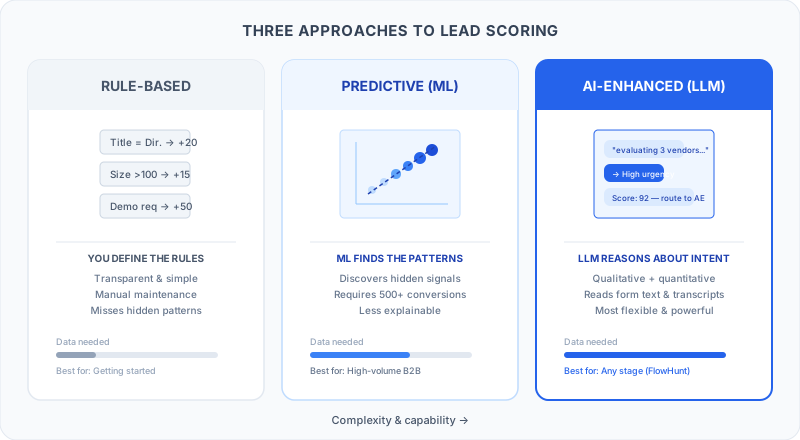
Before diving into specific tools, it’s worth understanding the two core approaches to lead scoring — because the right approach depends on where you are in your data maturity journey.
Rule-Based Scoring
You define the rules. Job title = “Director” earns +20 points. Company size between 100-500 employees earns +15 points. Pricing page visit earns +25 points. Demo request earns +50 points. You can update rules any time.
Best when: You’re getting started, you have fewer than 500 historical closed deals, you want transparency and explainability, or your sales cycle is highly relationship-driven and doesn’t follow predictable patterns.
Predictive Scoring
Machine learning analyzes your historical CRM data — thousands of past leads with known outcomes — and identifies the combination of attributes that actually predicted conversion. It often finds non-obvious signals: companies in a specific SIC code with a particular tech stack that raised Series B funding convert at 4x average rates.
Best when: You have 500+ historical conversions to train on, your lead volume is high enough to make prioritization valuable, and you want to remove human bias from scoring weights.
AI-Enhanced Scoring (Emerging)
LLM-powered scoring adds qualitative reasoning to numeric scoring: analyzing the content of an inbound form (“we’re evaluating 3 vendors and need to make a decision by Q3”) to detect high urgency, reading sales call transcripts for buying signals, or synthesizing news about a target company to adjust score dynamically. FlowHunt enables this layer on top of traditional scoring.
Ready to grow your business?
Start your free trial today and see results within days.
1. FlowHunt — Best for Custom AI-Powered Lead Scoring
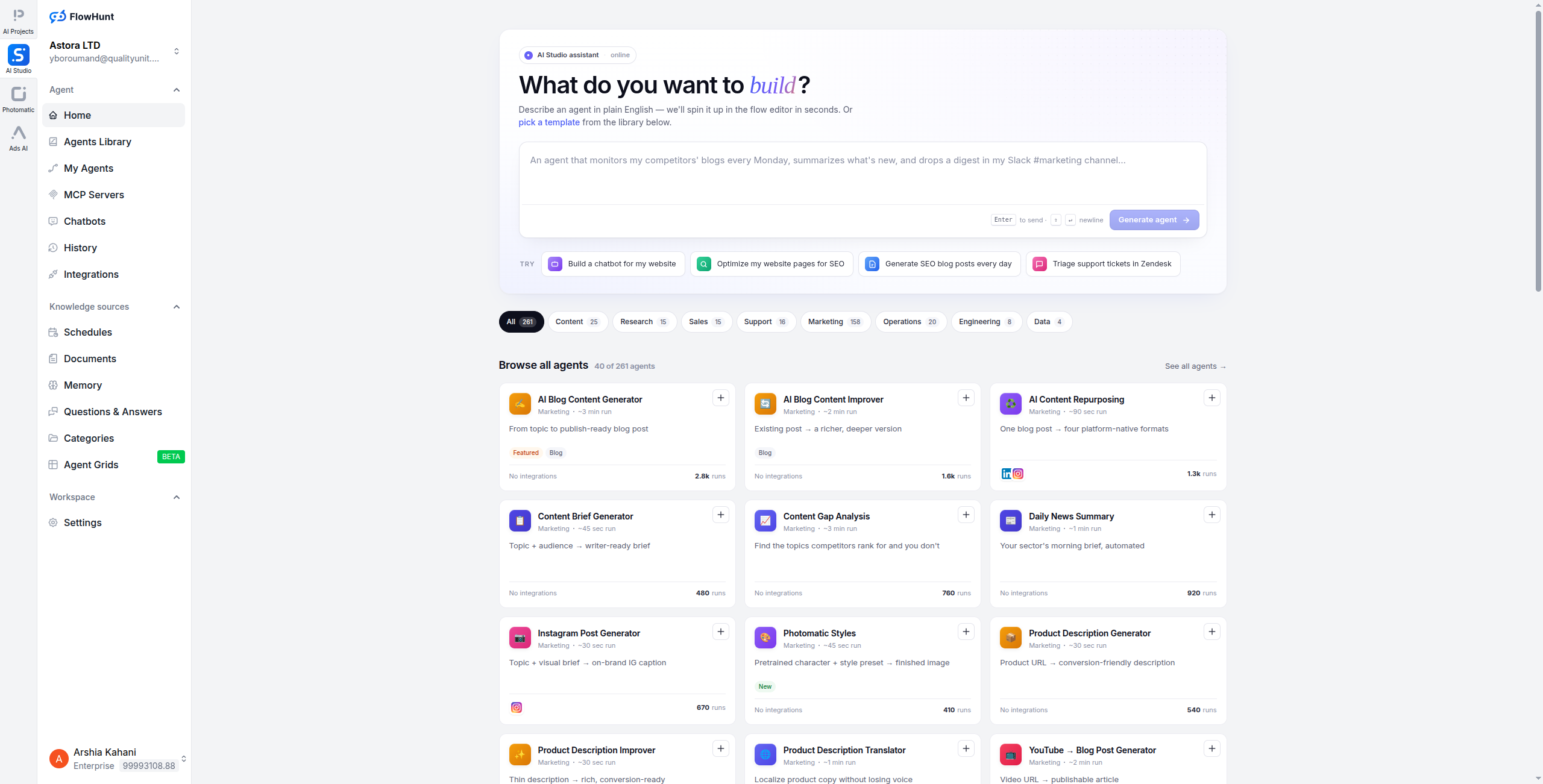
FlowHunt is the most flexible lead scoring solution on the market for teams that want something beyond the scoring models baked into their CRM or MAP. Using FlowHunt’s visual workflow builder, you design a scoring workflow that combines any data source with any scoring logic — including LLM-powered qualitative assessment.
A typical FlowHunt lead scoring workflow works like this: when a new lead enters your CRM, FlowHunt triggers an enrichment sequence (querying Apollo for firmographics, checking technographic data, pulling recent company news). It then applies your scoring rules: numeric points for demographic fit, additional points for behavioral signals from your CRM, and an LLM reasoning step that reads the lead’s form submission text and any available context to assess urgency and intent qualitatively. The total score is written back to your CRM field, and conditional routing sends high-score leads to an immediate SDR notification sequence while low-score leads enter a nurture track.
The critical advantage is transparency and flexibility: your scoring model is completely auditable (you built it), infinitely customizable without waiting for a vendor update, and not locked to a specific CRM. You can incorporate signals that no off-the-shelf scoring tool supports — for example, scoring based on a specific keyword in a form submission text, or adjusting score based on the sentiment of the lead’s last support ticket. FlowHunt’s LLM node can make qualitative scoring decisions that rules alone can’t capture.
Pricing: Free tier with workflow credits for building and testing. Starter plan from $49/month with increased execution volume. Growth and Enterprise plans for high-volume teams — contact FlowHunt for current pricing.
Pros: Fully custom scoring logic with no off-the-shelf constraints, LLM qualitative scoring for nuanced intent assessment, works with any CRM via API (HubSpot, Salesforce, Pipedrive, etc.), combines enrichment + scoring in one automated workflow, no per-seat pricing model Cons: Requires initial workflow design and configuration (not plug-and-play), best results need connecting external enrichment sources, no pre-built out-of-the-box scoring model
Best for: RevOps and sales ops teams that want full control over scoring logic, or teams with non-standard qualification criteria that don’t fit what any CRM or MAP scoring system can model out of the box.
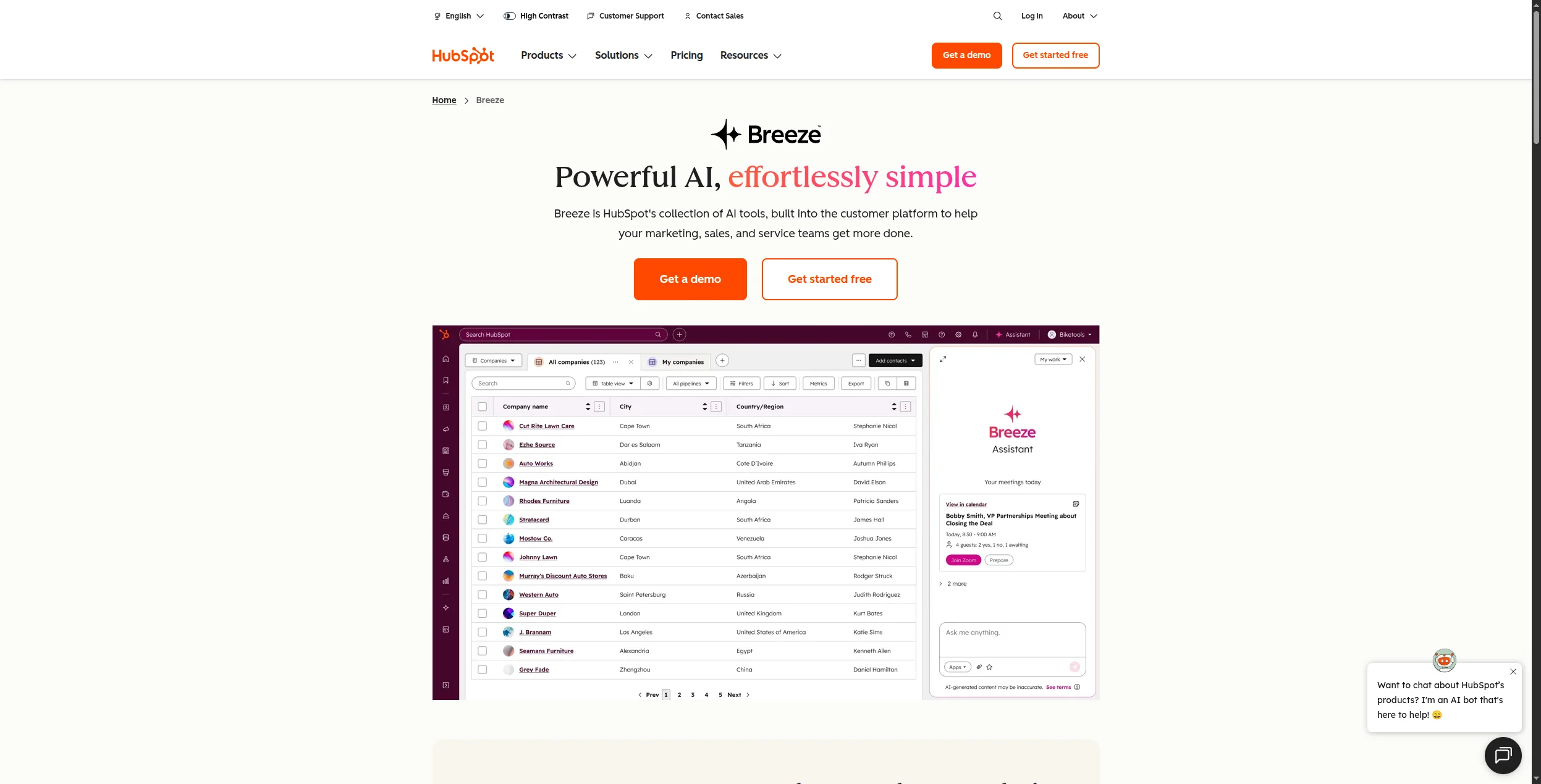
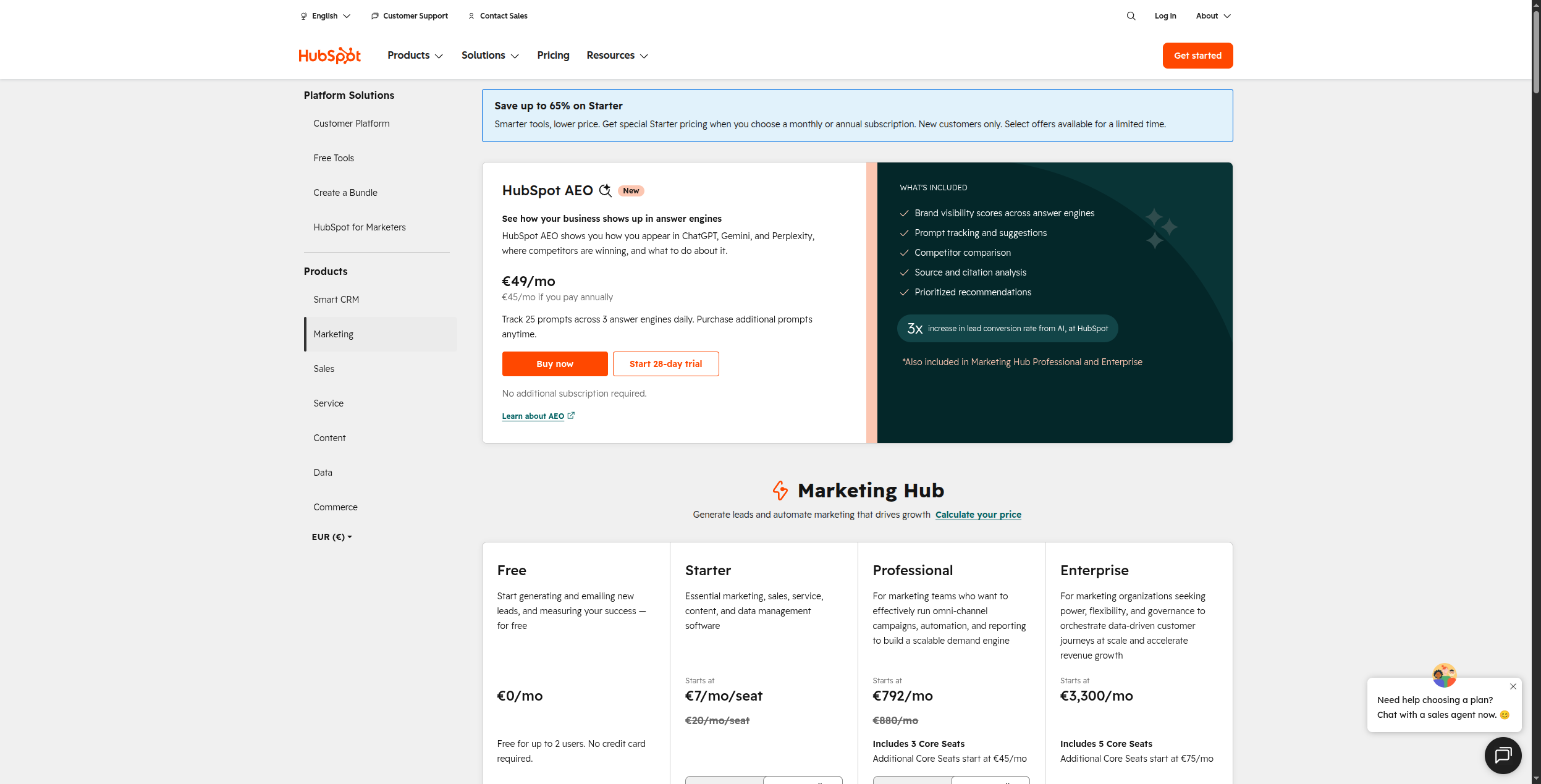
HubSpot offers two scoring systems: manual contact scoring (available on Starter+) and AI-powered predictive lead scoring (available on Professional and Enterprise plans). Manual scoring lets you define positive and negative scoring criteria — contact properties, form submissions, email opens, page visits, and deal activities — through a clean UI with no technical knowledge required. Adding +25 points for a pricing page visit and -10 for an unsubscribe takes minutes to configure.
Predictive scoring on Professional and Enterprise plans automatically trains a machine learning model on your historical CRM data — contacts that converted vs. those that didn’t — and applies those learned patterns to score incoming leads. For HubSpot shops with 500+ closed deals in their CRM, this predictive model delivers accuracy comparable to standalone tools like MadKudu without any additional vendor. Scores flow natively into HubSpot workflows: when a lead crosses a score threshold, automatically trigger a task for the assigned rep, enroll in a nurture sequence, or send a Slack notification to the sales manager.
Pricing: Scoring available in CRM Starter ($20/month). Predictive scoring requires Marketing Hub Professional ($890/month) or Sales Hub Professional ($450/month). Enterprise plans from $3,600/month unlock the most advanced scoring capabilities.
Pros: Deeply integrated with HubSpot CRM, workflows, and marketing hub, intuitive scoring UI with no technical setup, predictive scoring on Professional+, scores trigger workflows natively without external integration, actively developed Cons: Predictive scoring requires Professional plan ($890+/month) — significant cost jump, model accuracy decreases with less than 500 historical conversions, limited control over which features the ML model uses
Best for: Teams already on HubSpot Professional or Enterprise who want native lead scoring with seamless workflow triggers — without adding a separate vendor to their stack.
3. MadKudu — Best Standalone Predictive Scoring for SaaS
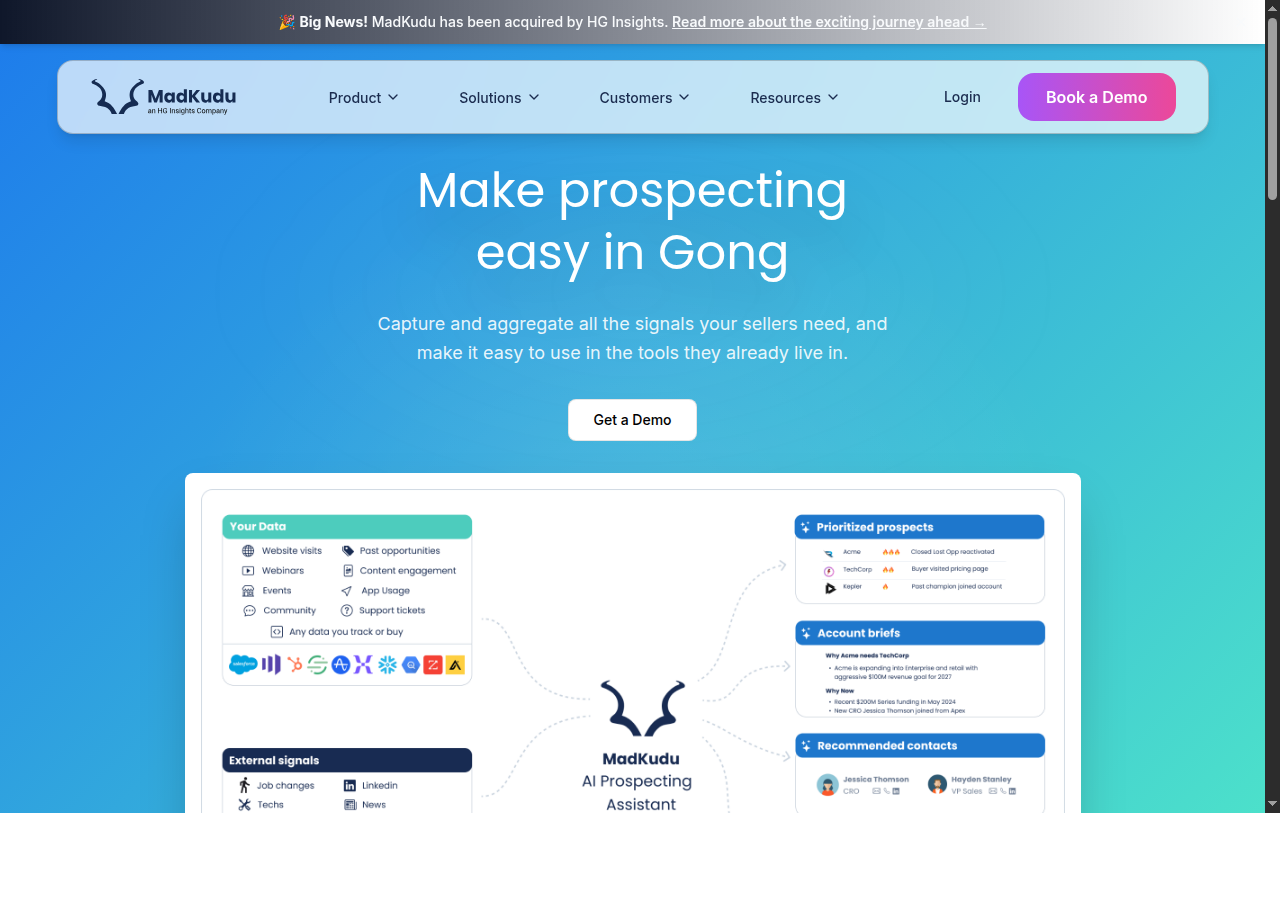
MadKudu is the purpose-built predictive lead scoring platform built specifically for B2B SaaS companies with product-led growth (PLG) motions. Its core strength: combining traditional firmographic scoring with product usage signals. When a free trial user hits a specific usage milestone (e.g., invites 3+ teammates, creates 5+ projects), MadKudu detects the PQL (product-qualified lead) signal and routes them to sales immediately.
MadKudu integrates with Salesforce, HubSpot, Segment, Mixpanel, and other data sources to build a composite score that reflects both who the lead is and what they’ve done in your product.
Pros: Best for PLG SaaS, combines firmographic + product usage signals, fast implementation (weeks, not months), transparent model methodology Cons: Premium pricing, primarily valuable for SaaS with free trial/freemium motion, requires product analytics integration for full value
Best for: B2B SaaS companies with free trials, freemium tiers, or self-serve product experiences.
4. 6sense — Best for Account-Based and Enterprise GTM
6sense is the most sophisticated platform on this list — an account-based revenue intelligence platform that predicts which accounts are in-market to buy, what buying stage they’re in, and who the key decision-makers are. Its scoring goes beyond individual lead attributes to model account-level buying committees and intent signals across the entire buying team.
6sense incorporates third-party intent data (web research activity), technographic signals, CRM history, and predictive AI to assign accounts to stages of the buying journey (Target → Awareness → Consideration → Decision → Purchase). This lets GTM teams time their outreach to catch accounts at the exact moment they’re actively evaluating solutions.
Pros: Most sophisticated account-level scoring, best intent signal integration, buying stage detection, strong ABM use case Cons: Enterprise pricing ($30,000+/year), complex implementation, overkill for SMB or transactional sales
Best for: Enterprise B2B companies with $25,000+ ACV deals, dedicated ABM programs, and complex multi-stakeholder buying processes.
5. Breadcrumbs.io — Best for Revenue Team Alignment
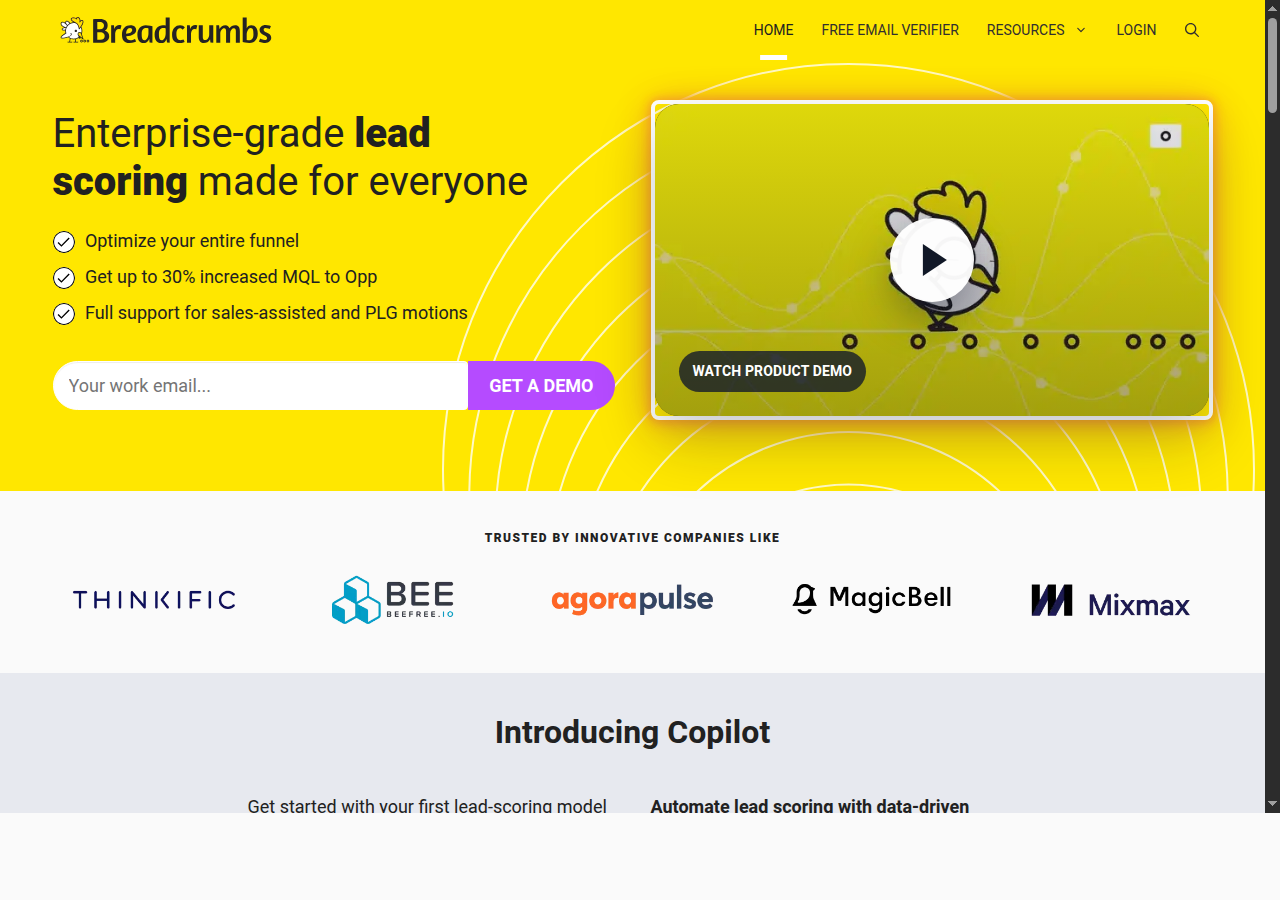
Breadcrumbs takes a differentiated approach: “co-dynamic” scoring that updates continuously as leads progress through the funnel (and decays when they go cold). Rather than static point totals, Breadcrumbs scores reflect current engagement recency and patterns — a lead that was highly engaged three months ago but hasn’t opened an email since is deprioritized automatically.
Breadcrumbs also has a collaborative design philosophy: sales and marketing build the scoring model together in a visual interface, building alignment on what “good” looks like before the model goes live.
Pros: Score decay prevents stale leads from clogging priority queues, collaborative model building, clean UI, Salesforce and HubSpot integration Cons: Smaller company with less market presence than HubSpot or Marketo, predictive capabilities less mature than MadKudu or 6sense
Best for: Teams struggling with marketing-sales alignment over lead quality definitions, or teams that need score decay to reflect actual current intent.
6. Salesforce Einstein — Best for Salesforce Enterprise Users
Salesforce Einstein Lead Scoring is the AI-powered scoring built natively into Sales Cloud. It analyzes your historical lead conversion data and trains a model that scores incoming leads on their likelihood to convert — completely within the Salesforce interface, with no third-party data leaving your instance.
Einstein’s advantage is tight native integration: scores appear on lead records, trigger automation rules, power list views for reps, and feed into forecast models. For organizations deeply committed to the Salesforce ecosystem, Einstein is the path of least resistance for predictive scoring.
Pros: Native Salesforce integration, no data leaving Salesforce (data governance), trains on your own CRM data, no additional vendor Cons: Requires Sales Cloud Enterprise or above, model accuracy lower than dedicated tools like MadKudu, limited customization of model inputs
Best for: Enterprise Salesforce customers on Sales Cloud Enterprise or Unlimited who want predictive scoring without an additional vendor.
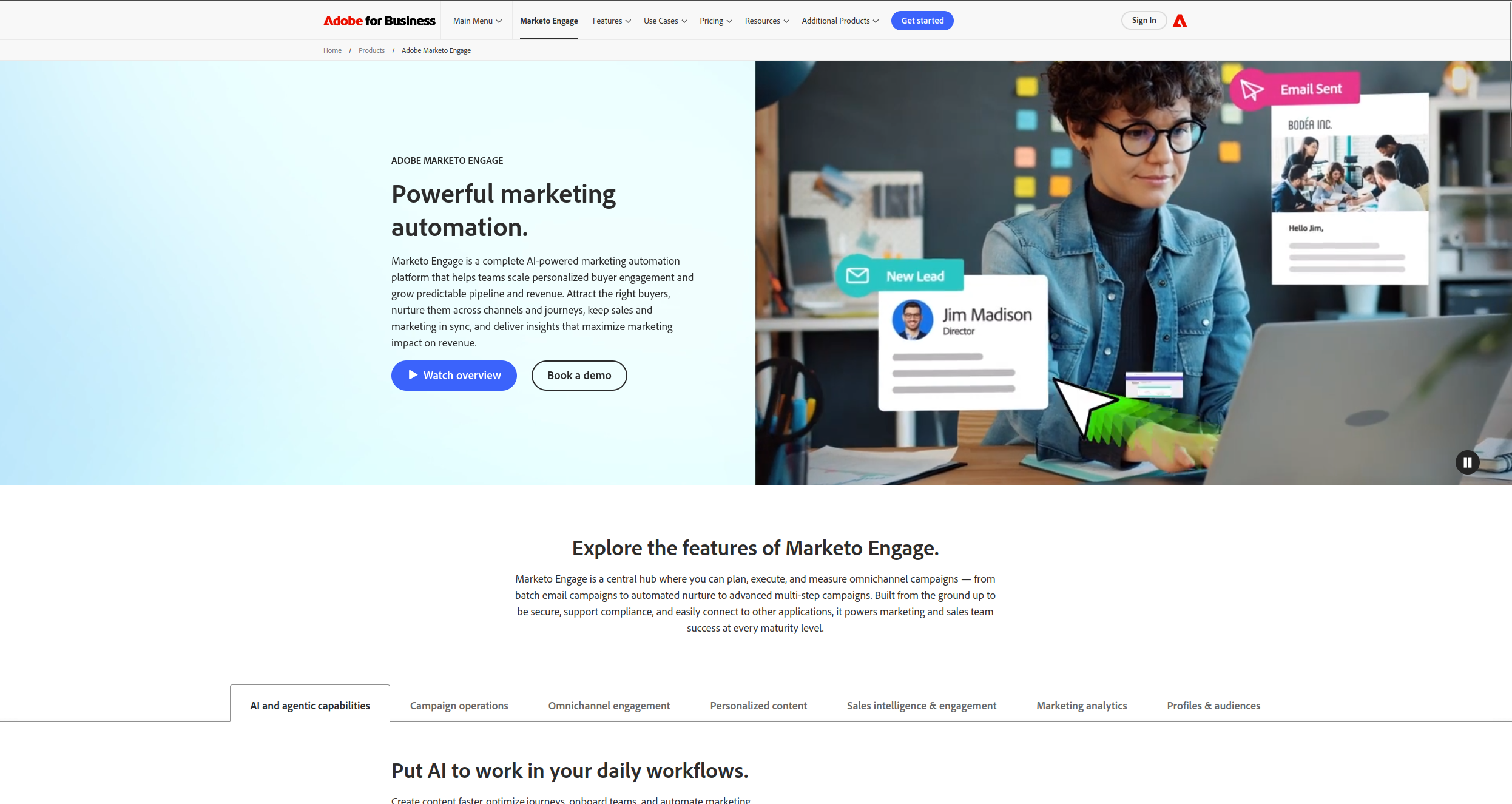
7. Marketo (Adobe Marketo Engage) — Best for Enterprise Marketing Automation
Marketo’s lead scoring is the gold standard for enterprise marketing automation teams. Its token-based scoring system supports sophisticated behavioral scoring (tracking dozens of engagement events across email, web, events, and webinar activity) and demographic scoring (matching lead attributes against ICP criteria). Marketo’s “lead lifecycle” model lets teams define exactly how scores translate into sales readiness stages — from raw lead to Marketing Qualified Lead to Sales Accepted Lead — with automated hand-off triggers at each threshold.
Marketo is particularly powerful for complex, long-cycle B2B deals where leads engage with content over months before converting. The scoring accumulates and contextualizes that full engagement history: attending a webinar earns 15 points, downloading a whitepaper earns 10 points, visiting the pricing page three times earns 30 points. Score decay rules automatically reduce scores for leads that disengage over time, keeping the priority queue from filling with stale high-scorers. Combined with Marketo’s advanced segmentation, high-scoring leads can automatically receive different content tracks, ad targeting, and sales follow-up cadences.
Pricing: Marketo Engage Growth at $895/month (database up to 10,000 contacts). Select at approximately $1,795/month. Prime at approximately $2,995/month. Enterprise at $3,175+/month for large databases and advanced features. All pricing is annual contract.
Pros: Most sophisticated behavioral scoring and tracking of any MAP, robust lead lifecycle stage management, enterprise-grade segmentation and scoring triggers, strong native Salesforce integration, proven at scale for large marketing operations Cons: Expensive entry point ($895/month minimum on annual contract), steep learning curve requiring dedicated Marketo admin, overkill in complexity and cost for teams under 5,000 contacts, slow implementation timeline
Best for: Enterprise marketing teams with complex multi-channel lead nurturing programs, large contact databases, dedicated marketing operations resources, and existing Salesforce integration.
8. Pardot (Marketing Cloud Account Engagement) — Best for Salesforce B2B Marketing
Pardot’s scoring and grading system is unique: it combines a behavioral score (based on engagement activity) with a grade (based on demographic and firmographic fit against your ideal profile). A lead can have a high score but a low grade (very engaged, but wrong company type) — helping reps quickly identify leads that are enthusiastic but not a good fit.
Pardot is tightly integrated with Salesforce CRM and is the natural choice for Salesforce-centric organizations that want their MAP and CRM in the same ecosystem.
Pros: Unique score + grade dual model, deep Salesforce native integration, good engagement tracking, Salesforce support Cons: Pardot-brand is being sunset into Marketing Cloud (transition complexity), higher cost than alternatives for SMB, less innovative than modern tools
Best for: Salesforce-centric enterprise organizations with existing Pardot/Marketing Cloud investments.
9. ActiveCampaign — Best for SMB Marketing Automation
ActiveCampaign offers the best lead scoring within its price range. Both contact scoring and deal scoring are available, with flexible rule-based scoring criteria (form submissions, email opens, page visits, custom field values, tags) and automated actions that trigger when scores cross defined thresholds (assign to rep, enroll in sequence, send a Slack notification, update a deal stage). Contact scoring can be set up in under an hour with no technical expertise — the visual interface guides you through defining scoring conditions and their point values.
ActiveCampaign’s scoring integrates natively with its email marketing, CRM, and automation platform in one affordable subscription — making it the top choice for SMBs that want scoring without enterprise software complexity or a separate MAP + CRM stack. Automations can increase or decrease scores based on any tracked activity, and multiple scoring categories (e.g., a “product fit” score separate from an “engagement” score) can be run simultaneously. The predictive sending feature, while not scoring itself, uses machine learning to send emails at the time each contact is most likely to open them.
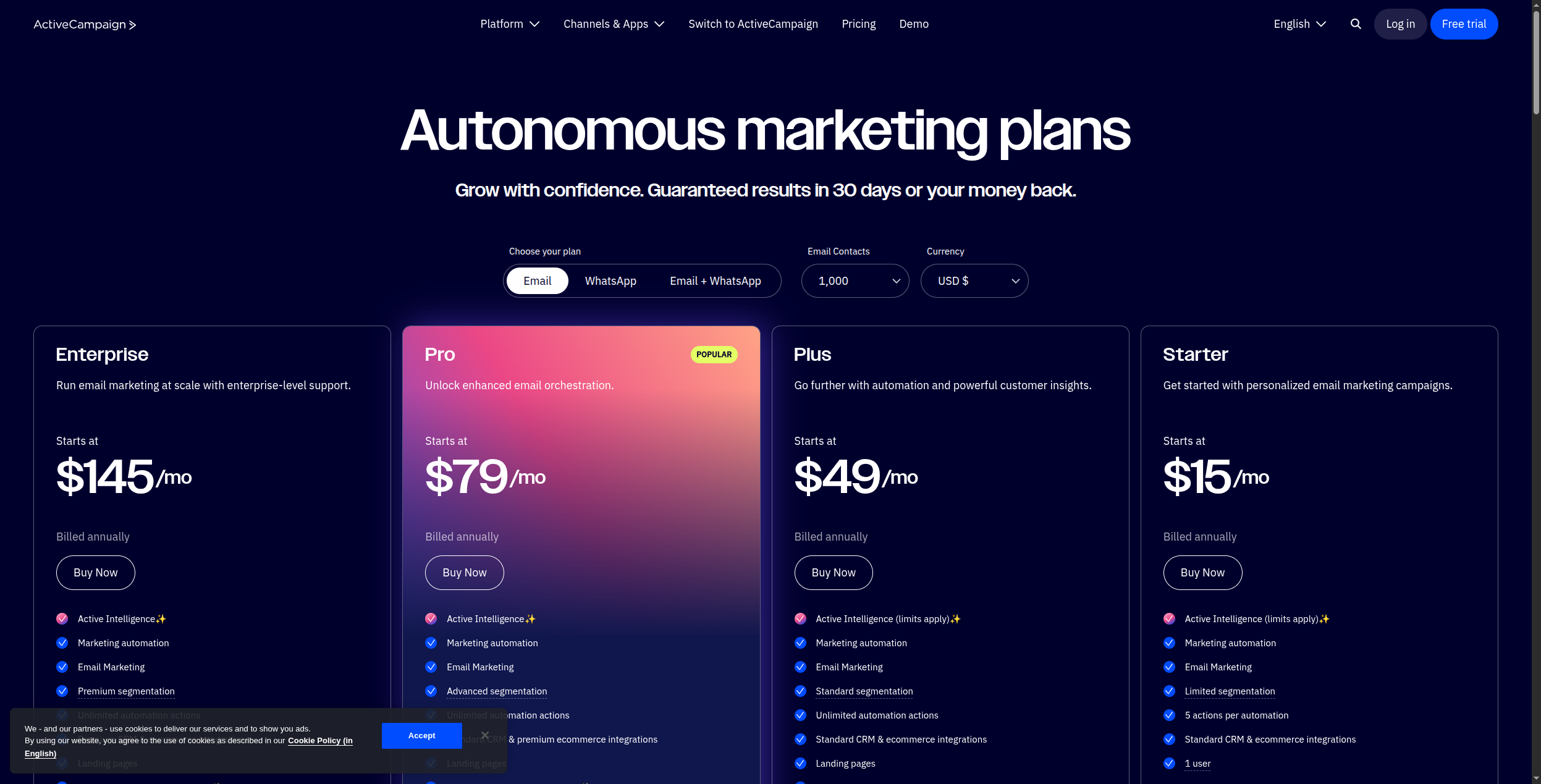
Pricing: Lite at $15/month (email only, no scoring). Plus at $49/month (contact scoring, CRM, basic automation). Professional at $79/month (advanced scoring, predictive sending, split automations). Enterprise custom (advanced reporting, SSO, dedicated support). All plans based on contact list size.
Pros: Affordable pricing starting at $49/month for scoring features, fully integrated with email marketing, CRM, and automation in one platform, flexible rule-based scoring easy to set up and modify, contact and deal scoring both available Cons: No predictive or ML-based scoring — entirely manual rule-based model, limited analytics specifically on scoring performance and model accuracy, scoring capability less sophisticated than Marketo or MadKudu for complex scenarios
Best for: SMBs and growing teams that need functional rule-based lead scoring integrated with their email marketing and CRM — without enterprise software complexity or cost.
10. Lusha — Best for Enrichment-Based Fit Scoring
Lusha is primarily a contact enrichment tool (see our Lead Enrichment Tools
guide), but its built-in scoring functionality deserves mention. Lusha automatically scores leads based on job title seniority, company size fit, and data completeness — providing a quick fit score at the point of prospecting rather than after leads enter the CRM. This prospecting-stage scoring is specifically useful for SDRs who need to quickly prioritize a large search result before manually reviewing each record.
Lusha’s ICP (Ideal Customer Profile) filter feature allows you to define your target criteria — company size range, industry, seniority level, geography — and Lusha will automatically score and sort prospected contacts by how closely they match. Contacts that best match your ICP criteria appear at the top of export lists, saving time in the manual qualification step before outreach begins. This is fit scoring at the data acquisition stage, not behavioral scoring after leads enter your marketing funnel.
Pricing: Free (5 phone credits, 50 email credits/month). Pro at $29/user/month (480 phone credits/year). Premium at $51/user/month (960 credits/year, ICP scoring, advanced filters). Scale custom for high-volume teams with bulk enrichment needs.
Pros: ICP-based fit scoring integrated directly into enrichment and prospecting workflow, no additional setup required beyond defining your ICP criteria, useful for quickly prioritizing large prospect lists before manual review, scoring updates dynamically as Lusha’s database is refreshed Cons: Fit-based only — no behavioral or engagement scoring capability, limited scoring customization beyond ICP criteria matching, designed for prospecting stage rather than full marketing funnel lifecycle scoring
Best for: SDRs and outbound sales teams that want basic ICP fit scoring at the prospecting stage, integrated with contact enrichment — to prioritize which leads to contact first before building a full CRM scoring model.
How to Choose the Right Lead Scoring Software
Choose FlowHunt if you want fully custom AI-powered scoring that goes beyond what any CRM or MAP can offer — or if you need to combine enrichment, scoring, and routing in a single automated workflow.
Choose HubSpot if you’re already on HubSpot and want native scoring without an additional vendor — especially if you’re on Professional or Enterprise where predictive scoring is available.
Choose MadKudu if you’re a PLG SaaS company that needs to combine firmographic scoring with product usage signals.
Choose 6sense if you’re running enterprise ABM programs and need account-level intent data and buying stage detection.
Choose Salesforce Einstein if you’re deeply invested in the Salesforce ecosystem and want predictive scoring without leaving the platform.
Choose Marketo or Pardot if you’re an enterprise marketing team that’s already on Adobe or Salesforce’s marketing cloud.
Choose ActiveCampaign if you’re an SMB that needs affordable, functional scoring integrated with email marketing and CRM.
Start with a simple model. Over-engineering your initial scoring framework is a common mistake — a 5-criteria rule-based model that your sales team actually understands and trusts will outperform a complex black-box model they don’t believe in. Add complexity as you validate what actually predicts conversion in your specific market.
Lead scoring is the process of assigning a numerical score to each lead based on how closely they match your ideal customer profile and how engaged they are with your brand. Higher scores indicate leads more likely to convert. Lead scoring matters because it helps sales teams prioritize their time — focusing on the 20% of leads that drive 80% of revenue rather than treating every lead equally. Teams with formal lead scoring consistently see higher conversion rates, shorter sales cycles, and better alignment between marketing and sales.
Rule-based lead scoring assigns points based on manually defined criteria: +10 points for job title 'VP', +20 points for company size over 500 employees, +15 points for visiting the pricing page. You define the rules and weights based on your assumptions. Predictive lead scoring uses machine learning to analyze your historical conversion data and identify the actual patterns that predict conversion — often finding signals that manual rules miss entirely. Predictive scoring typically outperforms rule-based by 20-30% in accuracy but requires sufficient historical data (usually 500+ closed deals) to train a reliable model.
Most predictive lead scoring tools recommend at least 500-1,000 historical leads with known outcomes (converted vs. not converted) to build a statistically reliable model. Tools like MadKudu and Salesforce Einstein will technically function with less data but will have low confidence scores and higher error rates. If you have fewer than 500 conversions in your CRM, rule-based scoring (HubSpot, ActiveCampaign, Marketo) is typically more reliable while you build history.
Start simple: (1) Define your ICP in writing — job titles, company sizes, industries, and geographies that convert best. (2) Identify your highest-intent behavioral signals — pricing page visits, demo requests, product trials. (3) Build a simple scoring model in your CRM: demographic fit (0-50 points) + behavioral engagement (0-50 points). (4) Set a threshold for MQL handoff to sales. (5) Run for 90 days, review which scored leads actually converted, and refine. Once you have sufficient data, graduate to predictive scoring.
Yes — AI improves lead scoring in three ways. First, machine learning identifies non-obvious conversion patterns in your historical data (e.g., companies that use a specific tech stack convert 3x better). Second, natural language processing can score qualitative signals — sales call transcripts, email sentiment, support ticket topics. Third, AI can combine real-time enrichment data with behavioral signals dynamically, without waiting for manual rule updates. Platforms like FlowHunt let you build scoring workflows that incorporate LLM reasoning for qualitative assessment alongside traditional numeric scoring.
Arshia is an AI Workflow Engineer at FlowHunt. With a background in computer science and a passion for AI, he specializes in creating efficient workflows that integrate AI tools into everyday tasks, enhancing productivity and creativity.
Arshia Kahani
AI Workflow Engineer
Score Leads Intelligently with AI — Try FlowHunt Free
FlowHunt lets you build custom AI-powered lead scoring workflows that combine behavioral signals, firmographic data, and LLM reasoning — then automatically route high-score leads to the right rep or sequence.
10 Best AI Lead Generation Tools in 2026 (Ranked and Reviewed)
The best AI lead generation tools in 2026, ranked by capability, ROI, and ease of use. From AI-powered prospecting to automated outreach — find the right tool f...
10 Best Sales Automation Tools in 2026: Ranked and Reviewed
The 10 best sales automation tools in 2026, ranked by outreach capability, AI personalisation, CRM integration, and pricing. Close more deals with less manual e...
10 Best Lead Enrichment Tools in 2026 (Ranked & Reviewed)
The 10 best lead enrichment tools in 2026 — ranked by data quality, coverage, API flexibility, and pricing. From Apollo and Clay to FlowHunt's AI enrichment wor...
14 min read
Lead Enrichment
Sales Tools
+2
Cookie Consent We use cookies to enhance your browsing experience and analyze our traffic. See our privacy policy.