10 Best Sales Automation Tools in 2026: Ranked and Reviewed
The 10 best sales automation tools in 2026, ranked by outreach capability, AI personalisation, CRM integration, and pricing. Close more deals with less manual effort.
Sales reps spend less than 30% of their time actually selling. The rest is consumed by prospecting research, writing emails, logging CRM notes, scheduling follow-ups, and generating reports. Sales automation tools exist to reclaim that time — and in 2026, AI has transformed what’s possible.
This guide ranks the 10 best sales automation tools based on AI capability, outreach automation depth, CRM integration quality, deliverability infrastructure, and pricing.
Two forces are converging in 2026: buyers are harder to reach (inbox saturation, LinkedIn connection limits, privacy regulations), and sales teams are expected to do more with fewer reps. The only sustainable path is automation — specifically AI automation that can research individual prospects, write personalised messages based on real signals, and execute multi-touch sequences across channels without rep intervention.
The best sales automation tools in 2026 don’t just schedule emails — they decide who to email, what to say, when to send it, and how to follow up based on engagement signals. For context on where sales automation fits in a broader GTM stack, see our solutions for sales
page.
Ready to grow your business?
Start your free trial today and see results within days.
1. FlowHunt — Best AI-Native Sales Automation Platform
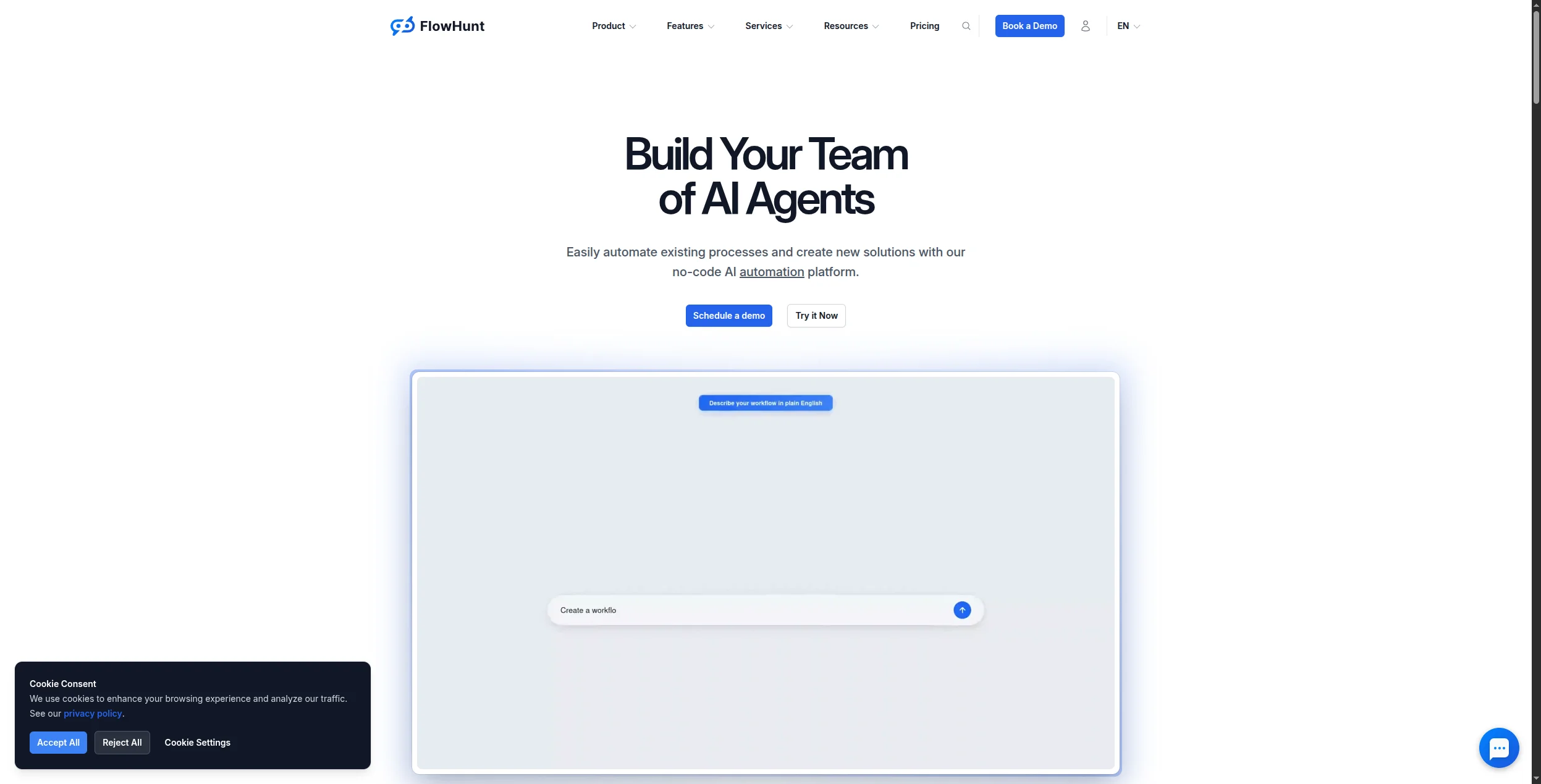
FlowHunt is the most capable AI-driven sales automation platform available in 2026. Where tools like Apollo and Instantly automate the sending of pre-written sequences, FlowHunt automates the entire research-to-outreach pipeline: finding prospects, researching their company, identifying personalisation signals, writing unique emails per prospect, and sending them through your preferred email tool — automatically.
A typical FlowHunt sales workflow: scrape target company websites → identify key decision-maker signals (recent funding, new hire, product launch) → enrich with LinkedIn and public data → write a personalised first-line email referencing a specific trigger → route to outreach tool → log contact and notes to CRM → trigger follow-up sequence if no response in 3 days. All automated. All personalised per prospect.
What sets FlowHunt apart:
Full pipeline automation — from prospecting research to outreach to CRM update
Signal-based personalisation — AI reads company news, job postings, and LinkedIn before writing
1,400+ integrations — works with HubSpot, Salesforce, Apollo, Instantly, and any CRM or sequencing tool
Multi-agent orchestration — research agent, writing agent, and CRM update agent working in sequence
Custom workflow logic — build any combination of steps, triggers, and conditions
Pricing:
Free — $0/month. Generous execution credits, access to all components and integrations, no credit card required
Pro — Usage-based. Scales with workflow executions and AI API calls — no per-seat or per-contact charges
Visual workflow builder combining prospect research, AI writing, and outreach automation in one canvas
Signal detection: AI reads company news, funding announcements, job postings, and LinkedIn before composing
Multi-agent orchestration: research agent, personalisation agent, and CRM update agent in sequence
1,400+ integrations: works with Apollo, Instantly, HubSpot, Salesforce, and any CRM or sequencing tool
Custom workflow logic: build any combination of research steps, triggers, conditions, and outreach actions
Web scraping: reads target company websites, LinkedIn profiles, and public data sources automatically
CRM enrichment: automatically logs contact research, personalisation notes, and outreach activity to CRM
Pros:
Writes genuinely personalised emails at scale — not template-merged, uniquely AI-composed per prospect
Replaces multiple point tools (research + writing + enrichment + CRM logging) in one platform
Integrates with your existing outreach stack rather than replacing it — add research and personalisation to Apollo or Instantly
Signal-based personalisation reads company news and job postings before writing — not generic personalisation tokens
1,400+ integrations mean every CRM, sequencing tool, and data source in your stack is connectable
Cons:
Requires workflow setup — more configuration upfront than a plug-and-play sequencer
For raw sending infrastructure at massive volume, pair with Instantly or Apollo for deliverability
Not a standalone prospecting database — needs Apollo or Sales Navigator for initial contact sourcing
Best for: Sales ops teams, outbound managers, and founders who want AI to handle the full research and personalisation layer of their outbound process. See the best Zapier alternatives guide
for how FlowHunt compares to other automation platforms for sales workflows.
2. HubSpot Sales Hub — Best All-in-One CRM and Sales Automation
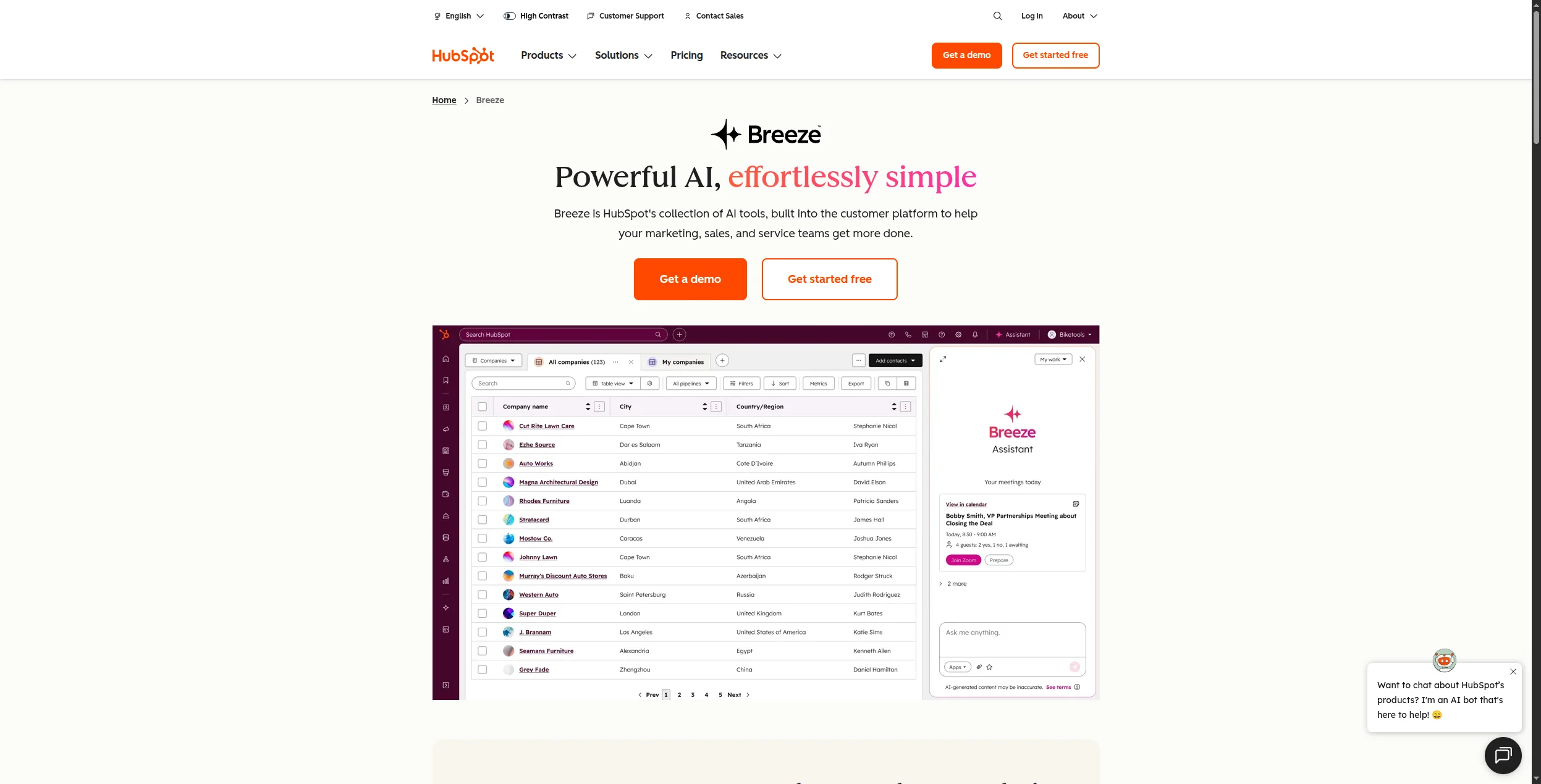
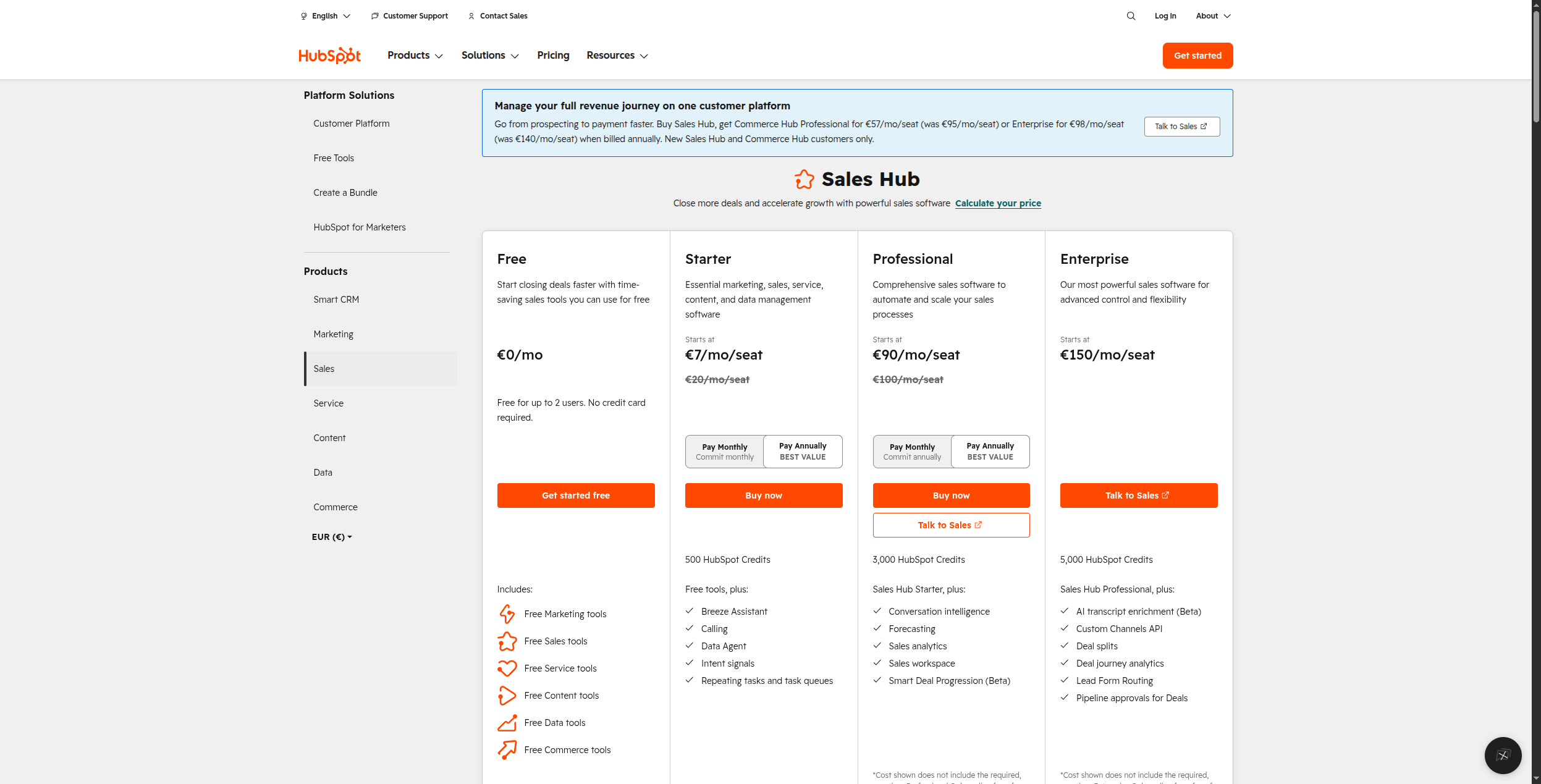
HubSpot Sales Hub is the most complete all-in-one sales platform — combining CRM, email sequences, deal pipeline management, meeting scheduling, call tracking, and AI writing assistance in a single suite. The CRM is free; meaningful automation starts at Sales Hub Professional ($90/user/mo). The key advantage is integration: every email sent, call logged, and meeting booked is automatically recorded against the contact and deal record, eliminating the manual CRM hygiene burden that burns out sales reps.
The Sequences feature sends automated, personalised email cadences on behalf of the rep — they appear to come from the rep’s own Gmail or Outlook account, not a marketing platform. Deal pipelines are fully customisable, and automation rules can move deals between stages, assign tasks, and trigger follow-up emails based on deal changes. Sales Hub Professional adds AI-generated email writing (Breeze AI), predictive lead scoring, and call intelligence with automatic transcription and coaching suggestions.
Pricing:
Free — $0/month. Unlimited contacts and deals, basic email and call logging, meeting scheduler, live chat, 1-to-1 email templates
Professional — $90/user/month (billed annually). Full sequences, playbooks, call transcription, predictive lead scoring, custom reporting, Breeze AI email writing
Sequences: automated email cadences sent from rep’s own inbox — not a marketing tool
Meetings: personalised scheduling links with round-robin assignment and buffer time
Playbooks: guided selling scripts and call frameworks accessible in-context during calls
Call transcription and intelligence: automatic recording, AI summary, and coaching highlights
Predictive lead scoring: AI model scores contacts based on demographic and behavioural fit
Breeze AI: generates email drafts, suggests follow-up language, and personalises based on CRM context
Deal pipeline automation: trigger tasks, notifications, and emails based on stage changes
Prospecting workspace: dedicated view surfacing highest-priority contacts and overdue tasks
Pros:
Best all-in-one platform — combines CRM, sequences, calling, and scheduling in one tool
Free CRM is genuinely powerful for early-stage teams starting without budget
Sequences, meeting scheduling, and deal management in a single unified UI
Strong reporting and pipeline visibility — managers get real-time deal health overview
Breeze AI writes email drafts from CRM context — reduces rep time on manual writing
Cons:
Expensive at scale — costs escalate sharply with user count at the Professional and Enterprise tiers
Sequences feature is less powerful than dedicated outreach tools like Outreach for enterprise complexity
AI personalisation lags behind Amplemarket and FlowHunt for signal-based, individual-level customisation
Free plan’s sequences limit (5 enrolled/day) is too restrictive for active outbound teams
Best for: Growing sales teams that want CRM + automation in one platform and are willing to pay for the consolidation benefit — particularly those already using HubSpot Marketing Hub.
Join our newsletter
Get latest tips, trends, and deals for free.
3. Apollo.io — Best Prospecting Database + Outreach Platform
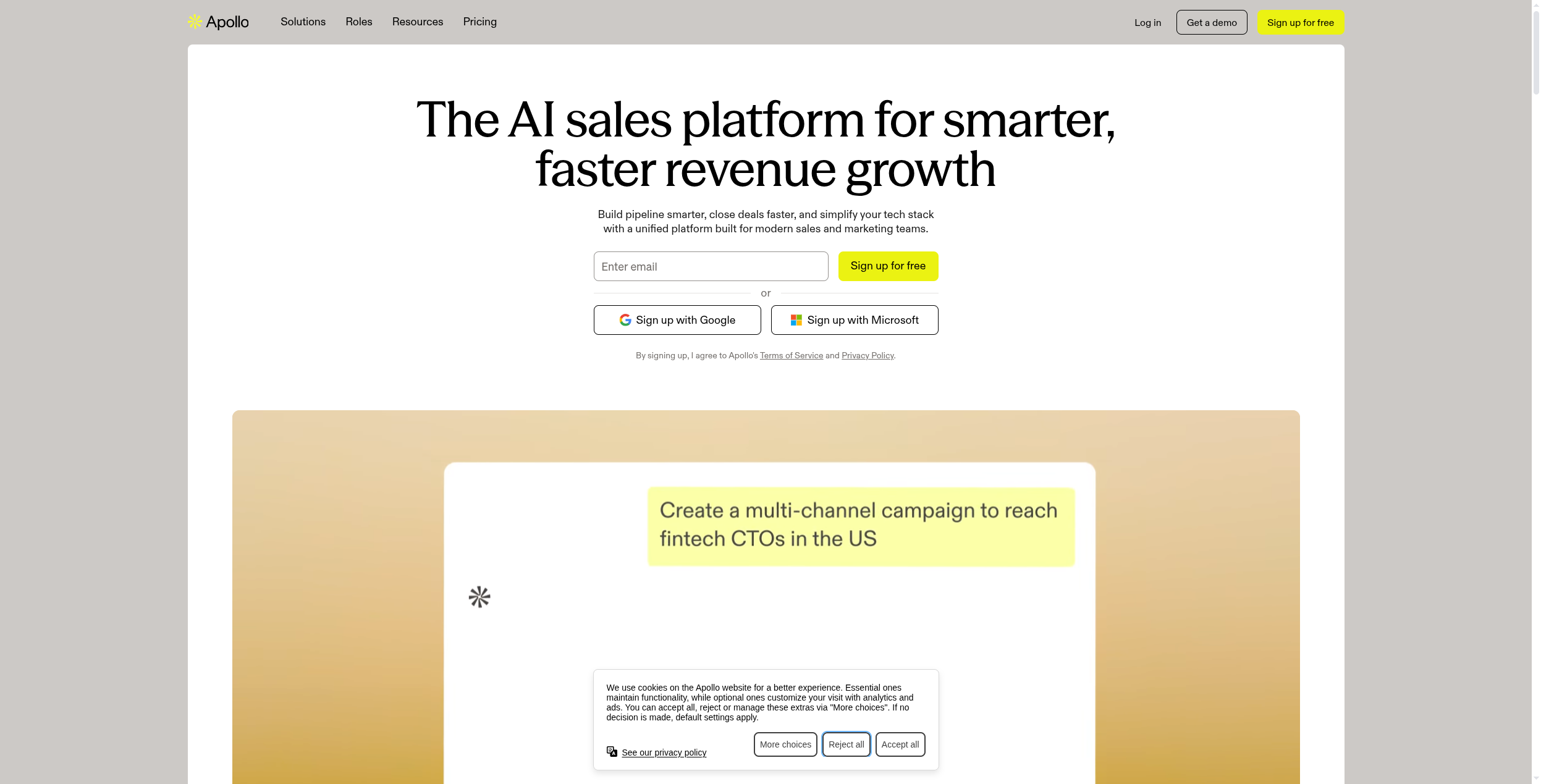
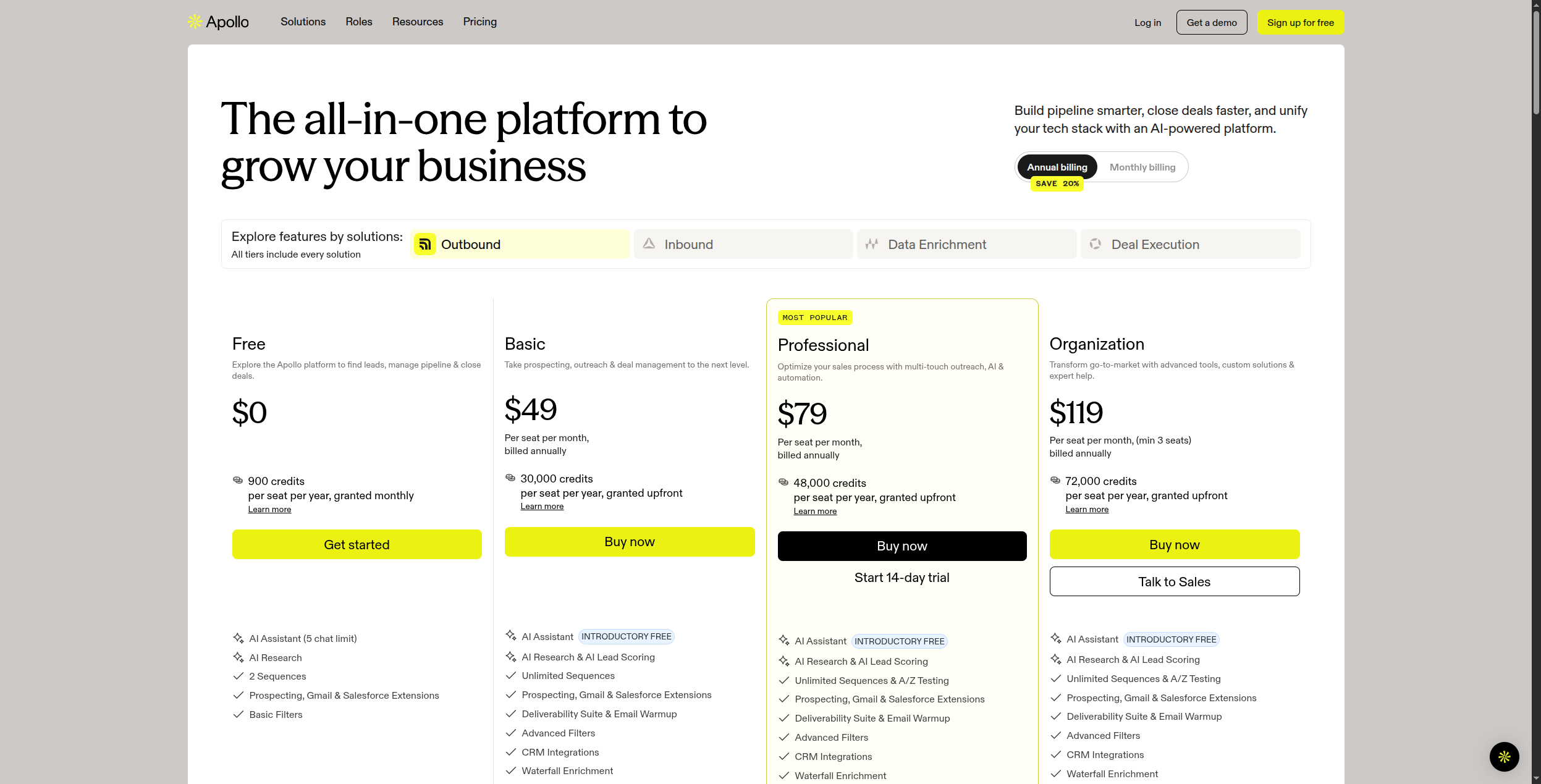
Apollo combines a 265M+ contact database with built-in email sequencing, LinkedIn automation, a dialer, and AI email writing — making it the most complete end-to-end prospecting and outreach platform at its price point. The free tier (50 email exports/month) is genuinely useful for evaluating the database quality before committing. Apollo’s data is sourced from a combination of first-party user contributions, public web crawling, and third-party data partnerships — delivering strong coverage for enterprise and mid-market contacts in the US and Europe.
What makes Apollo valuable beyond the database is the breadth of its sequences: multi-step automations combining email, LinkedIn connection requests, LinkedIn messages, phone tasks, and manual steps in a single cadence. The AI email writer (Apollo AI) can generate a personalised first email using prospect’s LinkedIn, job title, company news, and intent signals with one click. The intent data layer — tracking which companies are actively researching topics relevant to your product — helps prioritise outreach to accounts most likely to be in-market.
Basic — $49/user/month (billed annually). Unlimited email credits, 1,000 mobile credits/year, full sequence builder, email health monitoring, AI email writer
Professional — $79/user/month (billed annually). Intent data (50 topics), advanced filters, A/B testing, custom stages, email analytics
AI personalisation quality doesn’t match FlowHunt’s signal-based research depth
Mobile phone data accuracy is lower than email — often needs verification before calling
Best for: SDRs and sales teams that need a contact database and multi-step outreach tool in one platform at an affordable price.
4. Outreach — Best Enterprise Sales Execution Platform
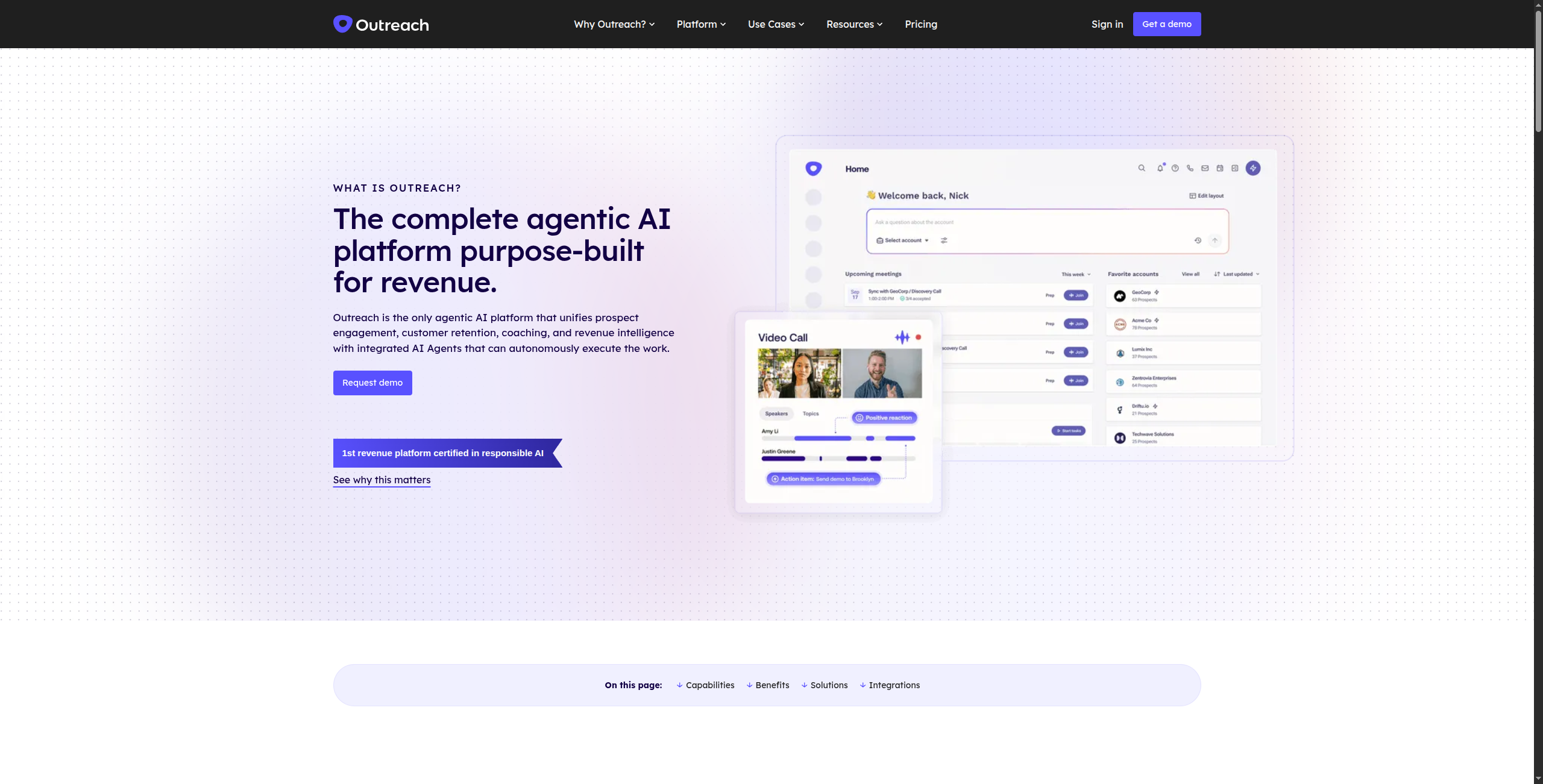
Outreach is the market leader for enterprise sales teams that need deep pipeline management alongside sequence automation. Its deal health scoring, pipeline risk alerts, and AI call coaching features go well beyond what SMB tools offer. The platform is built around the concept of a “sales execution platform” — bringing together prospecting, sequencing, pipeline management, forecasting, and rep coaching into a unified system that sales ops and RevOps teams can manage at scale.
Kaia (Outreach’s AI) provides real-time call coaching: during a live sales call, it surfaces relevant battlecards, objection handling scripts, and next-step recommendations on screen as the conversation unfolds. Post-call, it generates automatic summaries, extracts action items, and updates Salesforce opportunities. The pipeline module tracks deal health based on engagement signals — email open rates, meeting frequency, response time — and surfaces at-risk deals for manager intervention before they fall through.
Heavier UX than newer, leaner tools like Apollo or Instantly — steeper onboarding curve
Real-time coaching and forecasting features require higher-tier plans at additional cost
Best for: Enterprise sales teams with dedicated sales ops and RevOps functions that need pipeline execution, rep coaching, and AI-powered forecasting at scale.
5. Salesloft — Best Revenue Orchestration Platform
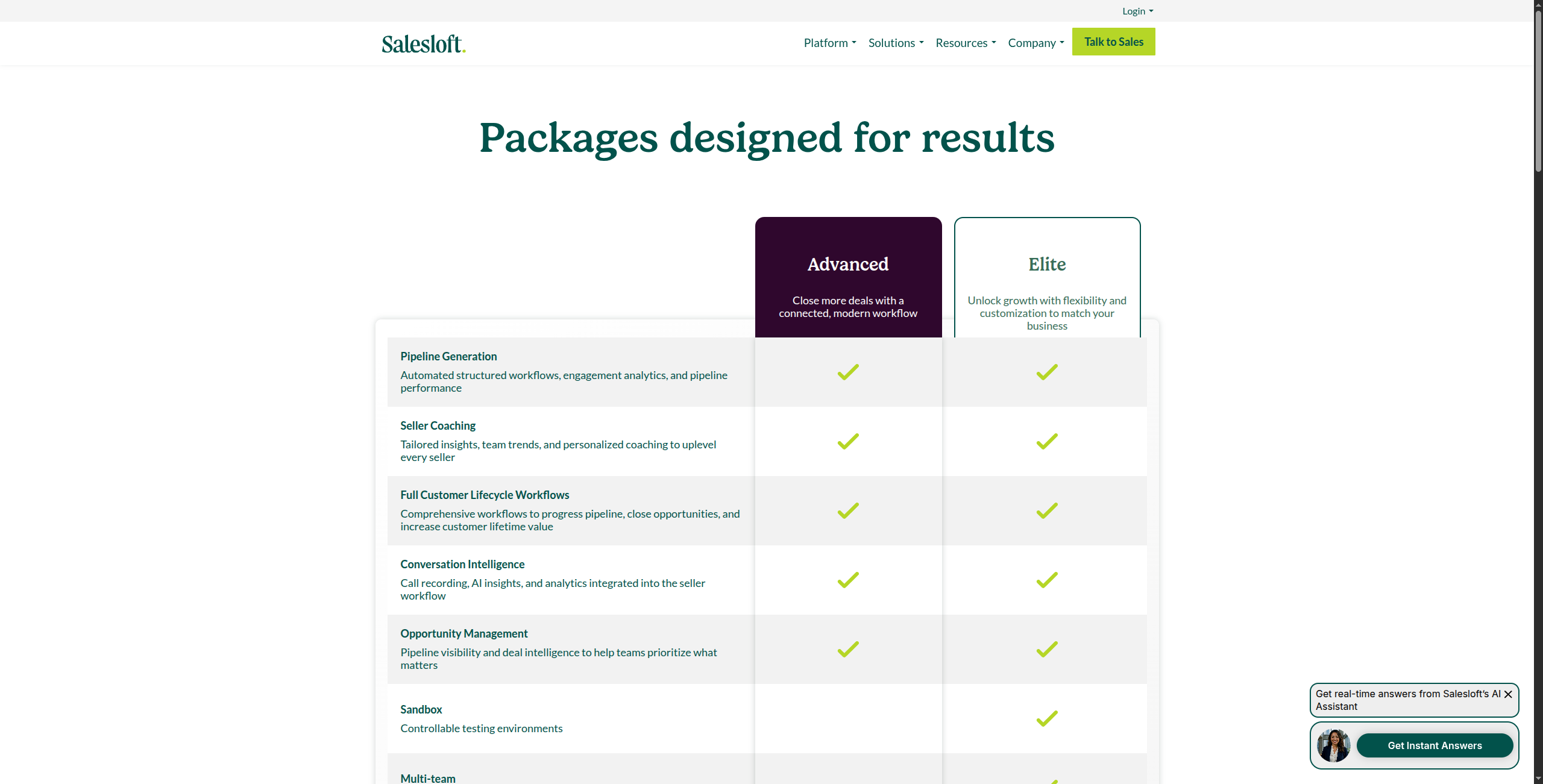
Salesloft competes directly with Outreach at the enterprise tier and in many accounts beats it on conversation intelligence depth and AI-guided selling. Its Cadences (sequences), Dialer, Conversations (call intelligence), and Deals (opportunity management) modules cover the full revenue team workflow — from first outbound touch to closed-won — in a single platform. The Conductor AI layer orchestrates when and how reps engage each prospect based on intent signals, engagement history, and deal stage context.
What differentiates Salesloft from Outreach is the depth of its Conversations module: automatic call transcription, sentiment analysis, talk/listen ratio tracking, keyword spotting, and AI-generated coaching recommendations for each recorded call. Managers can leave timestamped comments on call recordings, and Salesloft automatically surfaces calls that match specific coaching criteria (competitor mentioned, pricing discussed, specific objection raised) without a manager needing to review every call.
Coaching workflows: managers review calls, leave comments, and assign follow-up training in-platform
Salesforce and HubSpot bi-directional sync with field mapping and activity attribution
Pros:
Strong conversation intelligence — automatic transcription, sentiment analysis, and keyword tracking across all calls
Conductor AI for intent-based next-best-action recommendations that guide rep priority daily
Solid LinkedIn and multi-channel sequence support including SMS and direct mail steps
Good API for custom enterprise integrations and data warehouse connectivity
Coaching workflows make manager oversight and rep development systematic
Cons:
Enterprise pricing comparable to Outreach — not accessible for small sales teams
Deals module is less mature than dedicated CRM platforms like Salesforce or HubSpot
UI is feature-dense — steeper learning curve for new reps joining from simpler tools
Best features (Conversations, Conductor AI) are on higher-cost tiers
Best for: Enterprise revenue teams that want conversation intelligence and AI-guided selling alongside cadence automation — particularly those investing in systematic rep coaching.
6. Instantly — Best for High-Volume Cold Email
Instantly is purpose-built for high-volume cold email outreach. Its unlimited sending accounts model — you connect as many Google Workspace or Microsoft 365 accounts as you want on any plan — is unique in the market and enables the high daily sending volumes required for aggressive outbound campaigns. The platform automatically warm-up new email accounts through a network of real accounts, raising sender reputation before live campaign sending begins.
Beyond deliverability infrastructure, Instantly includes a B2B lead database (Instantly Leads) with 160M+ contacts for built-in prospecting alongside outreach. The AI email writer generates personalised cold email drafts using prospect data, and the campaign analytics dashboard tracks open rates, reply rates, and conversion by campaign with A/Z testing (up to 26 email variants per campaign) for optimising subject lines and opening lines at scale.
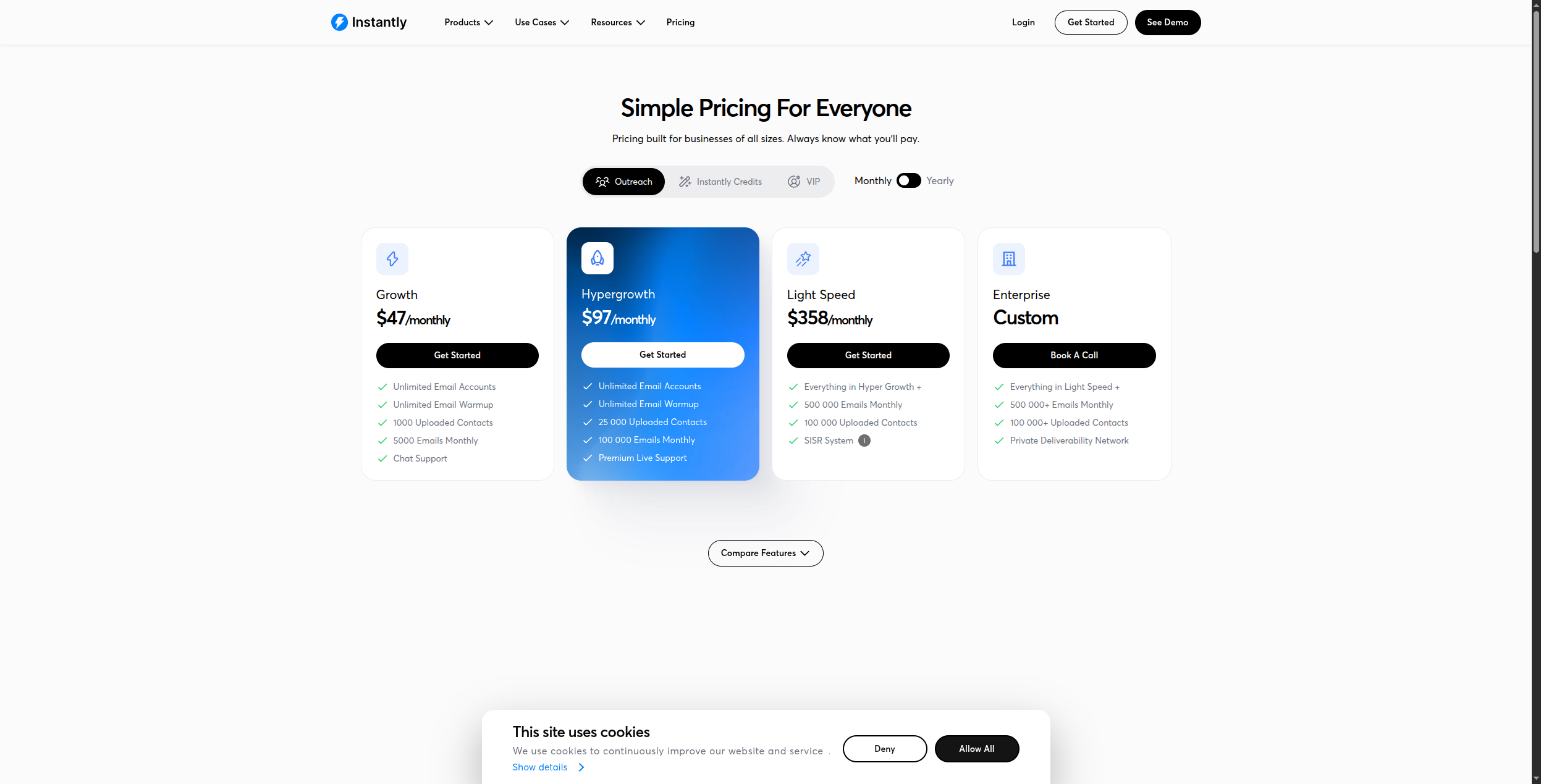
Hypergrowth — $97/month (billed annually). 25,000 active leads, 100,000 emails/month, A/Z testing, advanced analytics, premium support
Light Speed — $358/month (billed annually). 500,000 emails/month, 100,000 active leads, premium deliverability features, priority support
Instantly Leads — Separate pricing. B2B contact database access: $47/month for 1,000 verified exports, scaling up to enterprise plans
Key features:
Unlimited email account connections — connect Gmail, Google Workspace, and Microsoft 365 accounts freely
Automated email warm-up: gradually builds sender reputation through a shared warm-up network
A/Z testing: test up to 26 email variants simultaneously for subject lines and email body copy
AI email writer: generates personalised cold email drafts from prospect company and role data
Instantly Leads: built-in B2B database with 160M+ contacts for prospecting alongside outreach
Smart email rotation: automatically distributes sends across multiple accounts to optimise deliverability
Unibox: unified inbox aggregating replies from all connected email accounts in one view
Campaign analytics: real-time tracking of open rates, reply rates, bounce rates, and conversions per campaign
Pros:
Unlimited email accounts on all plans — unmatched flexibility for high-volume outreach scaling
Industry-leading deliverability infrastructure with automated email warm-up built in
Instantly Leads database for prospecting without a separate Apollo or ZoomInfo subscription
A/Z testing (up to 26 variants) enables aggressive optimisation of messaging at scale
Unibox aggregates all replies across accounts — no switching between inboxes manually
Cons:
Focused on email only — no LinkedIn automation or multi-channel sequence support
CRM is basic — needs integration with HubSpot, Salesforce, or Close for full pipeline management
AI personalisation is lighter than FlowHunt’s research-based approach or Amplemarket’s signal layer
Active lead limits on lower plans restrict simultaneous campaign volume
Best for: Agencies, SDR teams, and founders running high-volume cold email campaigns who prioritise deliverability infrastructure and need unlimited sending accounts.
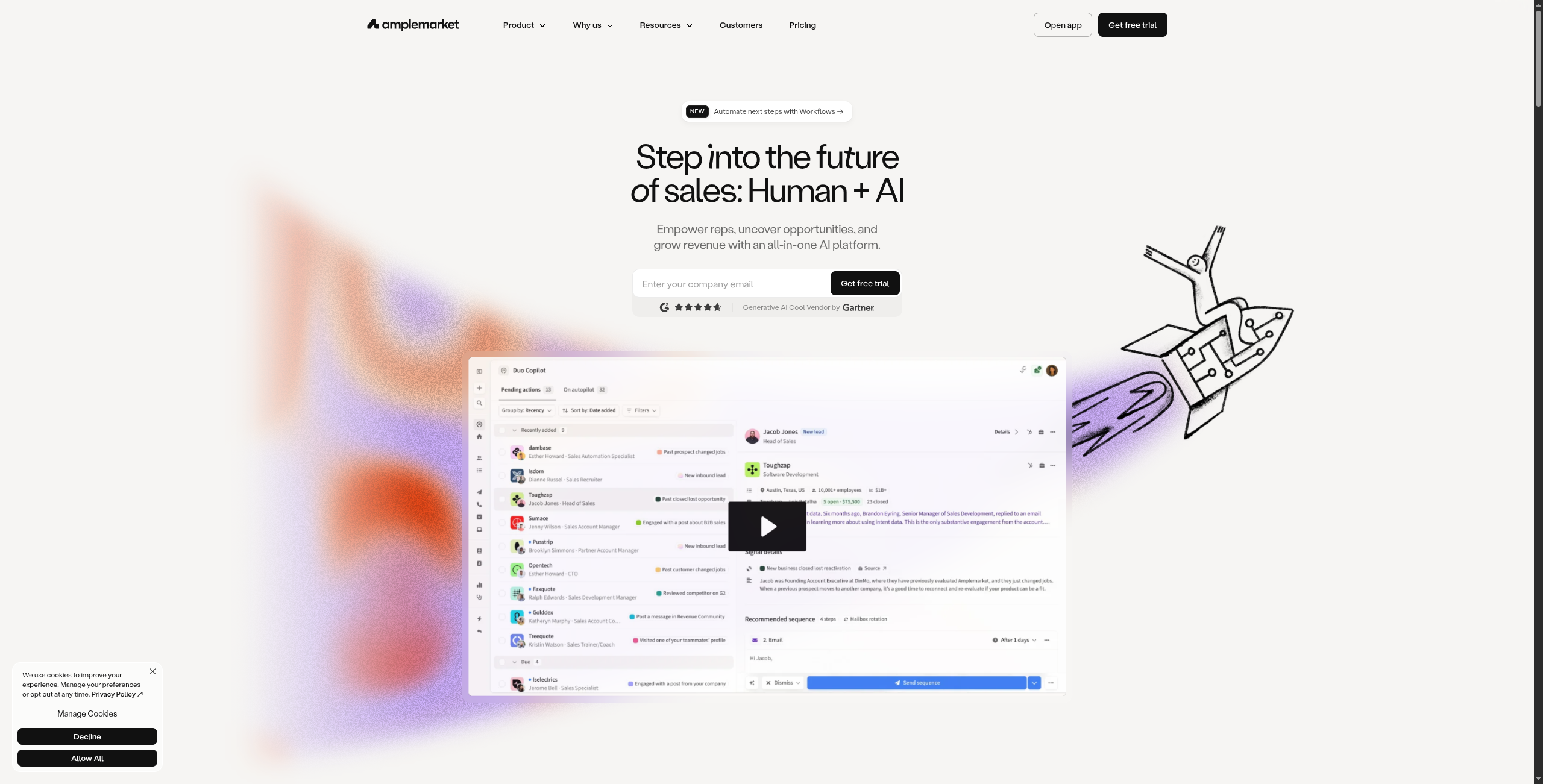
7. Amplemarket — Best AI-Powered Intent Outreach
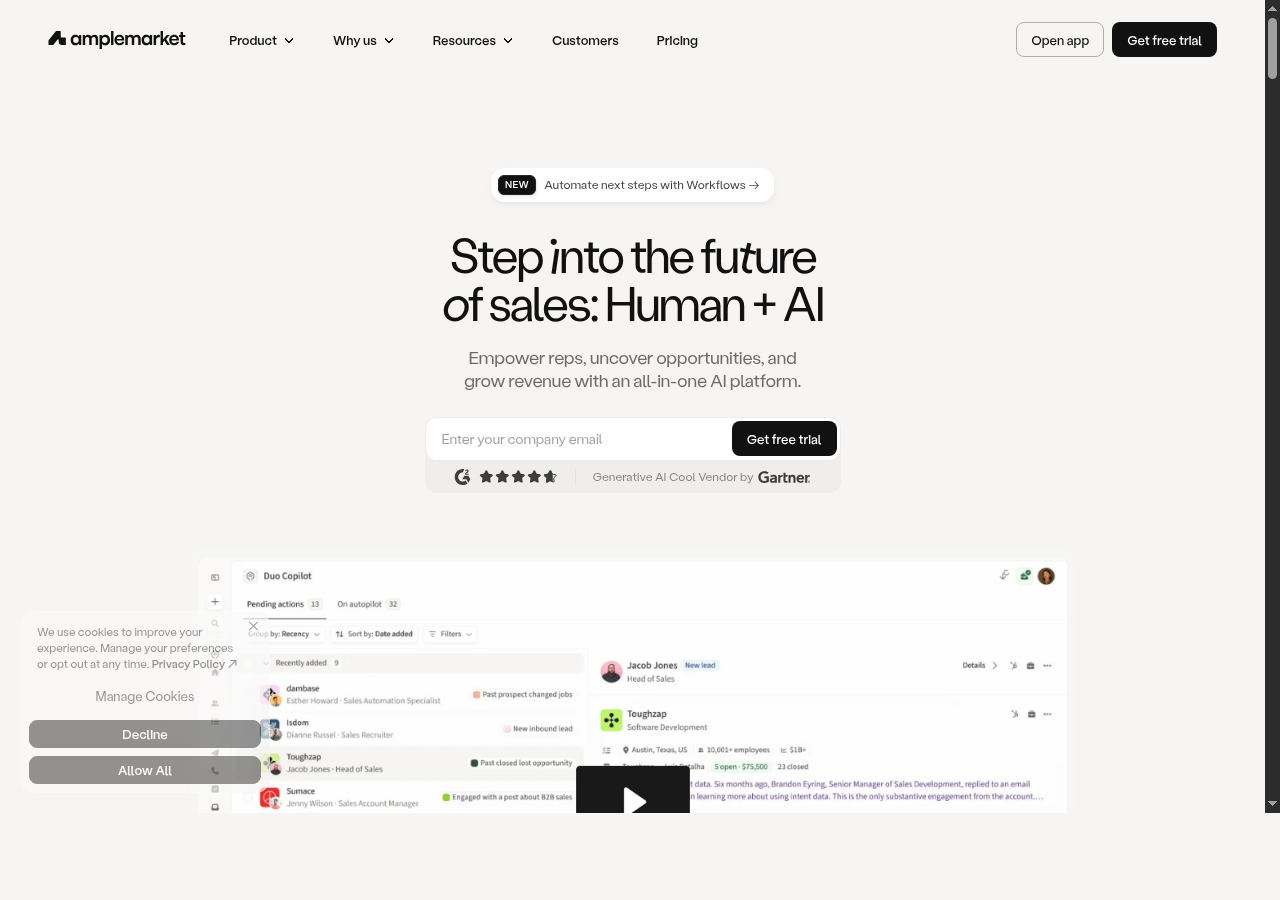
Amplemarket is the most sophisticated AI-driven outreach tool in the enterprise tier. Its intent signal layer monitors prospect companies for buying signals — job postings indicating tool category investment, funding rounds creating expansion budgets, tech stack changes revealing competitive displacement opportunities, and leadership changes bringing new decision-maker relationships — and triggers personalised outreach automatically when the timing is right. This is signal-based selling at a level that manually-managed sequences can’t replicate.
The platform’s AI personalisation goes beyond template merging: for each prospect, it synthesises LinkedIn activity, recent company news, job postings, and intent signals to write a genuinely unique opening line that references a specific, timely trigger. The result is response rates that meaningfully outperform standard templated outreach. Amplemarket also includes a multi-channel sequence builder covering email, LinkedIn, and phone, alongside an email warm-up infrastructure for deliverability management.
Note: All Amplemarket plans are custom-quoted — contact sales for pricing based on team size and usage
Key features:
Intent signal monitoring: tracks 20+ buying signal types across funding, hiring, tech stack, and leadership data
AI Duo: autonomous AI system that identifies signals, selects prospects, and personalises outreach automatically
Multi-channel sequences: email, LinkedIn messages and connection requests, and phone steps in one cadence
Data waterfall enrichment: finds verified contact data across 30+ providers in sequence for maximum coverage
Email warm-up infrastructure: domain health monitoring and automated warm-up for deliverability management
Smart reply categorisation: AI classifies inbound replies (interested, not now, referral, out of office) automatically
CRM sync: bi-directional integration with Salesforce, HubSpot, and Outreach
Pros:
Best-in-class intent signal monitoring for timing outreach to prospects at the right buying moment
AI personalisation based on real company signals — not templates, genuinely unique per prospect
LinkedIn + email + phone multi-channel sequences from a single platform
Deliverability tools including email warm-up and domain health monitoring built in
Smart reply categorisation saves hours of manual inbox triage for active outbound teams
Cons:
Enterprise pricing with custom quotes only — not accessible for small or early-stage teams
Requires significant signal source configuration and onboarding for best intent results
Overkill for teams running simple templated outbound campaigns at low volume
Contact database coverage is strong for enterprise but weaker for SMB and non-US markets
Best for: Enterprise sales teams running signal-triggered, highly personalised outbound at scale — where the ROI of better timing and personalisation justifies the premium pricing.
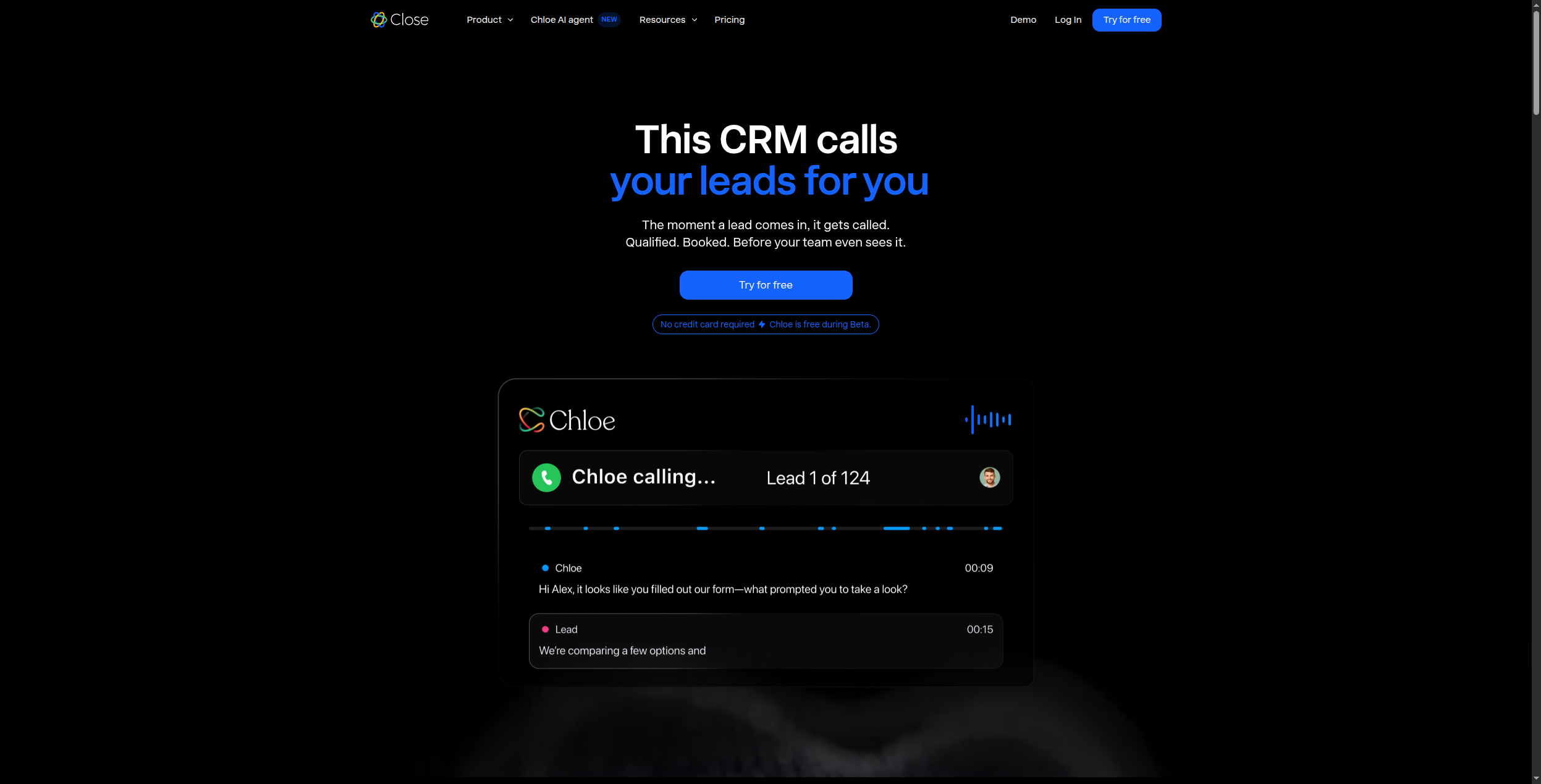
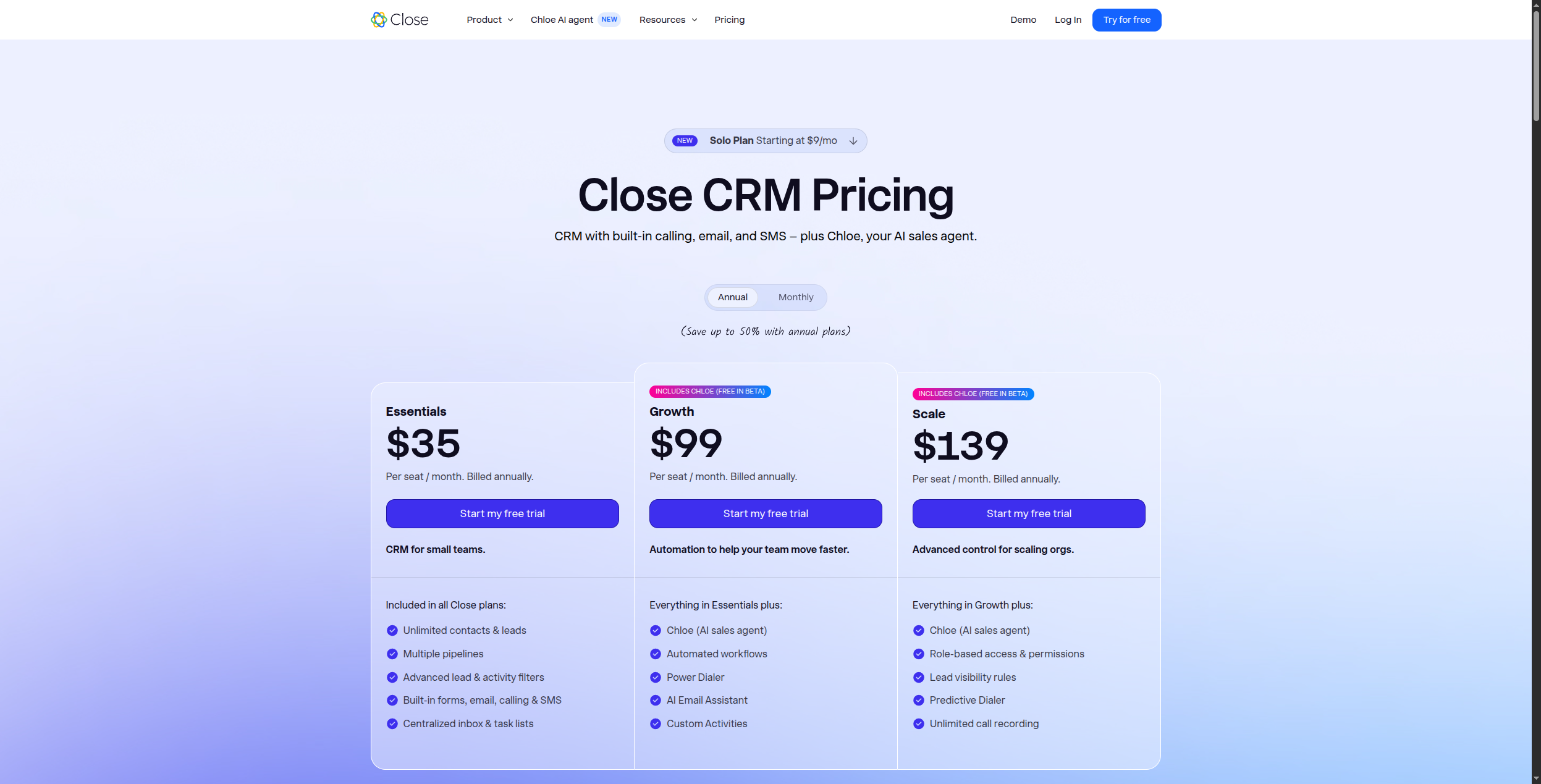
8. Close — Best CRM for High-Velocity Inside Sales
Close is the CRM built specifically for inside sales teams that live on the phone and email. Unlike HubSpot or Salesforce, where calling is an add-on that requires separate configuration, Close has built-in calling, SMS, and email that work natively within the deal pipeline — no third-party integrations needed. The design philosophy is speed: every action (log a call, send an email, move a deal) takes fewer clicks than in traditional CRMs built for admin completeness rather than rep productivity.
The Power Dialer automatically queues calls from a Smart View list and dials the next number the moment a call ends, with zero manual intervention between dials. Smart Views are saved searches that intelligently surface the highest-priority contacts based on criteria you define (last contact date, lead score, deal stage, sequence status) — replacing the “which lead should I call next?” decision that wastes rep time every morning. Sequences automate follow-up emails and SMS messages from within the CRM, sent from the rep’s own email address.
Power Dialer maximises calls-per-hour without sacrificing call quality or CRM data capture
Cons:
Less comprehensive marketing automation than HubSpot — not designed for nurture campaigns
Database/prospecting capabilities require external tools like Apollo — no built-in contact data
Less suitable for enterprise deal complexity with long procurement cycles and multiple stakeholders
Calling minutes are US and Canada only — international calling incurs per-minute charges
Best for: Inside sales teams at SaaS companies that rely heavily on phone outreach and want CRM + calling + sequences in one tool with no configuration overhead.
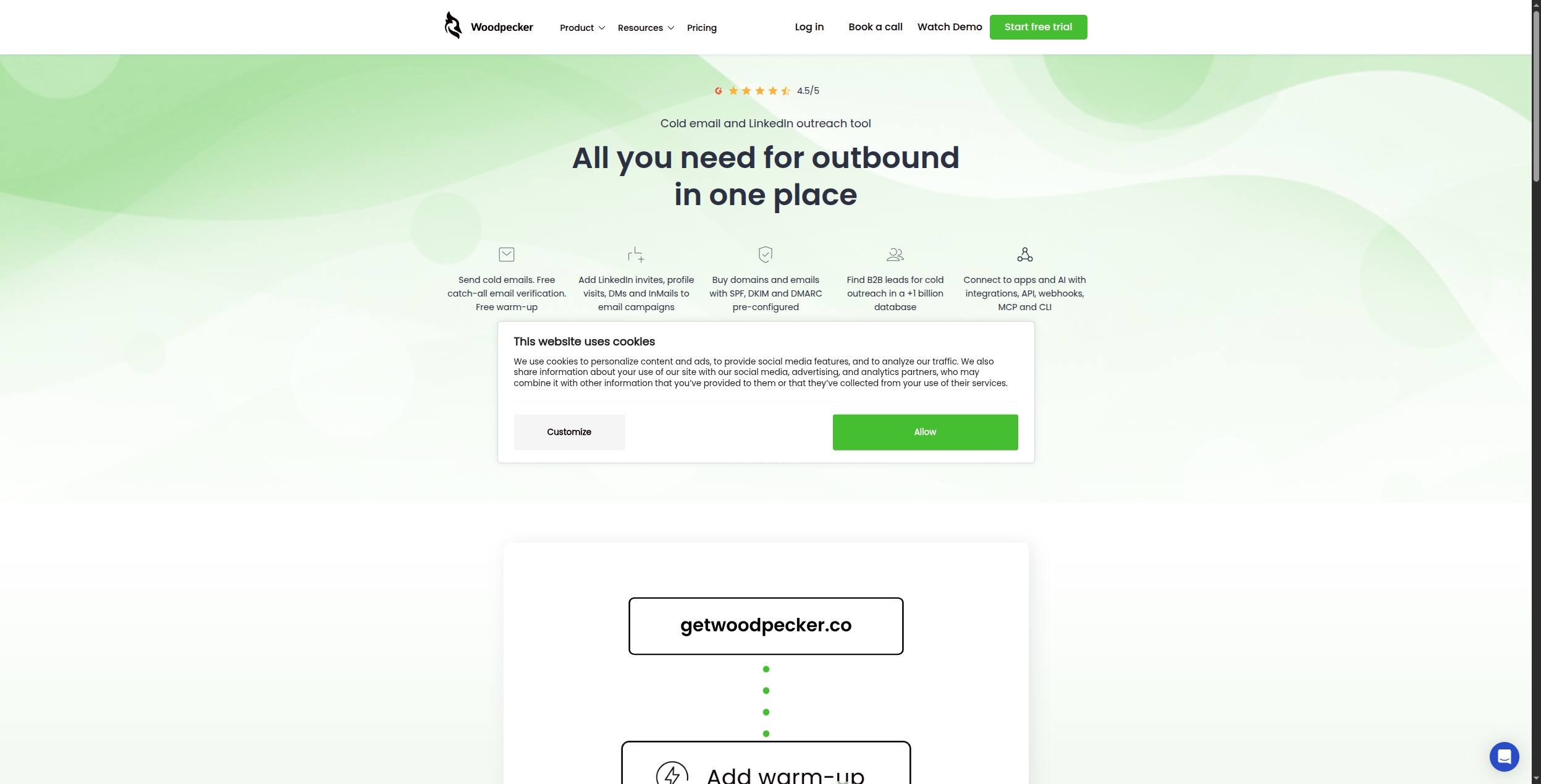
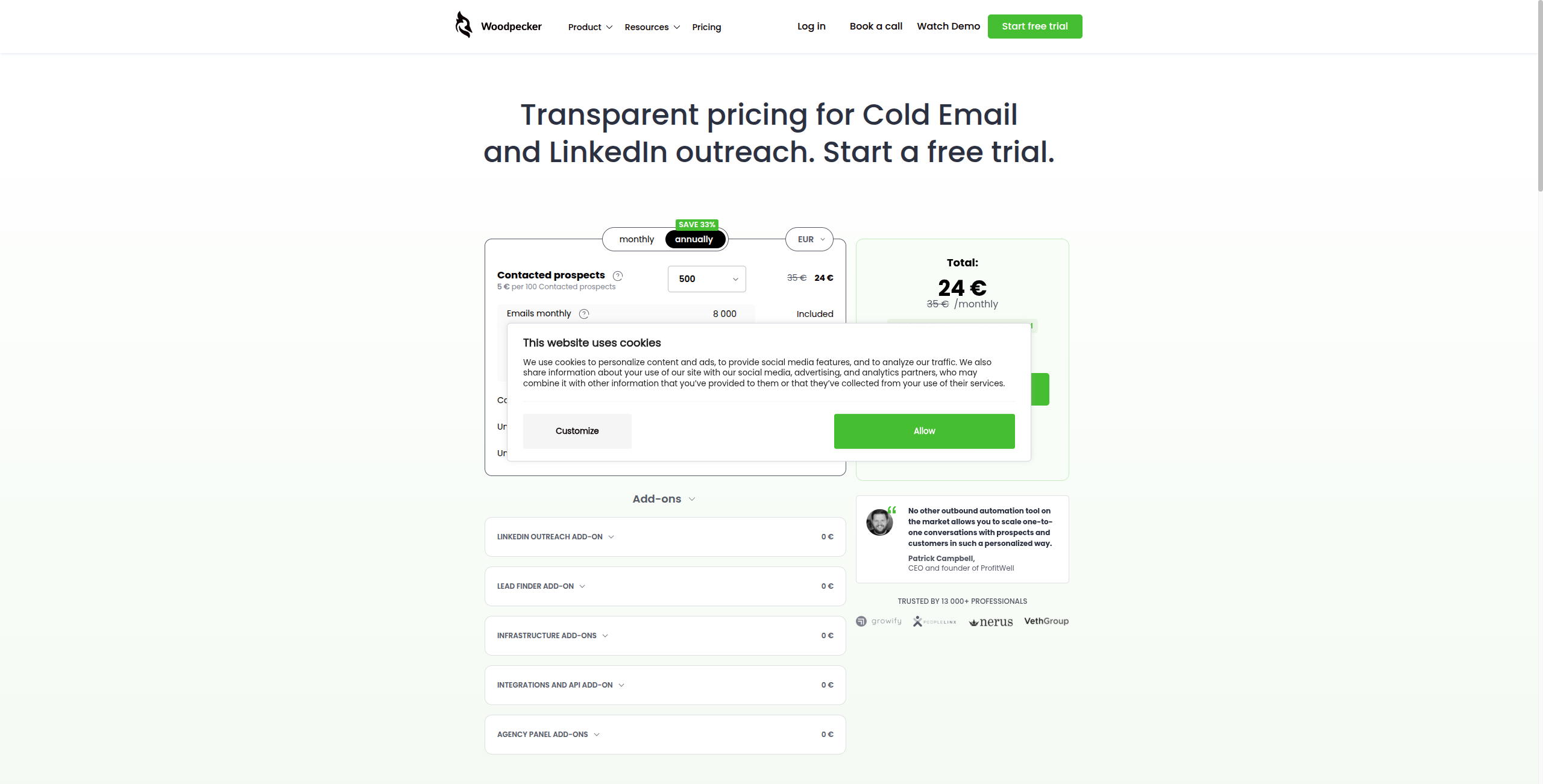
9. Woodpecker — Best for Deliverability-Focused Outreach
Woodpecker is a cold email tool built around deliverability best practices. Its per-sending-slot pricing model (you pay per email account you connect, not per contact) encourages responsible sending volumes that are less likely to trigger spam filters. This philosophy — quality over quantity — makes Woodpecker a popular choice for teams that want sustainable long-term deliverability rather than burning through domains at high volume.
The multi-channel sequences include LinkedIn automation alongside email, letting you build cadences that follow up a cold email with a LinkedIn connection request and message without switching platforms. The agency features are among the best in the market: separate workspaces per client, consolidated billing, white-label reporting, and a client portal make it practical for sales agencies managing outbound for multiple brands simultaneously. Condition-based sequences allow branching based on opens, clicks, and replies, so non-responders and engaged prospects receive appropriately differentiated follow-ups.
A/B testing for subject lines and email body copy within active sequences
CRM integration with HubSpot, Salesforce, Pipedrive, and Copper for two-way sync
Pros:
Strong deliverability infrastructure with real-time spam risk monitoring and blacklist alerts
LinkedIn + email multi-channel sequences from a single platform without additional tools
Agency-friendly features: separate client workspaces, consolidated billing, and white-label reporting
Transparent per-slot pricing — no per-contact overage surprises that inflate costs unpredictably
Condition-based branching ensures engaged and non-engaged prospects receive different follow-ups
Cons:
AI personalisation features are basic — no signal-based research like FlowHunt or Amplemarket
No built-in contact database — requires external prospecting tools like Apollo or Sales Navigator
Slower to ship new features than Apollo or Instantly — feature roadmap moves more conservatively
Per-slot pricing model can be expensive for large teams running many email accounts
Best for: Sales agencies and teams that prioritise email deliverability and need LinkedIn + email sequences with strong agency workflow support for managing multiple clients.
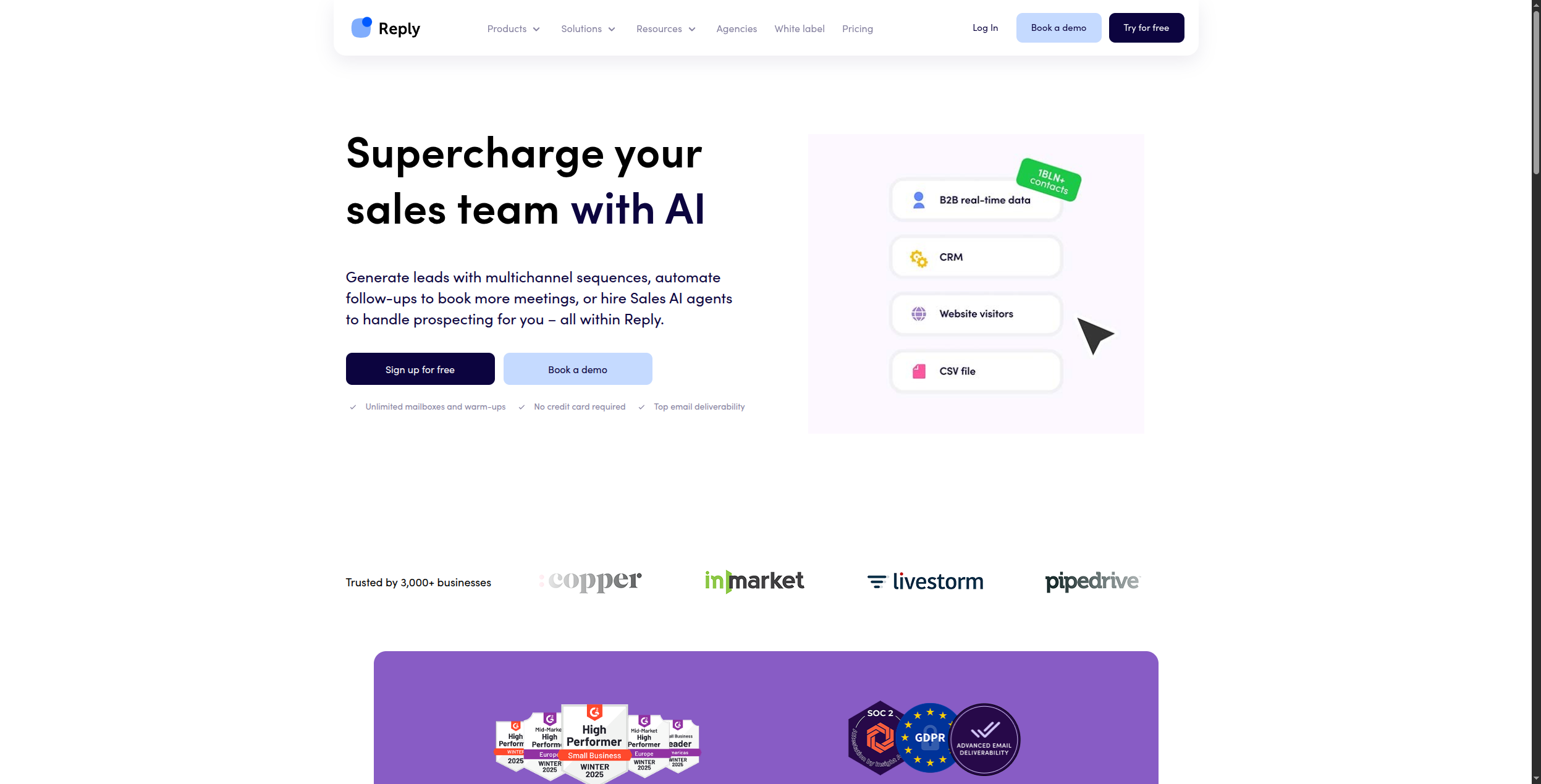
10. Reply.io — Best Multi-Channel Sales Platform
Reply.io supports email, LinkedIn, calls, SMS, and WhatsApp sequences from a single platform — the widest multi-channel coverage of any tool on this list. Rather than specialising in one channel and treating others as add-ons, Reply.io has built parity across channels: LinkedIn message automation is as configurable as email sequences, and SMS and WhatsApp steps are integrated into the same sequence builder rather than bolted on as separate products.
Its AI SDR feature (Jason AI) represents the platform’s push toward autonomous selling: Jason can search for prospect contacts matching your ICP, generate personalised opening messages, respond to inbound replies, and book meetings on your behalf — operating as an always-on AI representative. The meeting booking integration connects directly to Calendly and Google Calendar for frictionless scheduling within the sequence flow. For agencies and teams managing outbound for multiple clients, Reply.io provides separate workspace environments, team permission controls, and consolidated campaign reporting.
Pricing:
Starter — $60/month per user (billed annually). 1,000 active contacts, email sequences, basic analytics, CRM integration, email warm-up
Professional — $90/month per user (billed annually). Unlimited active contacts, LinkedIn automation, SMS, WhatsApp, calling, A/B testing, AI email assistant
Ultimate — $120/month per user (billed annually). Jason AI SDR, advanced analytics, custom reporting, priority support
Agency — $60/month per slot (billed annually). Multi-client workspace management, white-label, client reporting, separate billing
Key features:
Multi-channel sequences: email, LinkedIn, phone calls, SMS, and WhatsApp steps in one cadence
Jason AI SDR: autonomous prospecting, personalised message generation, and reply handling for meeting booking
Email warm-up: automated inbox warming for deliverability management across connected accounts
Meeting booking: direct calendar integration for seamless scheduling within active sequences
AI email assistant: writes personalised email drafts from prospect data and sequence context
A/B testing: test multiple variants of email subject lines and body copy within live sequences
Reply Data: built-in prospect database for finding contacts without a separate prospecting tool
CRM integration: bi-directional sync with HubSpot, Salesforce, Pipedrive, and Copper
Pros:
Most channel coverage of any tool: email + LinkedIn + calls + SMS + WhatsApp in one sequence builder
Jason AI for autonomous prospect research, outreach, and meeting booking
Built-in meeting booking with direct calendar integration reduces friction in the booking step
Good agency and team management features with multi-workspace support
Reply Data provides a contact database — reduces need for a separate prospecting tool
Cons:
Jack-of-all-trades — less depth on any single channel than specialised tools (Instantly for email volume, Woodpecker for deliverability)
Deliverability infrastructure is less robust than Instantly or Woodpecker for high-volume sending
AI SDR quality is improving but not yet at FlowHunt’s research depth for genuine signal-based personalisation
Per-user pricing on Professional and Ultimate adds up quickly for larger outbound teams
Best for: Teams that need true multi-channel automation across email, LinkedIn, calls, and SMS in a single platform without managing multiple specialist tools.
How to Choose the Right Sales Automation Tool
By team stage and size:
Solo founder / early-stage → Apollo free tier + FlowHunt
Small SDR team (1–10 reps) → Apollo, Instantly, or Woodpecker + Close CRM
Mid-market team → HubSpot Sales Hub + FlowHunt for research layer
Enterprise → Outreach or Salesloft + Amplemarket
By primary need:
Prospecting database → Apollo or Amplemarket
High-volume cold email → Instantly or Woodpecker
Multi-channel sequences → Reply.io or Amplemarket
AI-researched personalisation → FlowHunt
Pipeline management + CRM → HubSpot Sales Hub or Close
Enterprise deal intelligence → Outreach or Salesloft
By AI maturity:
Basic AI email suggestions → Apollo, Instantly, HubSpot
Apollo wins on database + outreach breadth. Instantly wins on deliverability infrastructure for high-volume email. Outreach and Salesloft win for enterprise pipeline management and coaching. HubSpot wins for all-in-one CRM consolidation.
But if you want AI to handle the full cycle — researching individual prospects, writing genuinely personalised messages based on company signals, and updating your CRM automatically — FlowHunt is the only platform that automates that entire workflow without a human writing each email. For outbound teams drowning in research and personalisation work, that capability changes the economics of sales fundamentally.
Frequently asked questions
Sales automation tools are software platforms that automate repetitive sales tasks — prospect research, email outreach, follow-up sequences, meeting scheduling, CRM updates, and pipeline reporting. They reduce the administrative burden on sales reps so they spend more time on high-value activities: calls, demos, and closing deals. Modern AI-powered sales automation tools go further, personalising outreach at scale, scoring leads based on intent signals, and adapting sequences based on prospect behaviour.
For small sales teams (1–10 reps), Apollo.io offers the best combination of contact data + outreach automation at an accessible price. Instantly is the best choice for teams focused primarily on cold email volume. Close is the best CRM with built-in automation for inside sales teams. FlowHunt is the best option for teams that want AI to handle the full research-to-outreach pipeline automatically.
AI improves sales automation in four key ways: personalisation at scale (writing unique emails based on each prospect's LinkedIn, website, and news signals), intent scoring (predicting which prospects are most likely to convert based on behavioural data), conversation intelligence (analysing sales calls to identify patterns in what top performers say), and pipeline forecasting (predicting deal outcomes based on engagement signals). Tools like FlowHunt, Apollo, Amplemarket, and Salesloft lead on different aspects of AI-driven sales automation.
A CRM (customer relationship management) is a database that stores contact records, deal stages, and interaction history. A sales automation tool automates the actions that create and update those records — outreach sequences, follow-ups, meeting scheduling, and status updates. Most modern sales platforms combine both: HubSpot Sales Hub, Close, and Apollo include CRM functionality alongside automation. Specialised outreach tools like Instantly and Woodpecker focus purely on the automation layer and integrate with external CRMs.
Pricing varies widely: Instantly starts at $37/month (unlimited sending accounts). Apollo's free tier covers 50 email exports/month; paid plans start at $49/month. Woodpecker starts at $29/month per slot. HubSpot Sales Hub Professional starts at $90/user/month. Outreach and Salesloft are enterprise-priced, typically $100–$150/user/month. FlowHunt offers a free tier with usage-based scaling. The right choice depends on team size, outreach volume, and required features.
Arshia is an AI Workflow Engineer at FlowHunt. With a background in computer science and a passion for AI, he specializes in creating efficient workflows that integrate AI tools into everyday tasks, enhancing productivity and creativity.
Arshia Kahani
AI Workflow Engineer
Automate Your Entire Sales Pipeline with AI — Try FlowHunt Free
FlowHunt automates prospect research, personalised outreach, follow-up sequences, and CRM updates — so your sales team focuses on closing, not admin.
10 Best Marketing Automation Software Platforms in 2026: Ranked and Reviewed
The 10 best marketing automation software platforms in 2026, ranked by AI capability, ease of use, and pricing. Find the right platform for your team's size and...
10 Best AI Lead Generation Tools in 2026 (Ranked and Reviewed)
The best AI lead generation tools in 2026, ranked by capability, ROI, and ease of use. From AI-powered prospecting to automated outreach — find the right tool f...
How to Automate Lead Generation in 2026 (Step-by-Step Guide)
Learn how to automate lead generation from prospect sourcing to CRM sync. This step-by-step guide covers tools, workflows, and AI-powered strategies that genera...
7 min read
Lead Generation
Automation
+2
Cookie Consent We use cookies to enhance your browsing experience and analyze our traffic. See our privacy policy.