Why YouTubers Are Missing 70% of Their Search Traffic And How to Fix It
A video ranking #1 on YouTube is invisible to Google Search. Here’s why the most successful creators publish both — and how AI makes it fast enough to actually stick to.
YouTube and Google are two completely separate search engines. A video ranking #1 on YouTube might very well be invisible to Google Search and vice versa. Developing a solid YouTuber SEO blog strategy that works across both platforms is how the most successful creators build sustainable, compounding reach. AI makes this strategy fast enough to actually stick to.
YouTube SEO vs Google SEO: Why They’re Completely Different
YouTube SEO and Google SEO operate on fundamentally different signals, and understanding the gap is the first step to fixing it.
YouTube ranks videos based on watch time, click-through rate from search, engagement (likes, comments, shares), and how well your title, description, and tags match a query. It surfaces content that people watch and interact with.
Google ranks pages based on written content relevance, page structure, backlink authority, and whether the text directly answers the searcher’s intent. For informational queries, it consistently surfaces long-form articles, guides, and structured written content.
A video that performs perfectly on YouTube, garnering strong retention, high CTR, and lots of comments, gives Google almost nothing to index. The video metadata is indexed, but a 50-word description can’t compete with a 1,500-word article targeting the same topic. These aren’t variations of the same algorithm. They’re different systems, built for different user behaviors, and fed by different content formats.
The Search Traffic You’re Leaving on the Table (With Numbers)
Google results are dominated by articles, guides, and structured written content for informational queries (“how to do X,” “best way to Y,” “what is Z”). Semrush’s content marketing research
confirms that long-form written articles consistently earn significantly more Google organic traffic than short-form or video-only content.
In other words, if your content lives only on YouTube, it competes in one search engine. If you also publish a blog post on the same topic, you rank in both. You’re unlocking a second acquisition channel from your same core ideas, using a video SEO text SEO combined approach that compounds over time.
Ready to grow your business?
Start your free trial today and see results within days.
How Top YouTubers Use Blogs to Double Their Total Reach
The highest-performing creators in technology, finance, cooking, fitness, and business education consistently publish text alongside video as a deliberate strategy to grow a YouTube channel with a blog.
The main idea behind is that a tutorial video earns subscribers and watch time on YouTube, while the companion blog post earns Google rankings for the same topic. When someone discovers the article via Google search, they find an embedded video or a “watch the full tutorial” link, and arrive at the YouTube channel through a completely different acquisition path that would never have been available from YouTube SEO alone.
This approach also creates a durable content asset. A YouTube video’s views taper off as the algorithm promotes newer content. A well-structured blog post keeps accumulating organic traffic for years, especially when it’s updated and interlinked with related content. The YouTube to Blog Post Generator
is built for exactly this. It creates a written infrastructure systematically, whether you’re converting one video or building a backlist from an entire content library.
The creators who understand this dynamic don’t think of blog posts as extra work. They think of it as a second distribution channel that runs automatically once the content is published. Moreover, with AI on your side, you can take the transcript of your unique ideas and repurpose the content in minutes.
Every creator who has tried to manually transcribe and rewrite their videos knows why this strategy breaks down quickly.
The raw transcript is unusable. Auto-generated YouTube captions are run-on, punctuation-free walls of text. Cleaning a transcript for a 15-minute video takes 45 to 60 minutes before a single word of the actual article is written.
Writing isn’t the same skill as talking on camera. Many YouTubers are stronger on camera than on the page. The structural discipline required for an SEO-ready long-form article, including heading hierarchy, introductory hook, FAQ section, internal linking, doesn’t come naturally from video editing muscle memory.
The publishing cadence breaks the habit. When you’re already under pressure to maintain a posting schedule on YouTube, adding a manual writing step to every video is unsustainable. The first few posts happen, then a busy week hits, and the blog goes silent. Most creators who have tried this have been through that exact cycle at least once.
This is why a YouTube and blog content strategy fails for most creators who do it manually. The execution cost is simply too high to maintain consistently.
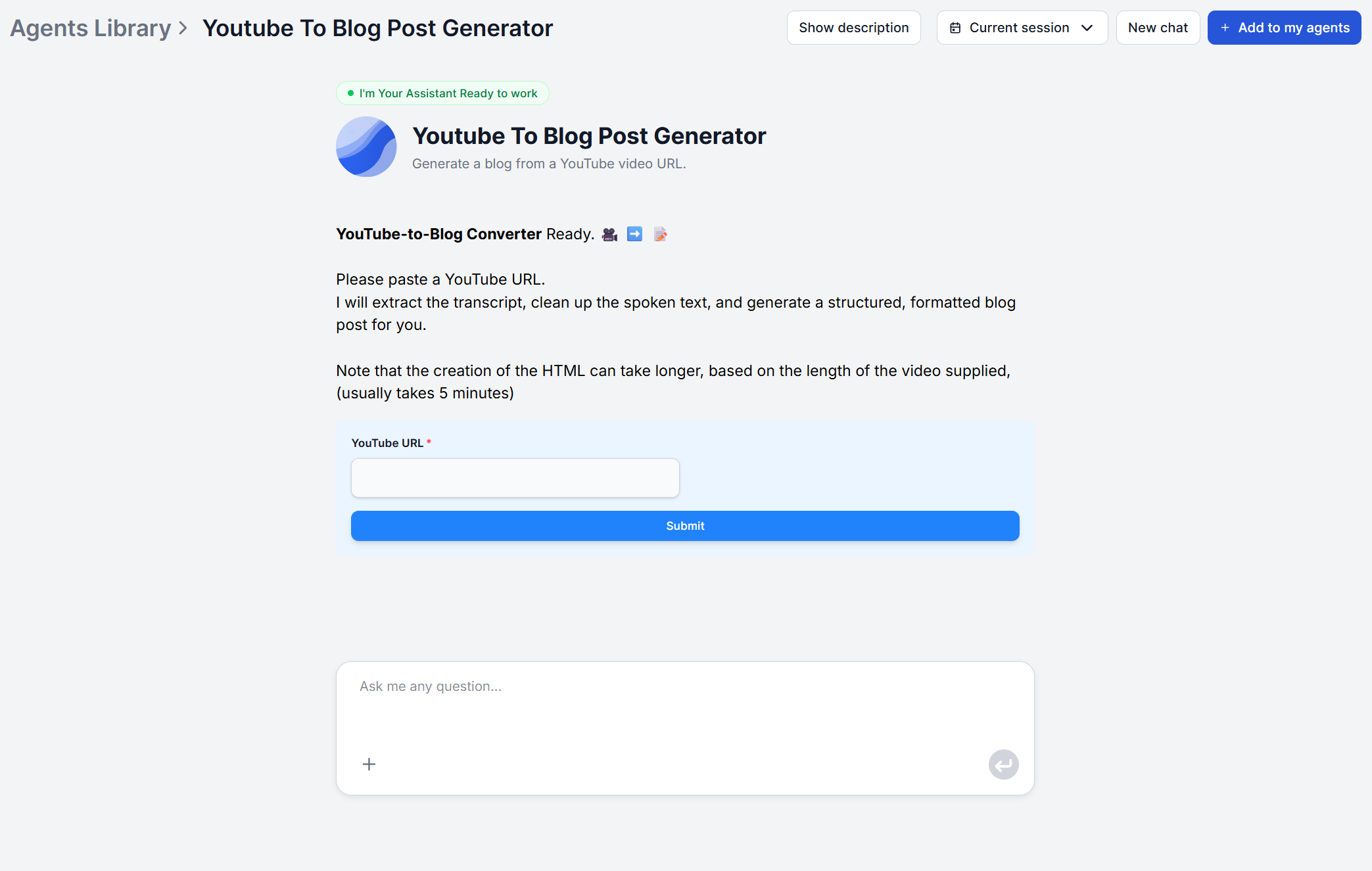
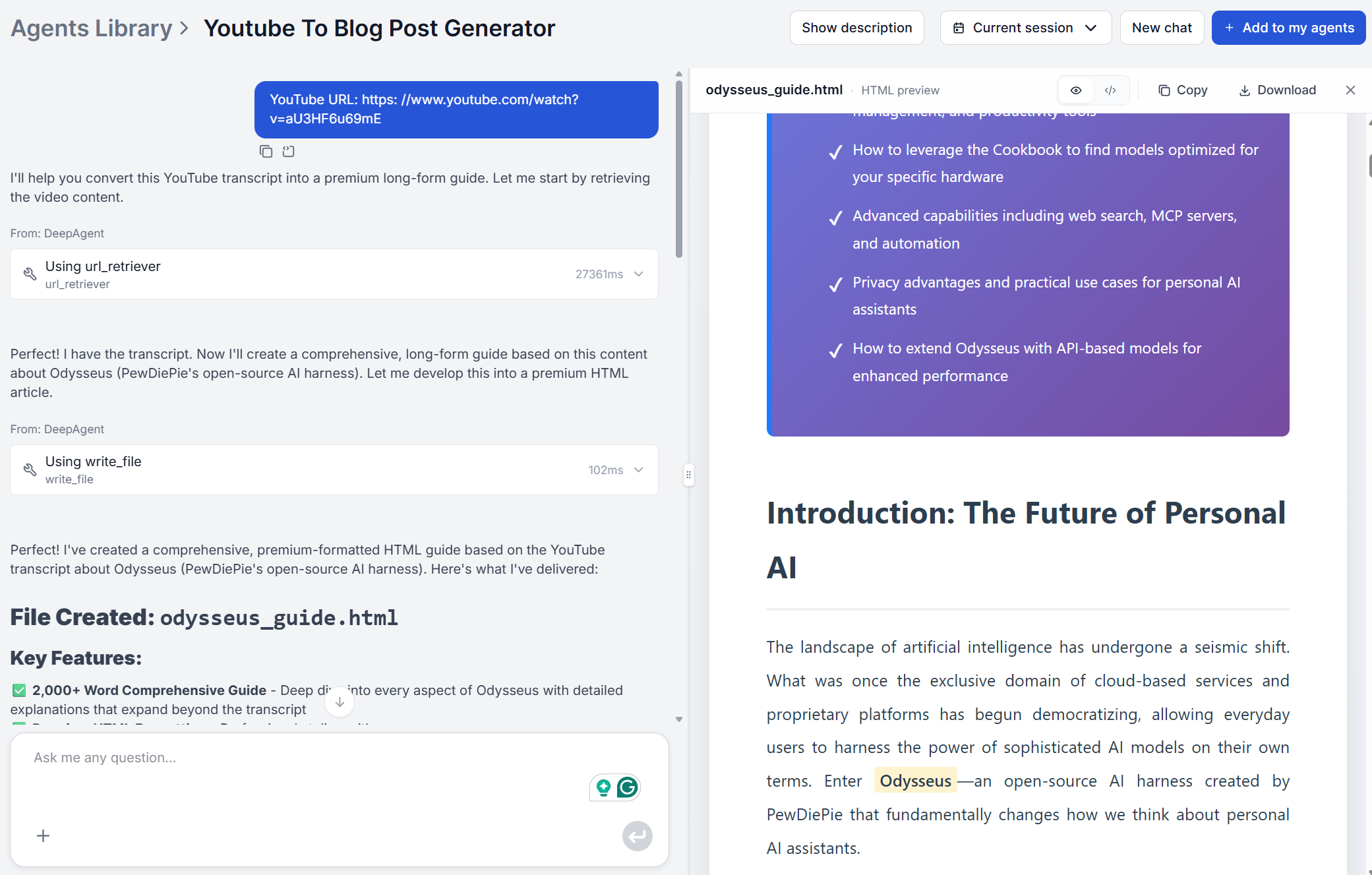
You paste the YouTube URL. The tool fetches the full video transcript, reads the entire content, and generates a structured article: introduction, H2 sections, supporting paragraphs, key takeaways, and an FAQ section targeting question-based searches. The output is clean, properly formatted content ready to paste into WordPress, Webflow, or any CMS.
The whole process may tak as little as ten minutes, and most of that is reviewing the draft, not writing it.
If you want to review the raw transcript accuracy before committing to a full article, the YouTube Transcript Generator
handles that as a standalone step. If you want to explore the video’s content and query it directly before writing, the Chat with YouTube Videos
tool lets you ask questions against the transcript. And once the blog post exists, the AI Content Repurposing Tool
can extend it further, turning the same article into a LinkedIn post, email newsletter, or social copy without any additional writing. If you’re comparing YouTube-to-blog tools before committing, see our head-to-head comparison of FlowHunt vs Castmagic vs VideoToBlog.ai vs RightBlogger
.
What a YouTube + Blog Content Strategy Looks Like in Practice
A realistic YouTube and blog content strategy for a creator publishing two videos per week looks like this:
Monday: Video goes live on YouTube. Paste the URL into the YouTube to Blog Post Generator. The draft is ready in minutes. Quick review, check the structure, add any personal commentary, flag any technical terms the auto-caption may have misread. Embed the YouTube video in the article and hit publish.
Wednesday: Second video publishes. Same process. Total weekly writing time: under an hour, most of which is reviewing.
Monthly: Review which blog posts are gaining impressions in Google Search Console. Add internal links between related articles. Update any outdated information in your highest-traffic posts. This signals freshness to Google and improves topical authority.
Quarterly: Run your top performing older videos through the generator if they haven’t been converted yet. A video library of 50 videos represents 50 potential blog posts and a backlist that earns traffic in the background while new content launches.
Getting Started: Your First Video-to-Blog Workflow in 10 Minutes
Pick one video from your existing library, ideally your most-viewed tutorial or explainer. Something with clear steps, a defined topic, and an audience that would also search for it in text form.
Read through the draft. Verify the structure matches the video’s logic, add any examples the AI missed, and adjust any technical terms that may have been captured incorrectly.
Add your meta title, meta description, and at least one internal link to a related post or tool.
Embed the original YouTube video somewhere in the article body.
Publish.
The result is a structured, SEO-ready article that targets the same topic in both search engines simultaneously. Each video you publish from this point forward earns two chances to be discovered — one on YouTube, one on Google. For a detailed walkthrough covering every step and what to edit before publishing, see how to turn YouTube videos into blog posts automatically with AI
. For the step-by-step platform walkthrough inside FlowHunt, see the YouTube to Blog Workflow guide
.
No. A blog and a YouTube channel are complementary, not competitive. Blog posts drive Google search traffic to your written content, which you can link to your YouTube videos. YouTube drives subscribers who can then find your full article library. Each platform reinforces the other — creators who run both consistently report higher total reach than those who focus on one alone.
Ideally, every evergreen video should become one, or even multiple blog posts. For most creators publishing one or two videos per week, that means four to eight blog posts per month. Start with your best-performing or most searchable videos, such as tutorials, explainers, and how-to content convert best because people search for those topics in text too. AI makes the conversion fast enough that keeping up with your video schedule is realistic.
Not necessarily. Evergreen, informational content (tutorials, guides, explainers, reviews) is the strongest candidate for conversion, because those topics have consistent text search volume. Timely videos (reactions, news commentary, vlogs) have shorter shelf lives, and should either be done quickly or not at all. If you're generating posts from your backlog, you might want to skip outdated content.
AI-generated blog posts from video transcripts are not exact duplicates — they're a different format, with added structure, expanded explanations, and different phrasing. Google's duplicate content concerns apply to pages with identical or near-identical text, not to the same ideas expressed in a different medium. Adding original commentary, internal links, and a proper meta description ensures the blog post is treated as a standalone piece of content.
Yes, with a light editing pass. The AI reads the full transcript, which already contains your phrasing, ideas, examples, and personality. The generated article reflects your structure and ideas, though written content naturally sounds slightly more polished than speech. Reading the draft once and adjusting a few phrases to match how you'd actually write is typically enough to make it feel authentic.
Maria is a copywriter at FlowHunt. A language nerd active in literary communities, she's fully aware that AI is transforming the way we write. Rather than resisting, she seeks to help define the perfect balance between AI workflows and the irreplaceable value of human creativity.
Maria Stasová
Copywriter & Content Strategist
Turn Your Next Video into a Blog Post
Paste a YouTube URL and get a structured, publish-ready blog post in minutes. No editing experience required.
How to Turn YouTube Videos into Blog Posts Automatically with AI
Turn any YouTube video into a publish-ready blog post in minutes. Step-by-step guide to using an AI YouTube to blog post generator. Simply paste a URL and get a...
5 Ways Content Teams Use YouTube-to-Blog AI to Scale Output
From solo creators to agency teams — five real workflows where AI turns YouTube videos into blog posts, newsletters, and social copy without extra headcount.
How to Crack the YouTube Algorithm: 21 Data-Driven Insights from 93,421 Videos
Discover 21 data-driven insights from analyzing 93,421 videos from the top 100 YouTubers. Learn exactly how to optimize thumbnails, titles, and content strategy...
15 min read
YouTube
Content Strategy
+3
Cookie Consent We use cookies to enhance your browsing experience and analyze our traffic. See our privacy policy.