


Google Tasks MCP Server
The Google Tasks MCP Server bridges AI assistants with Google Tasks, enabling seamless management and automation of tasks directly through standardized protocol...
5 min read
AI
MCP
+5
Label Studio MCP Server connects AI agents to powerful data labeling workflows. Automate project setup, task management, and prediction integration for streamlined annotation and quality assurance.
The Label Studio MCP Server is a Model Context Protocol (MCP) server that enables seamless integration of AI assistants with a Label Studio
instance. Leveraging the label-studio-sdk, it allows programmatic management of labeling projects, tasks, and predictions via natural language or structured calls from MCP clients. This server empowers developers and AI agents to efficiently create and manage projects, import and query tasks, and automate predictions, all through standardized MCP tools. By exposing Label Studio’s core functionalities, it streamlines labeling workflows and enhances productivity for data annotation, quality review, and machine learning operations.
No prompt templates are mentioned in the repository.

Start your free trial today and see results within days.
No explicit MCP resources are listed in the repository documentation.
Get latest tips, trends, and deals for free.
{
    "mcpServers": {
        "label-studio": {
            "command": "uvx",
            "args": [
                "--from",
                "git+https://github.com/HumanSignal/label-studio-mcp-server",
                "mcp-label-studio"
            ],
            "env": {
                "LABEL_STUDIO_API_KEY": "your_actual_api_key_here",
                "LABEL_STUDIO_URL": "http://localhost:8080"
            }
        }
    }
}
claude_desktop_config.json file.{
"mcpServers": {
"label-studio": {
"command": "uvx",
"args": [
"--from",
"git+https://github.com/HumanSignal/label-studio-mcp-server",
"mcp-label-studio"
],
"env": {
"LABEL_STUDIO_API_KEY": "your_actual_api_key_here",
"LABEL_STUDIO_URL": "http://localhost:8080"
}
}
}
}
{
    "mcpServers": {
        "label-studio": {
            "command": "uvx",
            "args": [
                "--from",
                "git+https://github.com/HumanSignal/label-studio-mcp-server",
                "mcp-label-studio"
            ],
            "env": {
                "LABEL_STUDIO_API_KEY": "your_actual_api_key_here",
                "LABEL_STUDIO_URL": "http://localhost:8080"
            }
        }
    }
}
{
    "mcpServers": {
        "label-studio": {
            "command": "uvx",
            "args": [
                "--from",
                "git+https://github.com/HumanSignal/label-studio-mcp-server",
                "mcp-label-studio"
            ],
            "env": {
                "LABEL_STUDIO_API_KEY": "your_actual_api_key_here",
                "LABEL_STUDIO_URL": "http://localhost:8080"
            }
        }
    }
}
Note:
Securely store your API key using environment variables as shown in the env section above. This keeps sensitive information out of source code and config files.
Using MCP in FlowHunt
To integrate MCP servers into your FlowHunt workflow, start by adding the MCP component to your flow and connecting it to your AI agent:
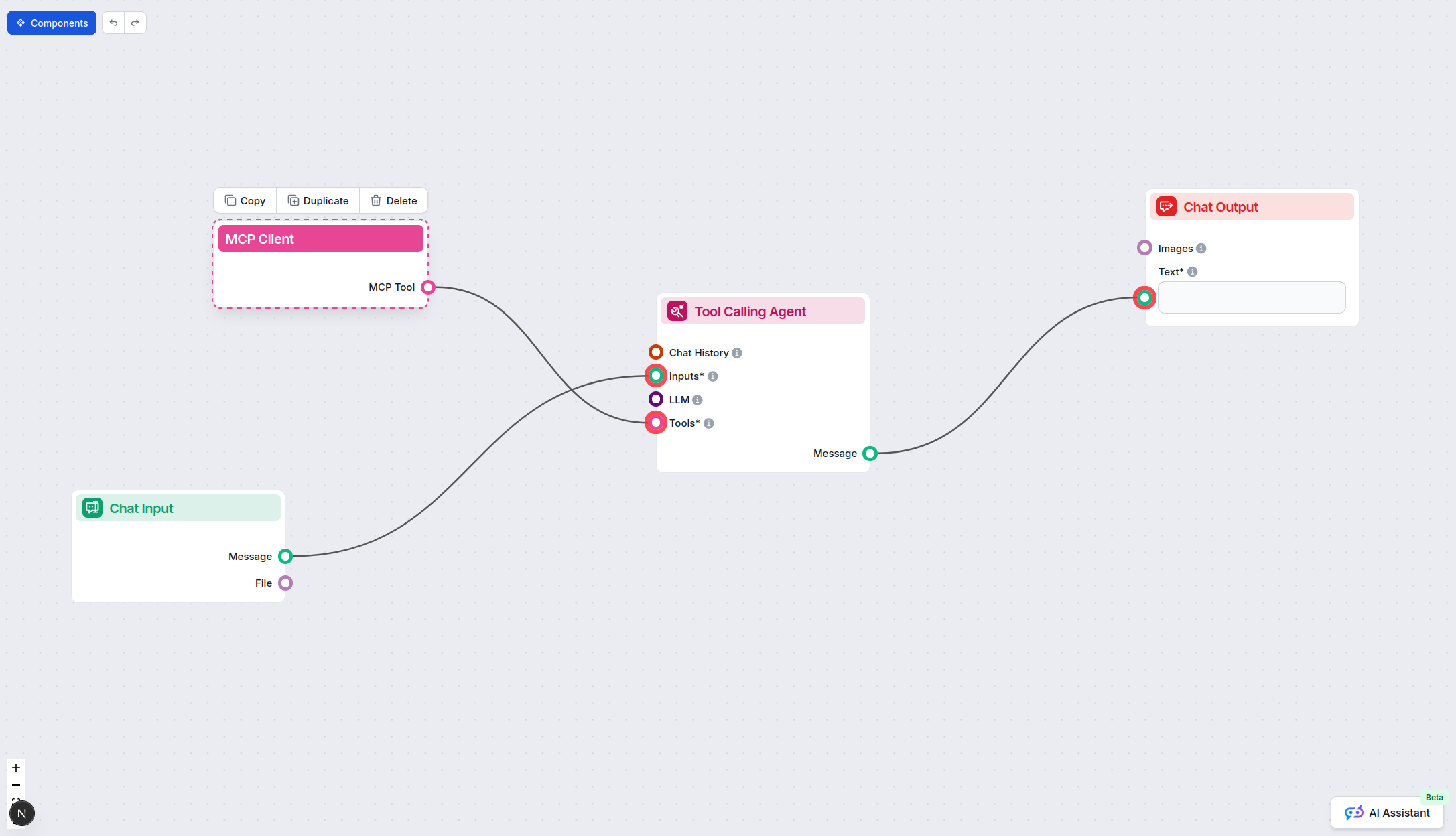
Click on the MCP component to open the configuration panel. In the system MCP configuration section, insert your MCP server details using this JSON format:
{
  "label-studio": {
    "transport": "streamable_http",
    "url": "https://yourmcpserver.example/pathtothemcp/url"
  }
}
Once configured, the AI agent is now able to use this MCP as a tool with access to all its functions and capabilities. Remember to change "label-studio" to whatever the actual name of your MCP server is and replace the URL with your own MCP server URL.
| Section | Availability | Details/Notes |
|---|---|---|
| Overview | ✅ | |
| List of Prompts | ⛔ | No prompt templates found in documentation. |
| List of Resources | ⛔ | No explicit MCP resources listed. |
| List of Tools | ✅ | Project/Task management, predictions tools. |
| Securing API Keys | ✅ | Uses environment variables in config (env). |
| Sampling Support (less important in evaluation) | ⛔ | Not mentioned. |
Between the two tables:
This MCP server provides strong tool coverage for Label Studio management and clear setup documentation, but lacks prompt templates and explicit resource definitions. Sampling and roots support are not mentioned. Overall, it’s a solid but basic implementation for dedicated data labeling workflows.
| Has a LICENSE | ✅ (Apache-2.0) |
|---|---|
| Has at least one tool | ✅ |
| Number of Forks | 3 |
| Number of Stars | 8 |
Empower your AI workflows by connecting Label Studio to FlowHunt. Automate project management, task imports, and predictions for fast, high-quality data annotation.
The Google Tasks MCP Server bridges AI assistants with Google Tasks, enabling seamless management and automation of tasks directly through standardized protocol...
The Todos MCP Server is an open-source todo list application with Model Context Protocol (MCP) support, allowing AI assistants and chatbots to manage tasks prog...

JupyterMCP enables seamless integration of Jupyter Notebook (6.x) with AI assistants through the Model Context Protocol. Automate code execution, manage cells, ...
Cookie Consent
We use cookies to enhance your browsing experience and analyze our traffic. See our privacy policy.