


AI-Agent-Powered Customer Service
Discover the benefits of an AI-Agent Powered Customer Service Flow. Enhance support with AI-driven responses, seamless transitions to human agents, and improved...
2 min read
AI
Customer Service
+4

Five specific customer service scenarios, from repetitive FAQs to after-hours coverage, where AI chatbot customer service use cases consistently beat human agents on speed and consistency.
AI chatbots don’t replace good support agents. Instead, they handle the work that shouldn’t require a human in the first place. Here are the five specific support scenarios where chatbots consistently outperform human agents on speed, consistency, and customer satisfaction, as well as where they still fall short.
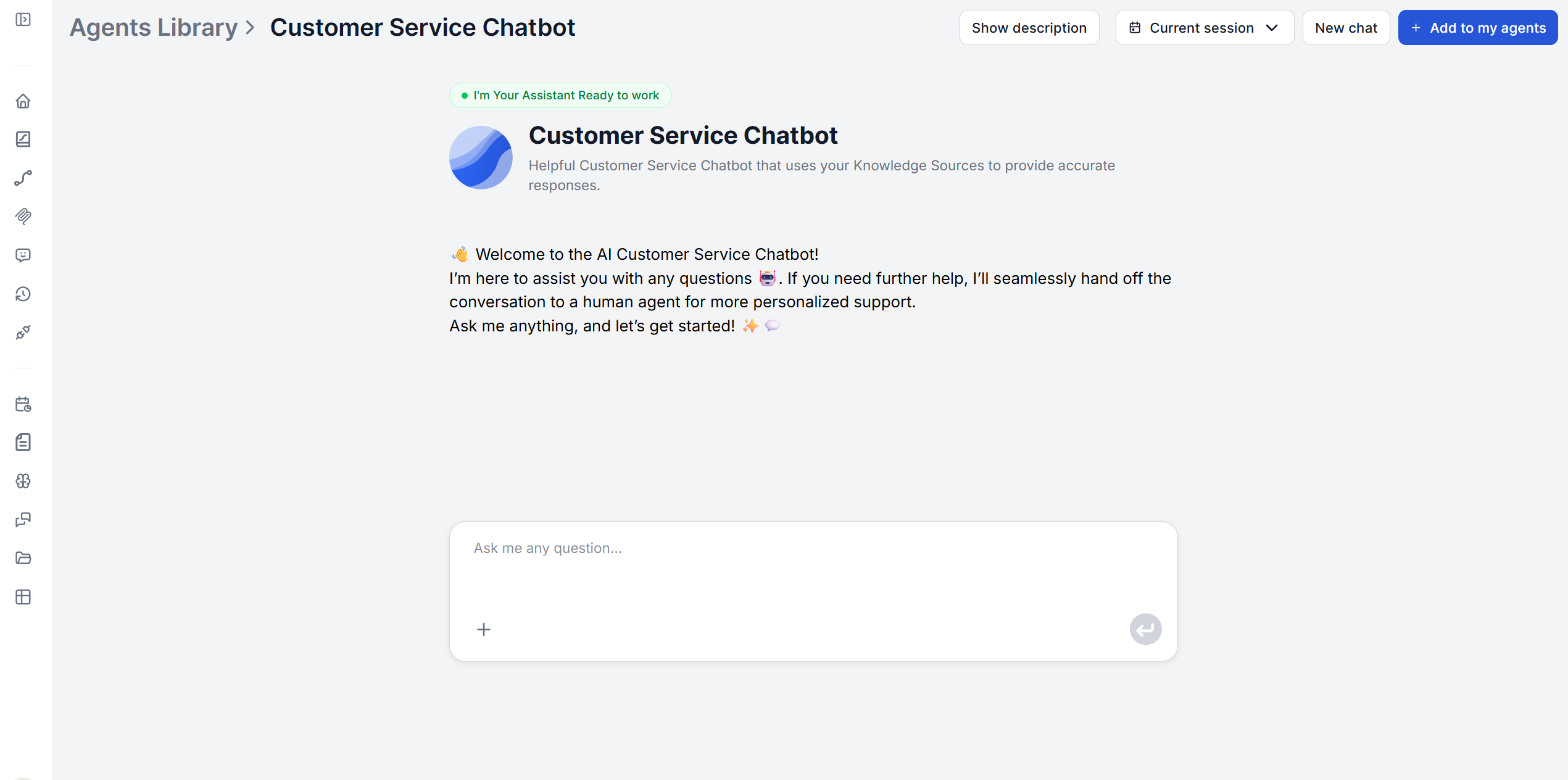
Every support team fields a small set of questions on repeat: shipping timelines, return policy, plan differences, how a simple, well-documented feature works. A human agent answering the same question for the hundredth time that day is prone to shortcuts and inconsistency, however good their intentions. A chatbot connected to your documentation gives the same accurate, policy-correct answer on the first repetition and the ten-thousandth, without fatigue changing the quality.
This is the highest-ROI use case for a customer service chatbot precisely because the value compounds. Every question the bot handles correctly is one an agent never has to, and the chatbot answer is never subtly different depending on who’s on shift.
Support demand doesn’t stop at 6 PM or on weekends, but staffing a human team around the clock is expensive, and overnight or weekend coverage is usually the first thing to get cut in a smaller team’s budget. A knowledge-base chatbot doesn’t have a shift schedule. It answers a question at 2 AM with the same accuracy as at 2 PM, so customers in different time zones or with after-hours urgency get an immediate, correct answer.
This scenario is less about the bot being “better” than a human and more about it being present when no human is scheduled to be. For teams building this out, building custom AI chatbots for support teams walks through the no-code, API, and custom-development paths to getting there.

Start your free trial today and see results within days.
Before a human ever looks at a queue, a chatbot can capture the customer’s question, check it against the knowledge base, and either resolve it outright or hand it off with the context already gathered. The conversation history, what’s already been tried, and why it wasn’t resolved automatically, all gets sent to the human agent. This greatly reduces time spent on catching up, speeds up answer time and eliminates the need to bother the customer with the same questions again and again.
“Where’s my order” and “what’s my account status” are exactly the kind of questions that don’t need judgment. All they need is a live lookup. The chatbot calls an external API to pull current data, and folds it directly into a natural-language answer, instead of the customer digging through a portal or an agent manually looking it up.
This is squarely in the zone customers are already comfortable delegating to AI. SurveyMonkey’s research found 65% comfortable letting AI handle a straightforward transactional request. A status check is about as low-stakes and fact-based as support questions get.
Get latest tips, trends, and deals for free.
Plan changes, billing questions, cancellation requests, and password or access issues are high-volume, mostly procedural, and rarely require an empathetic attitude. What they require instead is an accurate, immediate answer pulled from the right documentation. A chatbot handles these consistently and around the clock, while freeing agents from a category of ticket that’s high in volume but low in complexity.
Even here, though, customer comfort isn’t unconditional. The same SurveyMonkey research found 59% comfortable using AI specifically for something like processing a return, which is meaningfully lower than for placing an order. The closer a self-service task gets to “something went wrong,” the more customers want a visible path to a human if the automated answer doesn’t land.
None of this means chatbots should own the whole conversation. The same SurveyMonkey research also found 69% of people uncomfortable with AI giving medical advice and 68% uncomfortable with AI giving investment advice. This is a clear signal that comfort with AI drops sharply as the stakes and personal nature of the issue rise. A billing dispute that’s made someone genuinely upset, or a request that requires discretion needs a human who can exercise judgment the bot doesn’t have.
Note: There’s also a legal dimension worth building into the design, not bolting on afterward. Under the EU’s risk-based AI framework, chatbots are treated as a transparency obligation. See chatbots under the European AI Act for what that means in practice for a customer-facing bot.
The scenarios above are a case for deliberately splitting the work, rather than for full automation. The chatbot should own repetitive, well-documented, low-stakes questions and be explicitly designed to recognize when a conversation needs to escalate. Agents should be freed to spend their time on the tickets that actually need a human, such as emotionally charged interactions, edge cases the documentation doesn’t cover, and anything where a wrong automated answer would cost more than the time it saved.
The chatbot’s own conversation data is what makes this split get better over time. Every escalation and every recurring unanswered question is a direct signal of where the knowledge base has a gap or where a human’s judgment was genuinely necessary. Feed that back into both your documentation and your agent training, and the split between what the bot handles and what reaches a person keeps improving on its own.
Ready to offload the repetitive half of your support queue? Try the Customer Service Chatbot and see which of these five scenarios it can take off your team’s plate first.
Maria is a copywriter at FlowHunt. A language nerd active in literary communities, she's fully aware that AI is transforming the way we write. Rather than resisting, she seeks to help define the perfect balance between AI workflows and the irreplaceable value of human creativity.

FlowHunt's Customer Service Chatbot handles the repetitive, high-volume, always-on parts of support automatically — grounded in your own documentation, with a clean handoff to your team when it should be a human on the other end.
Discover the benefits of an AI-Agent Powered Customer Service Flow. Enhance support with AI-driven responses, seamless transitions to human agents, and improved...
Discover how a customer service chatbot can enhance your support operations with quick, accurate responses, 24/7 availability, and seamless platform integration...

Discover the simplest and most effective ways to build custom AI chatbots for your support team, from no-code platforms to advanced NLP solutions.
Cookie Consent
We use cookies to enhance your browsing experience and analyze our traffic. See our privacy policy.