Introduction
For two years, Big Tech earnings calls about AI were mostly about chatbots and capacity. This week, three of the largest cloud companies talked about something more specific. Microsoft and Alphabet reported on October 28, 2026, and Amazon followed on October 29. All three put AI agents at the center of the story: software that doesn’t just answer questions, but takes actions, runs multi-step tasks, and works in the background. They also spent a combined $172.5 billion on infrastructure in a single quarter to make that possible. Here’s what each company said, what the numbers show, and what it means for businesses that want to see what AI agents can do without a hyperscaler budget.
Microsoft Renamed a Segment
The clearest signal came from a line in Microsoft’s results table. Microsoft now reports a segment called Agents and Infra, which brought in $76.8 billion in the quarter, up 25%. Total revenue was $92.3 billion, up 19%, and Azure grew 48%.
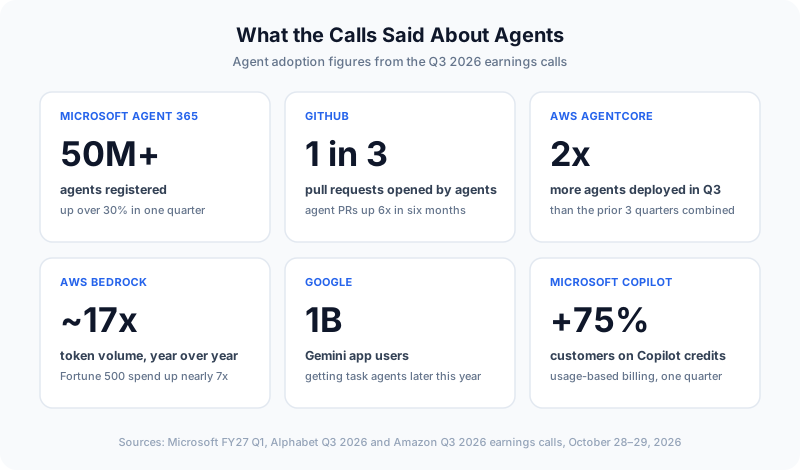
The agent numbers on the call backed up the name. Microsoft said more than 50 million agents are now registered in Agent 365, its registry and control plane for agents, up more than 30% from the previous quarter. Foundry, where customers build their own agents, passed 120,000 customers, and its revenue more than tripled year over year. On GitHub, agent-generated pull requests grew 6x in six months and now make up more than a third of all pull requests.
Satya Nadella framed it as ownership: Microsoft is “helping organizations build and own their own intelligence, and earning trust through agent safety and security.” That trust point isn’t a throwaway line. As background AI agents take on more work without a human watching each step, the security and approval gap around them has become one of the main reasons deployments stall.

Ready to grow your business?
Start your free trial today and see results within days.
Google Wants One Agent Layer
Alphabet’s quarter was rougher on paper. Revenue rose 25% to $127.6 billion, but capital expenditure of $51.4 billion pushed free cash flow to negative $9.1 billion, and shares fell about 10% in after-hours trading. The company kept its 2026 capex outlook at $195 billion to $205 billion and said spending will “increase significantly” in 2027.
What Alphabet is buying with that money is an agent layer across everything it ships. “Agents will operate as a unifying layer across our products,” said CEO Sundar Pichai, naming Chrome, Android, Workspace, Search and the Gemini app. The Gemini app, which now has 1 billion users, is getting agents later this year that can book reservations, fill in forms, and schedule appointments.
Commerce is where this gets concrete. Google is pairing its Universal Commerce Protocol, which lets shoppers check out directly with hundreds of thousands of brands, with the Agent Payments Protocol, so an agent can complete a purchase on a user’s behalf. This builds on the AI agents that already call stores and buy for you that Google started rolling out earlier this year. For any business that sells online, the customer clicking “buy” may increasingly be an agent.
Amazon Counts Agents Deployed
Amazon reported a day later. AWS revenue grew 39%, its fastest pace in nearly five years, and its backlog reached $578 billion. Amazon spent $75.9 billion in cash capex in the quarter and expects about $220 billion for 2026, with 2027 “meaningfully higher.”
Andy Jassy’s agent figures were some of the most striking of the week. “Agents continue to be deployed at accelerating rates,” he said. Tens of thousands of customers now use AgentCore, AWS’s platform for running agents in production, and they deployed twice as many agents in Q3 as in the three previous quarters combined. On Bedrock, AWS’s model service, token volume grew nearly 17x year over year, and Fortune 500 spending grew nearly 7x. Amazon also pointed to its own agents, including the Kiro coding agent and the Quick work assistant.
Join our newsletter
Get latest tips, trends, and deals for free.
$172.5B in One Quarter
Add the three together and you get $172.5 billion of capital expenditure in a single quarter, almost all of it for data centers, chips, and power. Each company counts capex a little differently, so treat the comparison as a sense of scale, not an exact ranking.
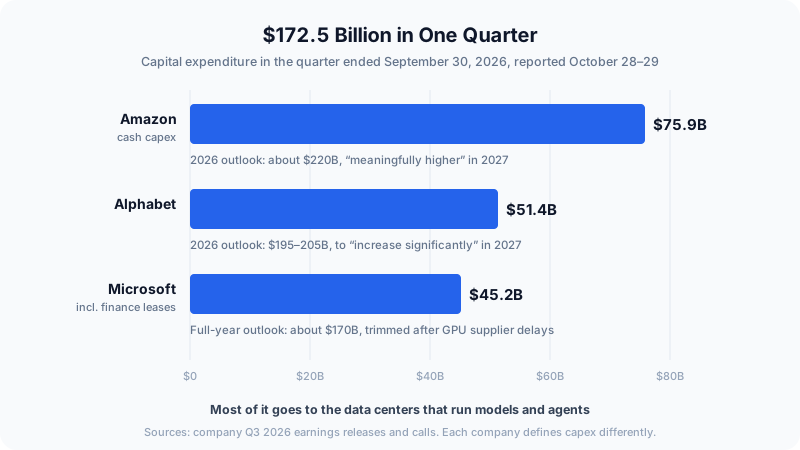
The spending isn’t slowing so much as running into supply limits. Microsoft trimmed its full-year capex outlook to about $170 billion and said delays at outside GPU suppliers will push some capacity into the first half of 2027. Alphabet and Amazon both said 2027 will be higher still. If you want a sense of what goes into that money, our look at what goes inside an AI data center covers the power, cooling, and construction behind it.
Build the Agents Your Team Actually Needs
FlowHunt gives you a visual builder, your choice of models, and MCP connections to your own tools, so you can ship agents for your own processes this week.
Pricing Is Moving to Usage
One quieter number may matter more to buyers than any capex figure. Microsoft said customers consuming Copilot credits, its usage-based billing, grew more than 75% in the quarter. Per-seat licenses made sense for assistants that one person chats with. They fit agents badly, because one agent might run for seconds and another for hours across dozens of tool calls.
That shift puts cost control in your hands, and on your plate. Under usage pricing, what you pay depends on how much context an agent carries, how many steps it takes, and which model it runs on. Understanding what an AI agent’s context window actually costs becomes a budgeting question, not just an engineering one. So does model choice. Splitting a job between a strong model that plans and a cheaper model doing the routine work is one of the more practical ways teams are keeping that bill in check.
What It Means for Your Business
Three things stand out for teams that aren’t spending $50 billion a quarter.
- The infrastructure is being built for you. Hyperscalers are absorbing the cost of chips, power, and data centers. What that buys smaller teams is cheaper, faster access to capable models, with no capex of their own.
- Agents will reach you from both sides. Your team will use agents internally, and your customers will increasingly arrive through agents, whether that’s a Gemini agent comparing your prices or an assistant booking your services.
- Governance is the bottleneck, not capability. 50 million registered agents is a management problem as much as a success story. Clear agent identity and governance rules (who an agent acts for, what it can touch, how it’s audited) decide whether agents reach production.
The practical move is to start with your own processes. Pick a workflow your team repeats every day, connect an agent to the tools and data it needs, and keep the model swappable so you can follow price and quality as they change. A no-code AI agent platform like FlowHunt lets you do that without building the plumbing yourself, and without tying your workflows to one cloud’s agent product. If you’re still comparing options, our roundup of the best AI agent builder platforms for 2026 covers the main choices.
Conclusion
This earnings week made the direction explicit. Microsoft named a segment after agents, Google described agents as the layer across all its products, and Amazon reported agent deployments doubling in a single quarter. The $172.5 billion behind those statements will keep flowing into 2027. For most businesses, the question is no longer whether agents will become part of how work and buying get done. It’s whether you build the agents that fit your own work, or wait for someone else’s to fit it for you.