What Are AI Agents? Complete Guide to Autonomous AI Systems
Learn what AI agents are, how they work, different types, and how to build them without code. Complete guide with examples, ROI data, challenges, and comparisons to AI assistants.
What Are AI Agents? Complete Guide to Autonomous AI Systems
The landscape of artificial intelligence is evolving rapidly. While most people are familiar with ChatGPT and other generative AI tools, a more powerful and transformative technology is emerging: AI agents. Unlike traditional AI systems that simply respond to prompts, AI agents take action autonomously to accomplish specific goals. This comprehensive guide explains what AI agents are, how they work, and why they’re becoming essential for businesses across every industry.
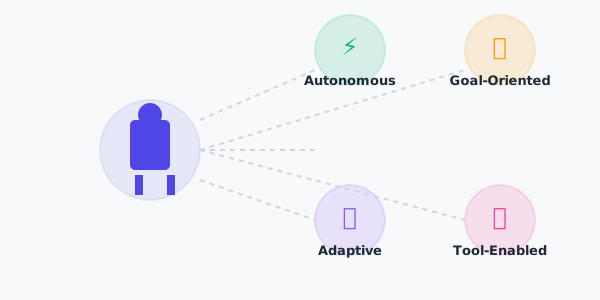
AI agents are autonomous software systems designed to perceive their environment, make decisions, and take actions to achieve specific goals without continuous human intervention.
This definition contains several critical elements:
Autonomous: Unlike chatbots that wait for user input, AI agents operate independently. Once given an objective, they determine what actions to take without asking permission at each step.
Goal-oriented: AI agents have a clear objective. Whether it’s “optimize our product listings for SEO,” “monitor brand mentions across the web,” or “qualify incoming sales leads,” the agent works toward that specific goal.
Adaptive: AI agents learn from their environment and past experiences. They adjust their approach based on outcomes, improving their performance over time.
Tool-enabled: AI agents can call external tools, APIs, and integrations. This allows them to interact with real systems—databases, CRMs, search engines, email platforms—and take tangible actions.
Intelligent reasoning: At their core, AI agents use Large Language Models (LLMs) as reasoning engines. They don’t just follow pre-programmed rules; they analyze information, consider options, and make informed decisions.
Why AI Agents Matter
Generative AI democratized content creation. AI agents are democratizing task automation. Before AI agents, automating complex workflows required either expensive software engineers or rigid, rule-based automation tools that couldn’t handle exceptions. AI agents change this equation. A marketing manager can now build an agent
to research competitors, a support team can build an agent to triage tickets, and an SEO team can build an agent to optimize product listings—all without writing code.
How AI Agents Work
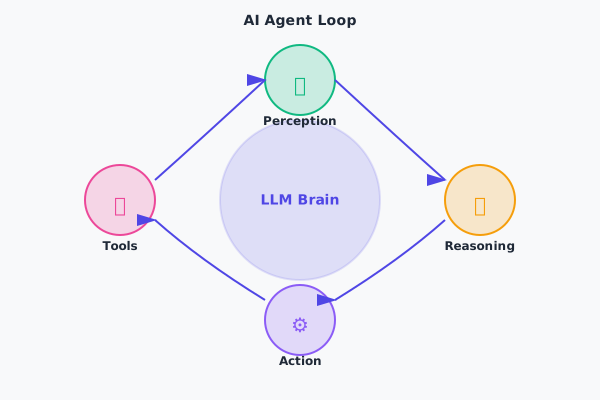
Understanding AI agent architecture helps clarify why they’re so powerful. Most modern AI agents operate using a simple but effective loop:
The AI Agent Loop
1. Perception: The agent receives input—either from a user, a scheduled trigger, or an external event. For example: “Optimize our top 10 products for SEO on Shopify.”
2. Reasoning: The agent’s LLM processes this request and determines what needs to happen. It breaks the goal into steps: “I need to pull the top products, audit them for SEO gaps, rewrite the titles and descriptions, and push updates back to Shopify.”
3. Tool Selection: The agent decides which tools to use. In this case: Shopify API (to get products), SEMrush API (to analyze keywords), a content writing tool (to rewrite copy), and Shopify again (to update listings).
4. Action: The agent executes these tools in sequence, handling errors and adapting if something goes wrong. If Shopify is temporarily unavailable, it might retry. If a product has no good keyword opportunities, it might skip it.
5. Learning: The agent stores information about what worked and what didn’t. This memory informs future decisions.
Key Components
The LLM Brain:Large Language Models
like GPT-4, Claude, or Gemini serve as the decision-making engine. They understand the goal, analyze available information, and decide what to do next.
Memory: AI agents maintain context across multiple steps and even across different runs. Short-term memory keeps track of the current task. Long-term memory remembers past interactions, user preferences, and lessons learned. This allows agents to improve over time and maintain consistency.
Tools & Integrations: An AI agent is only as powerful as the tools it can access. Modern AI agents
can integrate with 1,000+ tools and APIs: CRMs, databases, search engines, communication platforms, productivity tools, and specialized business software.
Planning & Reasoning: The agent doesn’t just react to each step; it plans ahead. Before taking action, it considers: “What are all the steps I need to complete? What’s the best order? What could go wrong?” This planning capability
is what separates AI agents from simple chatbots.
Execution Engine: This component actually calls the tools, handles failures, retries when needed, and manages the flow of data between different systems.
Example: SEO Product Optimization Agent in Action
To make this concrete, here’s how an AI agent optimizes product listings for SEO:
User: "Optimize our top 10 products for SEO"
↓
Agent Reasoning: "I need to:
1. Get the top 10 products from Shopify
2. Analyze each for SEO gaps using SEMrush
3. Rewrite titles and descriptions
4. Update Shopify with new copy"
↓
Agent Action:
- Calls Shopify API → Gets 10 products
- Calls SEMrush API → Analyzes keywords for each
- Calls AI Writer → Generates 10 optimized titles + 10 descriptions
- Calls Shopify API → Updates all 10 products
↓
Result: "Done. Updated 10 products. Projected +18% organic CTR."
↓
Agent Memory: "SEMrush integration works well. AI Writer needs 3.4s per product."
This entire process happens autonomously. The user didn’t need to manually run each tool or copy-paste data between systems.
Join our newsletter
Get latest tips, trends, and deals for free.
Types of AI Agents
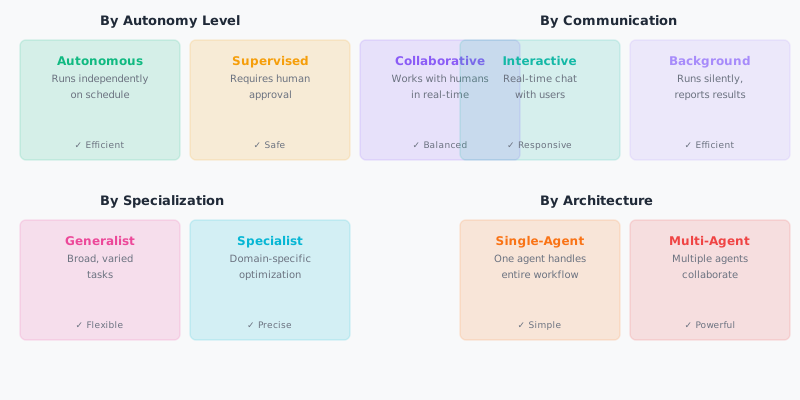
AI agents can be categorized in several ways. Here are the most common classifications:
By Autonomy Level
1. Autonomous Agents
Fully autonomous agents operate independently toward their goals with minimal human oversight. Once deployed, they run on a schedule or trigger without requiring approval at each step. Examples: content publishing agents, competitor monitoring agents, automated customer support agents.
Pros: Highly efficient, can handle high volume of tasks
Cons: Requires careful setup and monitoring to prevent errors
2. Supervised Agents
Supervised agents operate with human oversight
. They may require approval before taking certain actions, or they escalate complex decisions to humans. Examples: ticket triage agents (route tickets to humans), content review agents (generate content, wait for human approval).
Pros: Safer for sensitive operations, humans maintain control
Cons: Slower than fully autonomous agents, requires human availability
3. Collaborative Agents
Collaborative agents work alongside humans in real-time. The human and agent take turns: agent suggests an action, human approves or modifies it, agent executes. Examples: writing assistants, research agents.
Pros: Combines AI speed with human judgment
Cons: Requires active human participation
By Specialization
1. Generalist Agents
Generalist agents handle broad, varied tasks. They have access to many tools and can work across different domains. Example: a general-purpose AI assistant that can research, write, analyze, and code.
2. Specialist Agents
Specialist agents are designed for specific domains or tasks. They’re optimized for high performance in one area. Examples: SEO optimization agents, customer support agents, code review agents.
Pros: Better performance in their domain, easier to monitor and control
Cons: Less flexible, requires multiple agents for different tasks
By Architecture
1. Single-Agent Systems
A single agent handles the entire workflow. It has all the tools and decision-making authority it needs.
2. Multi-Agent SystemsMultiple agents collaborate
to complete complex tasks. Each agent has a specific role. Example: a Researcher agent gathers information, a Writer agent creates content, an Editor agent reviews it, a Publisher agent uploads it. Research shows multi-agent systems achieve 45% faster problem resolution and 60% more accurate outcomes compared to single-agent approaches.
Pros: Better for complex workflows, agents can specialize
Cons: More complex to set up and monitor, requires agent coordination
By Communication Style
1. Interactive Agents
Interactive agents engage in real-time conversation with users. They respond to questions, take actions, and report results. Example: customer service chatbots that can also place orders.
2. Background Agents
Background agents operate without user interaction. They run on schedules or triggers and report results asynchronously. Example: a nightly agent that monitors competitor pricing and sends a daily report.
Pros: Can run during off-hours, don’t require user availability
Cons: Less responsive to real-time needs
For most organizations, the most effective approach combines multiple agent types. You might have a specialist SEO agent running autonomously on a schedule, supervised content agents that require approval, and interactive customer service agents.
AI Agents vs AI Assistants vs Bots
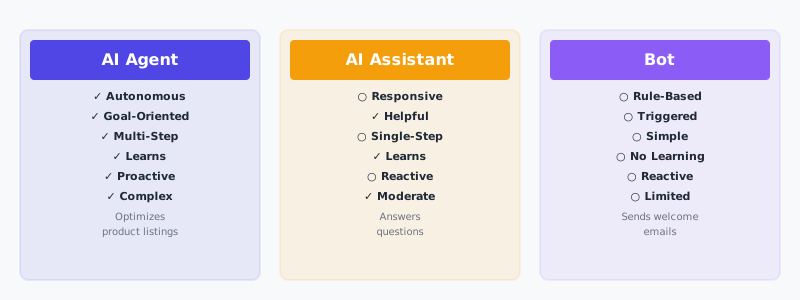
These three terms are often used interchangeably, but they represent fundamentally different technologies:
Characteristic
AI Agent
AI Assistant
Bot
Purpose
Autonomously complete tasks
Help users by responding to requests
Automate simple, repetitive actions
Autonomy Level
High - makes decisions independently
Medium - responds to user direction
Low - follows pre-programmed rules
Decision Making
Uses reasoning to decide what to do
Recommends actions; user decides
Executes if-then rules
Complexity
Handles complex, multi-step workflows
Handles simple to moderate tasks
Limited to specific scenarios
Learning
Learns from experience and adapts
May have some learning capability
No learning; fixed rules
User Interaction
Proactive; goal-oriented
Reactive; responds to prompts
Reactive; triggered by events
Examples
SEO optimizer, content researcher, ticket triage
ChatGPT, customer service assistant
Email autoresponder, form filler
Key Differences Explained
Autonomy: This is the biggest distinction. An AI assistant waits for you to ask a question and provide direction. An AI agent takes an objective and figures out what to do without asking at each step. You tell an assistant “What are the top keywords for my product?” and it gives you an answer. You tell an agent “Optimize our product listings for those keywords” and it does the work.
Complexity: AI assistants excel at answering questions and providing information. AI agents excel at executing complex workflows that involve multiple steps, multiple systems, and decision-making. An assistant can explain how to optimize an image. An agent can actually resize, optimize, and upload 100 images to your website.
Learning: Advanced AI agents improve over time by learning from past executions. They remember what worked, what failed, and how long things took. This allows them to become more efficient and effective with each run.
When to Use Each
Use an AI Agent when: You need to automate a workflow that involves multiple steps, multiple systems, and decision-making. Examples: content creation pipelines, competitor monitoring, lead qualification, customer support ticket triage.
Use an AI Assistant when: You need help with research, brainstorming, writing, or analysis. You’re the decision-maker; the assistant provides information and recommendations.
Use a Bot when: You need to automate simple, repetitive, rule-based tasks. Examples: sending welcome emails, filling out forms, posting to social media on a schedule.
AI agents are being deployed across every industry to automate critical workflows. Explore FlowHunt’s AI agent platform
to see how these use cases come to life. Here are the most common ones:
Marketing & Content
Content Research & Creation
An AI agent researches trending topics, analyzes competitor content, identifies content gaps, and drafts blog posts or social media content. The agent can publish directly or route to humans for approval. See how AI marketing agents
handle full content pipelines end to end.
Benefit: 10x faster content production, more consistent quality, better SEO optimization
Social Media Management
An agent monitors brand mentions, analyzes sentiment, identifies trending conversations, and drafts or posts content. It can handle routine inquiries and escalate complex issues to humans.
Email & Newsletter Campaigns
An agent curates content, writes newsletters, personalizes emails based on user behavior, and optimizes send times. It can also track performance and optimize future campaigns.
Benefit: More personalized communication, better open/click rates, less manual work
SEO & Growth
Product Listing Optimization
An agent audits product listings for SEO gaps, rewrites titles and descriptions for target keywords, and updates them across all sales channels. It can monitor rankings and continuously optimize. See our full guide on driving SEO results with AI agents
.
Benefit: 20-40% improvement in organic traffic, better conversion rates from organic search
Competitor Monitoring
An agent monitors competitor websites, pricing, content, marketing campaigns, and social media. It alerts your team to competitive threats and opportunities.
Benefit: Stay ahead of competition, identify market trends early, spot new opportunities
Technical SEO Auditing
An agent crawls your website, identifies technical issues (broken links, missing alt text, slow pages), and generates reports with recommendations.
Benefit: Faster audits, more consistent results, continuous monitoring
Customer Service
Ticket Triage & Routing
An agent reads incoming support tickets, categorizes them, prioritizes urgent issues, and routes them to the right team. It can also provide instant responses to common questions. Read our guide to AI-powered 24/7 customer support
.
Benefit: 50% faster first response time, better ticket routing, improved customer satisfaction
FAQ Automation
An agent learns from your knowledge base and FAQs, then answers customer questions automatically. It escalates complex issues to human agents with a smooth AI-to-human handoff
.
Benefit: Instant answers for 70-80% of questions, reduced support volume for humans
Proactive Support
An agent monitors your product for errors, user behavior changes, or potential issues, then proactively reaches out to customers who might be affected.
Benefit: Reduced churn, improved customer satisfaction, fewer support tickets
Research & Data
Competitive Intelligence
An agent gathers information about competitors—pricing, features, marketing messages, customer reviews—and generates regular competitive intelligence reports.
Benefit: Always-current competitive analysis, identify threats early
Market Research
An agent researches market trends, analyzes news and social media, conducts surveys, and generates insights about your target market.
Benefit: Faster insights, more comprehensive data, continuous monitoring
Lead Qualification
An agent reviews incoming leads, researches the company, assesses fit, and scores leads based on your criteria. It can also send personalized outreach messages. Explore the best AI lead generation tools
for automating your pipeline.
Benefit: Sales team focuses on hot leads, better conversion rates, faster sales cycles
Operations
Invoice & Expense Processing
An agent extracts data from invoices, categorizes expenses, validates against policies, and routes for approval. It can also reconcile with accounting systems.
The business case for AI agents is backed by measurable data. Early adopters are seeing returns that far exceed expectations:
Efficiency Gains
40–60% reduction in time spent on repetitive tasks across functions
70–80% of routine questions answered automatically without human involvement
3–5× faster output compared to manual processes
50% efficiency improvements in customer service, sales, and HR operations
Financial Returns
Average 312% ROI in the first year of AI agent deployment
Median payback period of 4.3 months—faster than most technology investments
The AI agents market is projected to grow from $5.1 billion in 2024 to $47.1 billion by 2030 as organizations recognize this value
Adoption Momentum
57% of companies already have AI agents running in production (G2 Enterprise AI Agents Report)
88% of companies now apply AI in at least one area, though only 23% run fully autonomous agent systems—meaning significant competitive advantage remains available
Early enterprise deployments report up to 50% efficiency improvements in core business functions
Beyond the Numbers
The benefits extend beyond what’s easily measured:
Improved consistency: Agents execute workflows the same way every time. No tired days, no forgotten steps, no variability in quality.
24/7 availability: Agents don’t sleep. Customer service agents handle inquiries at 3 AM. Monitoring agents catch issues on weekends.
Scalability: An agent that handles 100 tasks per day can handle 10,000 with no additional cost or hiring. Human teams cannot scale this way.
Employee satisfaction: When agents handle routine, repetitive work, people focus on strategic, creative, and relationship-driven tasks—work humans find more rewarding.
Challenges & Limitations
AI agents are powerful, but they come with real challenges that organizations need to plan for:
Reliability and Hallucinations
LLMs can generate plausible-sounding but incorrect outputs. When embedded in an agent that takes real-world actions, a hallucination can mean sending a wrong email, updating data incorrectly, or making a flawed business decision. Mitigation: use supervised agents for high-stakes tasks, validate outputs before applying them to production systems, and implement structured output parsing to constrain what agents can produce.
Security and Trust
Agents with access to business systems represent an expanded attack surface. A prompt injection attack—where malicious content in the environment hijacks agent instructions—can cause an agent to exfiltrate data or take unauthorized actions. Use minimal permissions (give agents only the tools they need), implement audit logging for all agent actions, and treat agent outputs as untrusted until validated.
Integration Complexity
Connecting agents to existing enterprise systems—legacy ERPs, proprietary databases, internal APIs—is often harder than expected. Authentication, rate limits, data format mismatches, and changing APIs create ongoing maintenance burden. Budget for integration engineering time, especially in larger organizations.
Cost at Scale
LLM API calls are inexpensive per query but add up at volume. An agent making 50 LLM calls per task, running 1,000 tasks per day, can generate significant monthly API costs. Model selection (smaller, faster models for simple tasks; large models only when needed) and caching strategies help control costs.
Governance and Compliance
The EU AI Act, emerging US regulations, and sector-specific rules (HIPAA, GDPR, financial services) create compliance requirements for AI systems that make decisions affecting people. Organizations in regulated industries need to document agent decision logic, maintain audit trails, and ensure human oversight for consequential decisions.
The “Human in the Loop” Balance
Fully autonomous agents are efficient but risky for high-stakes workflows. Overly supervised agents are safe but slow. Finding the right balance—automating what can be automated, keeping humans involved where judgment matters—is an ongoing design challenge rather than a one-time decision. See our business leader’s guide to human-in-the-loop AI
for a practical framework.
How to Build AI Agents
You have two main approaches to building AI agents: no-code and developer-focused.
No-Code Approach
Best for: Marketing teams, business operations, customer support teams, anyone without programming experience
Write Python code using a framework like LangChain
Define tools using the framework’s tool-calling API
Implement custom logic for decision-making
Test with unit tests and integration tests
Deploy to production (cloud, on-premise, or edge)
Advantages:
Maximum flexibility and control
Can implement complex custom logic
Better for high-volume, mission-critical agents
Integration with existing developer workflows
Example with LangChain:
from langchain.agents import AgentExecutor, Tool
from langchain.llms import OpenAI
# Define toolstools = [
Tool(name="Shopify", func=get_products),
Tool(name="SEMrush", func=analyze_keywords),
Tool(name="ContentWriter", func=rewrite_copy)
]
# Create agentagent = initialize_agent(tools, llm=OpenAI())
# Run agentresult = agent.run("Optimize top 10 products for SEO")
Best Practices for Building AI Agents
1. Start with a clear goal
Don’t build a general-purpose agent. Define exactly what you want it to accomplish. “Optimize product listings for SEO” is better than “help with marketing.”
2. Use the right tools
Give your agent access to the specific tools it needs, but not unnecessary ones. Too many tools can confuse the agent and slow it down.
3. Test extensively
Test your agent with real data before deploying. Make sure it handles edge cases and errors gracefully.
4. Monitor performance
Track how often your agent succeeds, how long it takes, what errors occur. Use this data to improve the agent.
5. Implement safeguards
For agents that modify data or take significant actions, implement approval workflows or limits. Don’t let agents run without oversight.
6. Iterate constantly
AI agents improve with iteration. Monitor results, gather feedback, refine prompts, add tools, and deploy improvements.
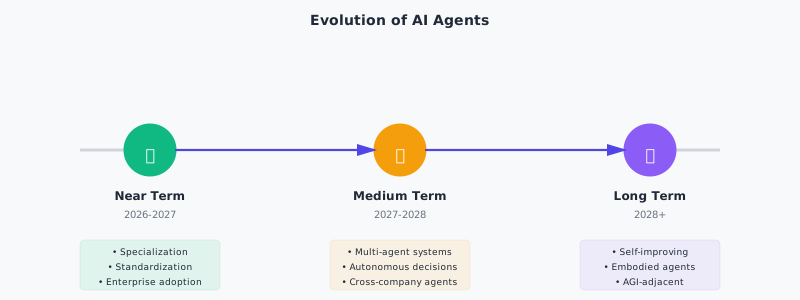
AI agents are still in the early stages of adoption, but the trajectory is clear. Here’s what we expect to see:
Near Term (2026-2027)
Specialization: Agents will become more specialized. Instead of general-purpose agents, we’ll see purpose-built agents for specific industries and use cases.
Standardization: Industry standards for agent communication, tool integration, and safety will emerge. Protocols like Anthropic’s Model Context Protocol (MCP) and Google’s Agent-to-Agent (A2A) protocol—both now donated to the Linux Foundation—are already laying this groundwork.
Enterprise adoption: More companies will move from experimentation to production deployments. We’ll see agents handling mission-critical workflows.
Medium Term (2027-2028)
Multi-agent systems: Complex workflows will use teams of agents that collaborate. A content agent, an editor agent, and a publisher agent will work together seamlessly.
Autonomous decision-making: Agents will be trusted with more autonomous decision-making, with humans only involved for major decisions.
Cross-company agents: Agents will operate across company boundaries. A supplier agent might communicate directly with a buyer agent to negotiate terms.
Long Term (2028+)
Self-improving agents: Agents will continuously improve themselves by learning from experience and optimizing their own prompts and workflows. For a deep-dive into the long-term trajectory, see Andrej Karpathy’s AGI timeline and the decade of AI agents
.
Embodied agents: AI agents will control physical systems—robots, vehicles, manufacturing equipment—bringing automation to the physical world.
AGI-adjacent capabilities: Advanced agents will approach general intelligence, capable of handling novel problems in unfamiliar domains.
Getting Started with AI Agents
The best time to start with AI agents is now. The technology is mature enough for production use, but early enough that you can gain competitive advantage by adopting it first.
Three Steps to Get Started
1. Identify a high-impact workflow
What task takes significant time and doesn’t require much human judgment? That’s a good candidate for an AI agent. Examples: content research, competitor monitoring, lead qualification.
2. Choose your approach
Do you want to build quickly without code? Start with FlowHunt
or a similar no-code platform. Do you need maximum flexibility? Use a developer framework like LangChain.
3. Start small and iterate
Build your first agent for one specific task. Get it working well. Then expand to other tasks. Don’t try to build the perfect agent on day one.
Frequently Asked Questions
What is the difference between an AI agent and a chatbot?
A chatbot responds to user inputs with pre-defined or AI-generated replies but cannot take actions in external systems. An AI agent perceives its environment, reasons about goals, uses tools (APIs, databases, search engines), and executes multi-step workflows autonomously—without requiring step-by-step human guidance. The key distinction is agency: a chatbot tells you; an agent does it for you.
How much does it cost to build an AI agent?
No-code AI agent platforms like FlowHunt start from free or a few hundred dollars per month for business use. Developer-built agents using LangChain or CrewAI cost primarily in LLM API usage (typically $0.01–$0.10 per run) plus engineering time. Enterprise deployments vary widely based on scale and integrations required.
Are AI agents safe to use in business?
AI agents are safe when deployed with proper guardrails: human-in-the-loop approval for high-stakes actions, scope-limited tool access, audit logging, and regular monitoring. The biggest risks are hallucinations causing incorrect actions and overly broad permissions. Starting with supervised agents before moving to fully autonomous ones is recommended.
Can AI agents replace human workers?
AI agents automate repetitive, rule-based, and data-heavy tasks rather than replace humans entirely. The World Economic Forum projects 92 million jobs displaced but 170 million new roles created by 2030. Most deployments augment workers—handling routine tasks so people can focus on strategy, creativity, and relationship-building.
What are the best AI agent frameworks for developers?
The most popular frameworks are LangChain (Python, most widely used), CrewAI (multi-agent role-based systems), AutoGen (Microsoft’s conversational multi-agent framework), and LlamaIndex (specialized for RAG-based agents). For no-code building, platforms like FlowHunt
offer 1,000+ integrations without programming.
How long does it take to build an AI agent?
A simple AI agent can be built in a few hours using a no-code platform. A production-grade custom agent using developer frameworks typically takes 1–4 weeks depending on integration complexity. Multi-agent systems for enterprise workflows may take several months to fully deploy and refine.
Conclusion
AI agents represent a fundamental shift in how we approach automation. Unlike traditional automation that requires explicit programming, or generative AI that requires human guidance, AI agents combine the best of both: they’re intelligent, autonomous, and capable of handling complex real-world workflows.
Whether you’re in marketing, SEO, customer service, operations, or any other function, AI agents can help you work smarter and faster. The organizations that master AI agent technology first will have a significant competitive advantage.
A chatbot responds to user inputs with pre-defined or AI-generated replies but cannot take actions in external systems. An AI agent perceives its environment, reasons about goals, uses tools (APIs, databases, search engines), and executes multi-step workflows autonomously—without requiring step-by-step human guidance.
No-code AI agent platforms like FlowHunt start from free or a few hundred dollars per month for business use. Developer-built agents using LangChain or CrewAI cost primarily in LLM API usage (typically $0.01–$0.10 per run) plus engineering time. Enterprise deployments vary widely based on scale and integrations required.
AI agents are safe when deployed with proper guardrails: human-in-the-loop approval for high-stakes actions, scope-limited tool access, audit logging, and regular monitoring. The biggest risks are hallucinations causing incorrect actions and overly broad permissions. Starting with supervised agents before moving to fully autonomous ones is recommended.
AI agents automate repetitive, rule-based, and data-heavy tasks rather than replace humans entirely. The World Economic Forum projects 92 million jobs displaced but 170 million new roles created by 2030. Most deployments augment workers—handling routine tasks so people can focus on strategy, creativity, and relationship-building.
The most popular frameworks are LangChain (Python, most widely used), CrewAI (multi-agent role-based systems), AutoGen (Microsoft's conversational multi-agent framework), and LlamaIndex (specialized for RAG-based agents). For no-code building, platforms like FlowHunt offer 1,000+ integrations without programming.
A simple AI agent can be built in a few hours using a no-code platform. A production-grade custom agent using developer frameworks typically takes 1–4 weeks depending on integration complexity. Multi-agent systems for enterprise workflows may take several months to fully deploy and refine.
Arshia is an AI Workflow Engineer at FlowHunt. With a background in computer science and a passion for AI, he specializes in creating efficient workflows that integrate AI tools into everyday tasks, enhancing productivity and creativity.
10 Real-World AI Agent Examples (And How to Build Your Own)
Explore 10 concrete, real-world AI agent examples — from customer support to financial research. See exactly what AI agents do, how they work, and how to build ...
An intelligent agent is an autonomous entity designed to perceive its environment through sensors and act upon that environment using actuators, equipped with a...
6 min read
AI
Intelligent Agents
+4
Cookie Consent We use cookies to enhance your browsing experience and analyze our traffic. See our privacy policy.