Is Your Team Experiencing Information Overload? Here's The AI Solution That Cuts Through The Noise
117 emails a day, interrupted every two minutes: the real data behind information overload, and why one structured digest beats another dashboard to check.
The average knowledge worker now encounters far more potentially relevant articles, newsletters, and updates every day than they can actually read. Microsoft’s 2025 Work Trend Index found employees are interrupted roughly every two minutes, 275 times a day, by emails, chats, and meetings (Microsoft WorkLab, 2025
). Reading everything is impossible and ignoring everything means missing opportunities and competitive threats.
How Much News Is Too Much? (The Data on Information Overload)
The scale of the problem predates AI tools. It’s a structural feature of how much gets published now. McKinsey Global Institute’s widely cited analysis found that interaction workers already spend around 28% of the workweek on email and another 19% searching for internal information, before counting industry news, competitor updates, or trend monitoring at all (McKinsey, “The Social Economy”
).
The practical effect isn’t just wasted time. It’s a binary choice teams make without meaning to: either someone reads everything, which doesn’t scale past a topic or two, or nothing gets consistently monitored, which means the team finds out about a competitor’s launch or a market shift after it’s already old news.
What makes this different from ordinary busywork is that skipping it has a real cost attached. A missed pricing change from a competitor shows up as a lost deal weeks later. A missed shift in industry sentiment shows up as a launch message that lands wrong. The information itself was available the whole time, published, indexed, searchable, it just never got read by the person who needed it, at the moment they needed it.
Why Existing Solutions (RSS, Google Alerts) Don’t Scale
RSS readers and Google Alerts solve a narrower problem than the one teams actually have. Both are built to reduce information overload AI, but they do it by surfacing every matching item rather than synthesizing across them. A Google Alert for a competitor name still sends one email per mention, ten mentions means ten emails, and each one is a raw link you still have to open and read. An RSS feed just moves the same reading load from your inbox to a reader app.
Neither tool does the part that actually saves time, which is deciding what’s important across everything it found and presenting a single, coherent answer. They’re built to catch things, not to reduce what you have to read once they’ve caught them.
This is also why both tend to get abandoned. A Google Alert that’s useful in week one becomes noise by week four once the novelty of catching every mention wears off and the volume of raw links piles up unread. An RSS reader with fifty subscribed feeds turns into an unread-count badge nobody opens. The tools didn’t fail at their job, catching mentions and aggregating feeds, they just were never built to solve the actual bottleneck, which is reading and synthesis time, not discovery.
Ready to grow your business?
Start your free trial today and see results within days.
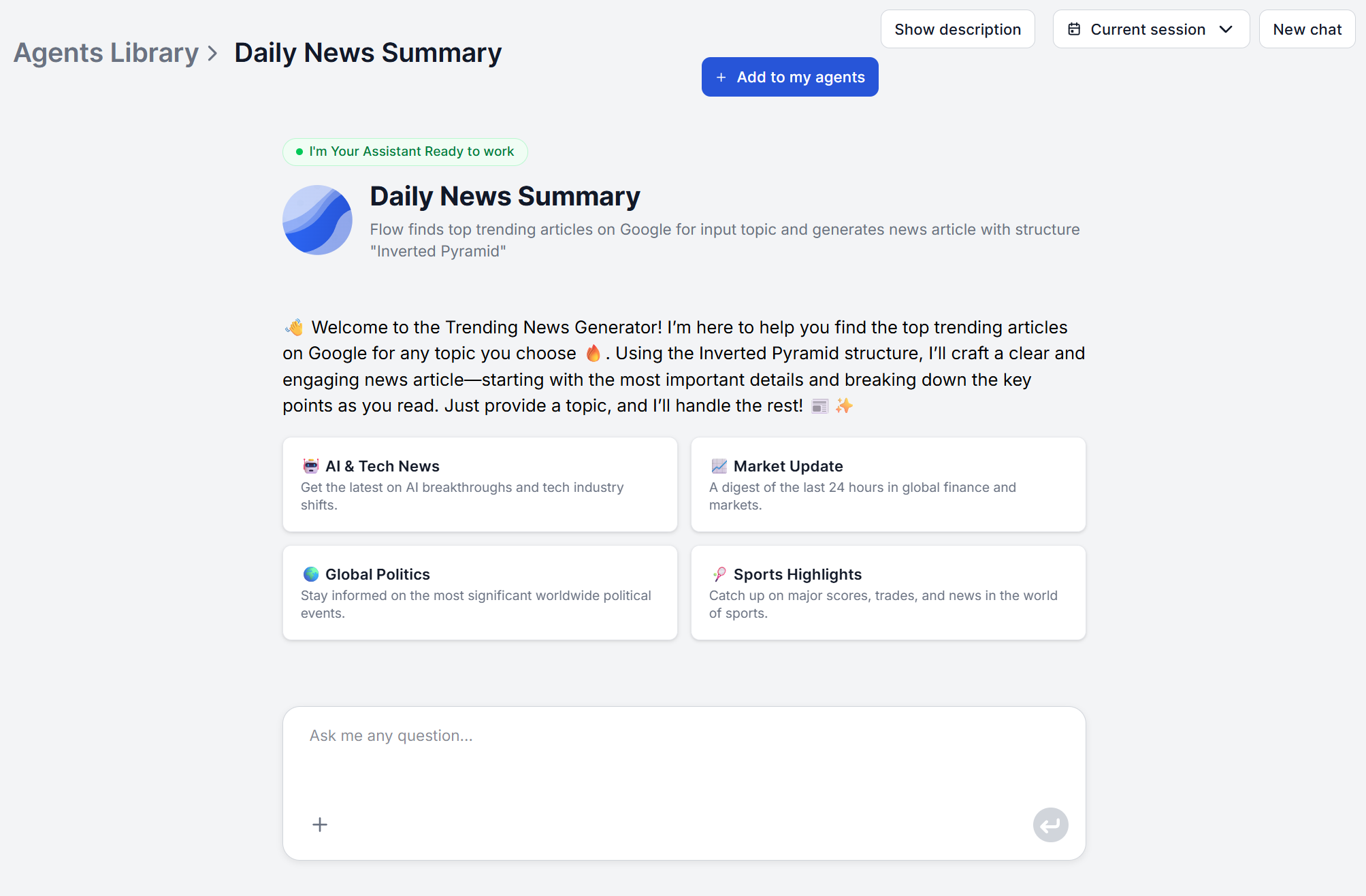
AI newsfilter for teams workflows like FlowHunt’s Daily News Summary
replace the catch-everything model with a search-extract-structure model, run against a single topic:
Searches recent news — finds current coverage on your topic, including trending results from sources like Google and YouTube, so what comes back reflects what’s actually being reported right now.
Extracts the key developments — identifies the most important information across sources rather than summarizing any single article on its own.
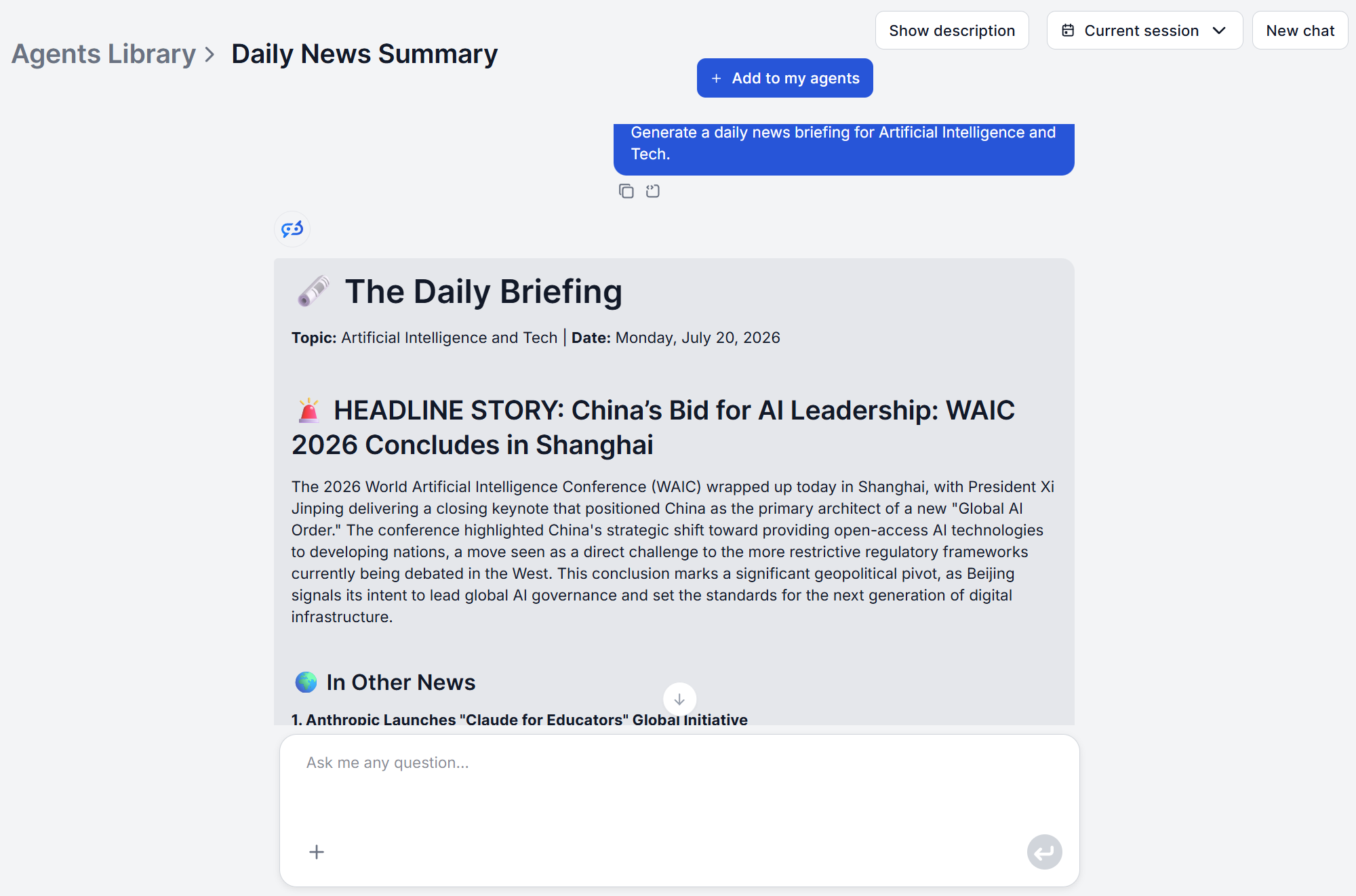
Produces a structured digest — organizes the findings into a clear, readable summary with the most important points up front.
The difference from RSS or alerts isn’t more coverage, it’s less reading for the same coverage. You get one digest instead of a folder of unread items. We ran this ourselves on July 20, 2026, the same day this article was written, to see it in practice:
Building a Team News Intelligence System in One Day
Setting this up doesn’t require a project plan. In practical terms:
Pick your topics. List the handful of things that actually matter, your company name, your top two or three competitors, the industry you operate in. Three to five topics is a reasonable starting point for most teams.
Run your first digests. Enter each topic into the Daily News Summary
chat interface. Each one returns a structured digest in seconds, no source list or research brief to prepare beforehand.
Connect delivery. Instead of leaving digests in a chat window someone has to remember to check, route them into Slack
, Gmail, or Notion via FlowHunt’s MCP integrations, so the team sees them where they already work.
Set up scheduled runs. Set the underlying workflow to run on a schedule by replacing the chat input with a scheduled tasks component. Then input your list of topics into the agent prompt to make it permanent. This way, you’ll get a fresh digest in your target channels as often as you find necessary.
By the end of one day, a team has a repeatable routine running on the topics that matter to them specifically, not a generic feed of everything.
Join our newsletter
Get latest tips, trends, and deals for free.
Avoiding the Trap of Monitoring Everything
The instinct once a team has a working monitoring system is to expand it to every topic that could possibly matter. This recreates the original problem in a new tool. A dozen digests a day is still too much to read carefully, even if each one is well structured.
Keep your monitoring narrow. Pick a handful of specific, well-chosen topics that map to actual decisions, competitor moves that affect sales strategy, industry shifts that affect the roadmap.
When a topic genuinely needs more than a daily digest, escalate it individually by pairin it with the AI Social Listening Tool
for the social and sentiment layer, or the AI Research Assistant
when it warrants a full, sourced deep-dive, rather than expanding the standing digest list to cover every possible angle.
A useful gut check is that if nobody could say in one sentence why a given topic is on the monitoring list, it probably shouldn’t be. “We’re tracking this competitor because we’re losing deals to them” is a reason. “We’re tracking this because it might be useful someday” is exactly the instinct that turned RSS readers and inboxes into the overload problem in the first place. The tool changes, but that discipline doesn’t.
Alert fatigue mostly comes from tools that ping you once per matching item, a Google Alert email per mention, a notification per RSS update. An AI news monitoring workflow avoids this structurally by consolidating everything into one digest per topic instead of one alert per article, so you get a single read instead of a stream of interruptions.
Start narrow with a handful of topics tied to an actual decision, a competitor set, your own company name, or your industry. Monitoring everything that could conceivably be relevant is how teams end up back at information overload.
Run narrower, more specific topic queries rather than one broad catch-all. A digest on a specific competitor's product line surfaces different results than one on the entire industry.
Yes. The Daily News Summary accepts any topic, even a niche subject, searching and summarizing whatever is currently being reported on it, the same way it would handle a broad topic.
Rather than asking stakeholders to log into another tool, FlowHunt connects to Slack, Gmail, Notion, and more, so a digest can be routed directly into any channel without separate login or copy-paste steps required.
Maria is a copywriter at FlowHunt. A language nerd active in literary communities, she's fully aware that AI is transforming the way we write. Rather than resisting, she seeks to help define the perfect balance between AI workflows and the irreplaceable value of human creativity.
Maria Stasová
Copywriter & Content Strategist
Set Up Your AI News Monitoring System
FlowHunt's Daily News Summary turns scattered coverage into one structured digest per topic, so your team reads less and misses less at the same time.
5 AI News Monitoring Use Cases: How Teams Stay Ahead Without Drowning in Content
From executive briefings to subscriber newsletters, these are five real AI news monitoring use cases teams rely on to stay informed without hours of manual cura...
How to Automate Your Daily News Monitoring With an AI News Summarizer Tool
An AI news summarizer tool turns daily news monitoring into a five-minute task. Here's how automated summary generation works and how to set up your first diges...
Best AI News Summarizer Comparison: FlowHunt vs Feedly AI vs Perplexity vs Inoreader
A best AI news summarizer comparison across FlowHunt, Feedly AI, Perplexity, and Inoreader — source coverage, summary quality, customization, and premium pricin...
8 min read
AI
News
+3
Cookie Consent We use cookies to enhance your browsing experience and analyze our traffic. See our privacy policy.