



脚本聊天机器人 vs AI 聊天机器人
探索脚本聊天机器人与AI聊天机器人的主要区别、实际应用,以及它们如何改变各行业的客户互动方式。
1 分钟阅读
Chatbots
AI
+4
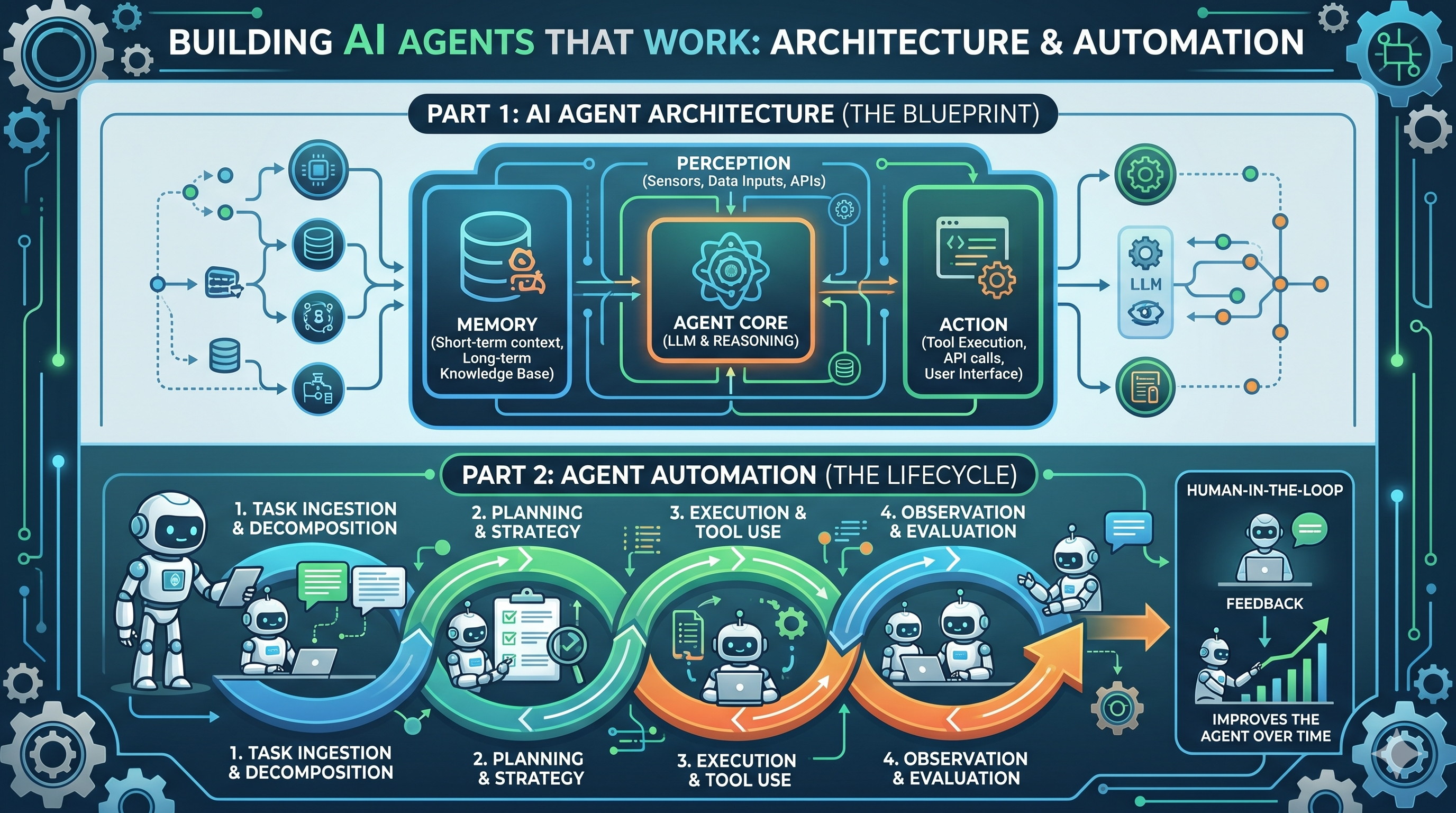
AI 智能体与聊天机器人有本质区别。聊天机器人等待用户输入并作出响应。而智能体则自主地追求目标,调用工具,对问题进行推理,并在每一步无需人工输入的情况下采取行动。
这种区别很重要,因为智能体可以自动化整个工作流。一个线索资格鉴定智能体会对潜在客户评分、丰富他们的数据并将他们分配给销售代表——全程无需人工干预。一个内容分流智能体会对支持工单进行分类、路由给专家,并将边缘情况升级给人类处理。
在本指南中,你将学习如何设计可靠智能体的架构,将它们与业务系统集成,防止常见故障,并衡量它们的影响。我们将介绍在企业生产环境中用于大规模自动化线索资格鉴定、文档处理和客户支持的真实模式。
AI 智能体是一个软件系统,它能够:
智能体是目标驱动的。你定义目标(“为该线索评分并资格鉴定”),智能体自行找出实现的方法。
User: "What's the status of my order?"
Chatbot: [Looks up order, responds]
User: "Can you cancel it?"
Chatbot: [Cancels order, responds]
用户主导每一次交互。聊天机器人是无状态的——每条消息相互独立。
Agent goal: "Qualify and score this lead"
1. Agent observes: [Lead data from CRM]
2. Agent reasons: "I need to enrich this data and score them"
3. Agent acts: Calls enrichment API
4. Agent observes: [Enriched data]
5. Agent reasons: "Score is 85, should assign to top sales rep"
6. Agent acts: Updates CRM, sends notification
7. Done. No human input required.
智能体朝着既定目标工作,自主做出多次决策并调用工具。
手动线索资格鉴定:每线索 5 分钟 × 100 个线索 = 每月 500 小时。成本:每月 10,000 美元(按每小时 20 美元计)。
由智能体驱动:每线索 10 秒 × 100 个线索 = 每月 16 小时。成本:100 美元(智能体 API 调用)。节省:99%。
智能体无需招聘即可倍增团队的产能。
复杂任务需要多个步骤:
智能体会自动处理这种推理。你定义目标;智能体将其分解为步骤。
智能体是"双手"。它们调用 API 来:
单个智能体可以协调 5-10 次工具调用来完成一个工作流。
智能体可以随着时间的推移而改进。如果智能体对文档分类错误,你提供反馈,智能体就会学习并调整其提示策略。
每个智能体的核心是一个循环:
┌─────────────────────────────────────────┐
│  START: Agent receives goal             │
└────────────────┬────────────────────────┘
                 │
                 ▼
┌─────────────────────────────────────────┐
│  OBSERVE: Read input, tool results,     │
│           memory, environment           │
└────────────────┬────────────────────────┘
                 │
                 ▼
┌─────────────────────────────────────────┐
│  REASON: LLM decides next action        │
│          (which tool to call, or done?) │
└────────────────┬────────────────────────┘
                 │
                 ▼
┌─────────────────────────────────────────┐
│  ACT: Execute tool call or complete     │
│       task                              │
└────────────────┬────────────────────────┘
                 │
                 ▼
┌─────────────────────────────────────────┐
│  FEEDBACK: Evaluate result, update      │
│            memory, check if goal met    │
└────────────────┬────────────────────────┘
                 │
                 ├─→ Goal not met? Loop back to OBSERVE
                 │
                 └─→ Goal met or max steps reached? DONE
智能体读取:
LLM 接收一个类似这样的提示:
You are a lead qualification agent. Your goal is to score and qualify this lead.

Available tools:
1. enrich_lead(lead_id) - Get additional data about the lead
2. score_lead(lead_data) - Score based on criteria
3. assign_to_sales_rep(lead_id, rep_id) - Assign lead to a rep
4. send_notification(rep_id, message) - Notify rep

Current state:
- Lead ID: 12345
- Company: Acme Corp
- Revenue: Unknown (need to enrich)
- Status: Not scored yet

What should you do next?
LLM 响应:“我应该先丰富线索以获取营收数据,然后评分,然后分配。”
智能体执行所选工具:
result = enrich_lead(lead_id=12345)
# Returns: {'revenue': '$10M', 'industry': 'SaaS', 'employees': 150}
智能体检查:工具调用是否成功?是否朝着目标前进?更新记忆并循环。
智能体重复观察 → 推理 → 行动 → 反馈,直到:
工具是智能体可以调用的函数。清楚地定义它们:
tools = [
    {
        "name": "enrich_lead",
        "description": "Get additional company data about a lead (revenue, employees, industry)",
        "parameters": {
            "lead_id": {"type": "string", "description": "Unique identifier of the lead"}
        }
    },
    {
        "name": "score_lead",
        "description": "Score a lead on a scale of 0-100 based on fit criteria",
        "parameters": {
            "lead_data": {"type": "object", "description": "Lead information including revenue, industry, etc."}
        }
    }
]
清晰的描述可帮助 LLM 选择正确的工具。
LLM 通过工具调用进行响应:
{
  "thought": "I need to enrich this lead to get revenue data",
  "action": "enrich_lead",
  "action_input": {"lead_id": "12345"}
}
你的智能体框架执行工具,并将结果传回给 LLM。
同时处理成功与失败:
def execute_tool(tool_name, tool_input):
    try:
        if tool_name == "enrich_lead":
            result = crm_api.enrich(tool_input['lead_id'])
            return {"status": "success", "data": result}
    except Exception as e:
        return {"status": "error", "message": str(e)}
如果工具失败,智能体应尝试不同的方式或升级给人类。
智能体的工作记忆:当前输入、工具结果、推理步骤。通常存储在上下文窗口(提示)中。
示例:线索资格鉴定智能体记住:
持久化记忆:过去的决策、学到的模式、知识库。
使用场景:
使用向量数据库(Pinecone、Weaviate)实现语义搜索。
LLM 具有有限的上下文窗口(4K-128K tokens)。智能体不能记住所有内容。策略:
对于大多数智能体,Claude 或开源模型足够且更便宜。
示例 reflexion 提示:
Agent: "I'll assign this lead to rep John."
Critic: "Wait, did you check if John is already at capacity?"
Agent: "Good point. Let me check John's workload first."
实时场景选择速度(客户支持)。高风险场景选择准确度(财务决策)。
响应式智能体做出单一决策并执行。没有多步规划。
Input: "What's my account balance?"
→ Agent queries database
→ Agent responds with balance
Done.
def customer_service_agent(question):
    # 1. Search knowledge base
    articles = search_kb(question)

    # 2. LLM picks best article
    response = llm.complete(f"""
        Question: {question}
        Relevant articles: {articles}
        Provide an answer based on these articles.
    """)

    # 3. Return response
    return response
延迟:1-3 秒。成本:每次查询 0.001-0.01 美元。
规划智能体将复杂目标分解为步骤。
Goal: "Qualify and assign this lead"
→ Agent plans: [enrich, score, assign, notify]
→ Agent executes each step
→ Agent verifies goal achieved
Done.
def lead_qualification_agent(lead_id):
    lead = crm.get_lead(lead_id)

    # Step 1: Enrich
    enriched = enrich_lead(lead)

    # Step 2: Score
    score = score_lead(enriched)

    # Step 3: Assign
    best_rep = find_best_sales_rep(score)
    crm.assign_lead(lead_id, best_rep)

    # Step 4: Notify
    send_slack(f"New qualified lead assigned to {best_rep}")

    return {"lead_id": lead_id, "score": score, "assigned_to": best_rep}
延迟:5-15 秒。成本:每线索 0.02-0.05 美元。
学习智能体通过反馈变得更好。
Initial: Agent classifies document as "Invoice" (60% confidence)
Human feedback: "Actually, it's a Receipt"
Agent learns: Adjust classification prompts
Next time: Same document classified as "Receipt" (90% confidence)
def recommendation_agent(user_id):
    # Get user history
    history = db.get_user_history(user_id)

    # LLM recommends based on patterns
    recommendation = llm.complete(f"""
        User history: {history}
        Based on past preferences, what should we recommend?
    """)

    # Show recommendation, collect feedback
    feedback = user_feedback  # thumbs up/down

    # Store feedback for future recommendations
    db.log_feedback(user_id, recommendation, feedback)

    return recommendation
随着时间推移,智能体学习用户偏好,推荐质量不断提高。
主管智能体协调专家智能体。
Supervisor: "Process this support ticket"
├─ Classifier agent: "This is a billing issue"
├─ Billing specialist agent: "Refund $50"
└─ Notification agent: "Send confirmation email"
def content_pipeline_agent(topic):
    # Supervisor delegates
    research = research_agent(topic)
    draft = writer_agent(research)
    edited = editor_agent(draft)
    published = publisher_agent(edited)

    return {"topic": topic, "status": "published"}
每个专家智能体针对其任务进行了优化。主管进行协调。
智能体思考的复杂程度。简单智能体使用 chain-of-thought。复杂智能体使用规划和 reflexion。
你能轻易连接 API、数据库、CRM 系统吗?还是需要自定义代码?
开发者多快能得到一个可用的智能体?无代码平台更快;Python 框架更灵活。
有些框架是开源的(免费)。其他按 API 调用或订阅收费。
每个工具针对什么进行了优化?
| 工具 | 框架类型 | 推理能力 | 工具集成 | 学习曲线 | 定价 | 最适合 |
|---|---|---|---|---|---|---|
| n8n | 可视化工作流构建器 | Chain-of-thought | 500+ 集成 | 低 | 免费 + 付费 | 非技术用户、快速搭建 |
| CrewAI | Python 框架 | 规划 + reflexion | 自定义工具(Python) | 中等 | 开源 | 开发者、复杂智能体 |
| Autogen | Python 框架 | 多智能体推理 | 自定义工具 | 高 | 开源 | 研究、多智能体系统 |
| LangGraph | Python 框架 | 规划 + 状态管理 | LangChain 生态系统 | 中等 | 开源 | 复杂工作流、状态跟踪 |
| FlowHunt | 原生平台 | Chain-of-thought + 规划 | 原生 + API 集成 | 低 | 订阅 | 工作流自动化、易用性 |
| Lindy.ai | 无代码平台 | Chain-of-thought | 100+ 集成 | 非常低 | 免费增值 | 非技术、快速智能体 |
| Gumloop | 无代码平台 | Chain-of-thought | 50+ 集成 | 非常低 | 免费增值 | 简单自动化、模板 |
主要差异:

免费获取最新提示、趋势和优惠。
要具体。差:“自动化线索管理。“好:“对线索进行 0-100 评分,以公司数据丰富,按容量分配给销售代表。”
权衡:
输入数据:线索数据、文档文本、客户问题、来自记忆的上下文。
列出智能体将调用的 API、数据库、服务。
线索资格鉴定示例:
定义成功条件。“当线索被评分并分配时停止。”
还需定义最大步数以防止无限循环。“无论如何,10 步后停止。”
CrewAI 示例:
from crewai import Agent, Task, Crew

# Define agents
enrichment_agent = Agent(
    role="Data Enrichment Specialist",
    goal="Enrich lead data with company information",
    tools=[enrich_tool]
)

scoring_agent = Agent(
    role="Lead Scoring Expert",
    goal="Score leads based on fit criteria",
    tools=[score_tool]
)

assignment_agent = Agent(
    role="Sales Manager",
    goal="Assign leads to best sales rep",
    tools=[assign_tool, notify_tool]
)

# Define tasks
enrich_task = Task(
    description="Enrich this lead: {lead_id}",
    agent=enrichment_agent
)

score_task = Task(
    description="Score the enriched lead",
    agent=scoring_agent
)

assign_task = Task(
    description="Assign lead to best rep and notify",
    agent=assignment_agent
)

# Run crew
crew = Crew(agents=[enrichment_agent, scoring_agent, assignment_agent],
            tasks=[enrich_task, score_task, assign_task])
result = crew.kickoff(inputs={"lead_id": "12345"})
def test_enrichment_tool():
    result = enrich_tool("lead_123")
    assert result['revenue'] is not None
    assert result['employees'] is not None

def test_scoring_agent():
    lead = {"company": "Acme", "revenue": "10M", "employees": 50}
    score = score_agent(lead)
    assert 0 <= score <= 100

def test_full_loop():
    result = lead_qualification_agent("lead_123")
    assert result['assigned_to'] is not None
    assert result['score'] > 0
def lead_qualification_agent(lead_id):
    """
    Autonomous agent that qualifies leads.
    1. Fetches lead from CRM
    2. Enriches with company data
    3. Scores based on fit criteria
    4. Assigns to best sales rep
    5. Notifies rep
    """
tools = {
    "get_lead": crm.get_lead,
    "enrich_lead": enrichment_api.enrich,
    "score_lead": scoring_model.score,
    "find_best_rep": crm.find_available_rep,
    "assign_lead": crm.assign,
    "send_notification": slack.send
}
# Step 1: Observe
lead = get_lead(lead_id)
print(f"Observing lead: {lead['company']}")

# Step 2: Reason (LLM decides next action)
# LLM: "I need to enrich this lead first"

# Step 3: Act
enriched = enrich_lead(lead)
print(f"Enriched: revenue={enriched['revenue']}")

# Step 4: Feedback + Loop
# LLM: "Now I'll score"

# Step 5: Act
score = score_lead(enriched)
print(f"Score: {score}")

# Step 6: Reason
# LLM: "Score is {score}, should assign to top rep"

# Step 7: Act
best_rep = find_best_rep(score)
assign_lead(lead_id, best_rep)
send_notification(best_rep, f"New lead: {lead['company']}")

print(f"Assigned to {best_rep}")
大多数智能体调用 REST API。使用标准 HTTP 客户端:
def call_crm_api(endpoint, method="GET", data=None):
    url = f"https://api.crm.com/{endpoint}"
    headers = {"Authorization": f"Bearer {api_key}"}

    if method == "GET":
        response = requests.get(url, headers=headers)
    elif method == "POST":
        response = requests.post(url, json=data, headers=headers)

    return response.json()
基于事件触发智能体(新线索、收到电子邮件、表单提交):
@app.post("/webhook/new_lead")
def on_new_lead(lead_data):
    # Trigger agent asynchronously
    queue.enqueue(lead_qualification_agent, lead_data['id'])
    return {"status": "queued"}
from ratelimit import limits, sleep_and_retry

@sleep_and_retry
@limits(calls=100, period=60)  # 100 calls per minute
def call_api(endpoint):
    return requests.get(f"https://api.example.com/{endpoint}")
智能体读取客户数据、过去交互、知识库:
def get_customer_history(customer_id):
    query = "SELECT * FROM interactions WHERE customer_id = %s"
    return db.execute(query, (customer_id,))
智能体将决策写入数据库:
def store_lead_score(lead_id, score, assigned_to):
    db.execute(
        "UPDATE leads SET score = %s, assigned_to = %s WHERE id = %s",
        (score, assigned_to, lead_id)
    )
对多步操作使用事务:
with db.transaction():
    score = score_lead(lead)
    db.update_lead_score(lead_id, score)
    rep = find_best_rep(score)
    db.assign_lead(lead_id, rep)
    # All-or-nothing: if any step fails, rollback
使用官方 SDK:
from salesforce import SalesforceAPI

sf = SalesforceAPI(api_key=key)

# Update lead
sf.update_lead(lead_id, {
    'score': 85,
    'assigned_to': 'john@acme.com',
    'status': 'qualified'
})
from slack_sdk import WebClient

slack = WebClient(token=slack_token)

# Notify sales rep
slack.chat_postMessage(
    channel="john",
    text=f"New qualified lead: {lead['company']} (score: {score})"
)
使用 OAuth 范围限制智能体能做什么:
# Agent can only read leads, update scores
# Cannot delete leads or access sensitive data
oauth_scopes = ["leads:read", "leads:update"]
高风险决策:金融交易、客户退款、政策例外。
if decision_risk_score > 0.7:
    # Route to human for approval
    escalate_to_human(decision, reason="High risk")
else:
    # Agent executes decision
    execute_decision(decision)
def lead_qualification_with_escalation(lead_id):
    score = score_lead(lead_id)

    if score > 80:
        # High confidence, assign directly
        assign_lead(lead_id, best_rep)
    elif 50 < score < 80:
        # Medium confidence, route to human
        escalate_to_human(lead_id, "Review and assign")
    else:
        # Low score, reject
        reject_lead(lead_id)
@app.post("/feedback/lead_score")
def on_score_feedback(lead_id, actual_score, agent_score):
    # Store feedback
    db.log_feedback(lead_id, agent_score, actual_score)

    # Retrain model on feedback (periodic)
    if should_retrain():
        retrain_scoring_model()
# Bad: Agent keeps calling same tool
Agent thinks: "I need to get lead data"
→ Calls get_lead()
→ Still doesn't have enriched data
→ Calls get_lead() again
→ Infinite loop
max_steps = 10
steps_taken = 0

while steps_taken < max_steps:
    action = llm.decide_next_action()

    if action == last_action:
        # Same action twice, break loop
        break

    execute_action(action)
    steps_taken += 1
try:
    result = agent.run(timeout=30)  # 30 second timeout
except TimeoutError:
    escalate_to_human("Agent loop timeout")
# Bad: Agent hallucinates tool output
Agent: "I called enrich_lead, got revenue=$100M"
Reality: enrich_lead() returned null (API failed)
Agent made up the result
def execute_tool_safely(tool_name, params):
    try:
        result = execute_tool(tool_name, params)

        # Validate result
        if result is None:
            return {"error": "Tool returned null"}

        if not validate_result(result):
            return {"error": "Result failed validation"}

        return result
    except Exception as e:
        return {"error": str(e)}
使用 RAG 将智能体锚定在事实之上:
# Instead of: "Summarize this article"
# Use: "Summarize this article, citing specific passages"

knowledge_base = vector_db.search(query)
prompt = f"""
Summarize this article. Only cite specific passages.
Article: {article}
Knowledge base: {knowledge_base}
"""
def robust_agent_call(goal, retries=3):
    for attempt in range(retries):
        try:
            result = agent.run(goal)

            # Validate result
            if validate(result):
                return result
        except Exception as e:
            if attempt == retries - 1:
                escalate_to_human(goal)
            else:
                time.sleep(2 ** attempt)  # Backoff
# Bad: Ambiguous tool description
"update_lead - Update a lead"

# Good: Clear description
"update_lead - Update a lead's score, status, or assigned_to field.
Parameters: lead_id (required), score (0-100), status (qualified/disqualified),
assigned_to (sales rep email)"
# Validate before execution
tool_call = llm.decide_tool_call()

if not validate_tool_call(tool_call):
    # Tool call is invalid, ask LLM to fix
    llm.correct_tool_call(tool_call)
else:
    execute_tool(tool_call)

def validate_tool_call(call):
    tool = tools[call['name']]
    required_params = tool['required_parameters']

    for param in required_params:
        if param not in call['params']:
            return False

    return True
try:
    result = execute_tool(tool_call)
except ToolExecutionError as e:
    # Suggest correct tool
    correct_tool = suggest_correct_tool(e)
    llm.suggest_retry(correct_tool)
# Bad: Agent calls same tool multiple times
Agent: "Let me get lead data"
→ Calls get_lead()
→ Calls get_lead() again (forgot it already did)
→ Calls get_lead() a third time
Cost: 3x higher than needed
budget = {"tokens": 10000, "api_calls": 50}
spent = {"tokens": 0, "api_calls": 0}

def execute_with_budget(action):
    global spent

    if spent['api_calls'] >= budget['api_calls']:
        raise BudgetExceededError()

    result = execute_action(action)
    spent['api_calls'] += 1

    return result
实现缓存:
cache = {}

def get_lead_cached(lead_id):
    if lead_id in cache:
        return cache[lead_id]

    result = crm_api.get_lead(lead_id)
    cache[lead_id] = result
    return result
if cost_this_hour > budget_per_hour:
    # Switch to cheaper model
    switch_to_model("gpt-3.5-turbo")  # Cheaper than GPT-4
一个进行 5 次顺序 API 调用(每次 1 秒)的智能体 = 5+ 秒延迟。
# Parallel execution
import asyncio

async def parallel_agent(lead_id):
    lead = await get_lead_async(lead_id)

    # Call multiple tools in parallel
    enrichment, scoring = await asyncio.gather(
        enrich_lead_async(lead),
        score_lead_async(lead)
    )

    return (enrichment, scoring)
使用更快的模型:
# Instead of GPT-4 (slower, more accurate)
# Use GPT-3.5-turbo (faster, still accurate enough)
model = "gpt-3.5-turbo"  # 200ms latency vs 500ms for GPT-4
try:
    result = agent.run(timeout=5)  # 5 second timeout
    return result
except TimeoutError:
    # Return partial results
    return partial_result
    # Queue for async completion
    queue.enqueue(complete_agent, lead_id)
将智能体输出与基准事实(人工审查、实际结果)进行比较。
correct = 0
total = 100

for decision in agent_decisions:
    if decision == human_review[decision.id]:
        correct += 1

accuracy = correct / total * 100  # e.g., 94%
测量从输入到输出的端到端时间。
start = time.time()
result = agent.run(input_data)
latency = time.time() - start  # e.g., 8.5 seconds
cost = (llm_api_calls * llm_cost) + (tool_calls * tool_cost) + (human_review_rate * hourly_rate)
# e.g., $0.03 per lead
调查用户:“你对智能体的决策满意度如何?”
automated = tasks_completed_by_agent
total = all_tasks
automation_rate = automated / total * 100  # e.g., 87%
Manual lead qualification:
- 100 leads/month
- 5 minutes per lead
- 500 hours/month
- $20/hour = $10,000/month
Agent-driven:
- 100 leads/month
- $0.03 per lead (API calls)
- $3 total API cost
- $500/month human review (10% escalation)
- $100/month infrastructure
Total: $603/month
Savings per month: $10,000 - $603 = $9,397
ROI: 1,557% (9,397 / 603)
Payback period: < 1 month (immediate)
Manual process:
- 500 leads/month
- 5 min per lead = 2,500 hours = $50,000/month

Agent process:
- 500 leads/month
- $0.03 per lead = $15
- 5% escalation (25 leads) = $250 human time
- Infrastructure = $500
Total: $765/month

Savings: $50,000 - $765 = $49,235/month
ROI: 6,436%
# Track daily metrics
daily_metrics = {
    'accuracy': 0.94,
    'latency': 8.5,
    'cost_per_task': 0.03,
    'automation_rate': 0.87
}
# Test 1: GPT-4 (more accurate, slower)
# Test 2: GPT-3.5-turbo (faster, slightly less accurate)

# Measure: accuracy, latency, cost
# Choose based on your priorities
# Collect human feedback on agent mistakes
feedback = db.get_feedback()

# Retrain agent (adjust prompts, add examples)
agent.retrain(feedback)

# Measure: accuracy improves from 94% to 96%
监控 ROI。如果智能体没有产生价值,就淘汰它。将成功的智能体扩展到其他团队。
FAQ 部分从 frontmatter 自动渲染并显示在下方。
{{ cta-dark-panel heading=“构建智能体,告别复杂性” description=“FlowHunt 原生智能体平台处理工具集成、错误处理和监控。在几分钟内开始构建自主工作流,而不是几周。” ctaPrimaryText=“免费试用 FlowHunt” ctaPrimaryURL=“https://app.flowhunt.io/sign-in" ctaSecondaryText=“预约演示” ctaSecondaryURL=“https://www.flowhunt.io/demo/" gradientStartColor="#7c3aed” gradientEndColor="#ec4899” gradientId=“cta-ai-agents” }}
阿尔西亚是 FlowHunt 的一名 AI 工作流程工程师。拥有计算机科学背景并热衷于人工智能,他专注于创建高效的工作流程,将 AI 工具整合到日常任务中,从而提升生产力和创造力。

探索脚本聊天机器人与AI聊天机器人的主要区别、实际应用,以及它们如何改变各行业的客户互动方式。

通过我们的全面指南,学习如何从零开始构建 AI 聊天机器人。了解最佳工具、框架,以及使用 FlowHunt 零代码平台创建智能对话 AI 系统的详细流程。...
智能体是一种自主实体,能够通过传感器感知其环境,并利用执行器对环境进行操作,具备用于决策和问题解决的人工智能能力。...
Cookie 同意
我们使用 cookie 来增强您的浏览体验并分析我们的流量。 See our privacy policy.