Building a Context Engine for AI Agents: Reducing Token Consumption and Improving Accuracy
Learn how to build an efficient context engine for AI agents that reduces token consumption by 23% while improving accuracy through intelligent context management.
The efficiency of AI agents depends critically on one fundamental factor: having access to the right information at the right time. As organizations deploy more sophisticated AI agents internally, a clear pattern has emerged—when agents receive properly curated and indexed context, their accuracy improves dramatically while their token consumption decreases significantly. This shift represents a fundamental change in how we think about AI agent architecture. Rather than providing agents with raw, unfiltered access to all available data, modern approaches focus on building intelligent context engines that serve as the brain of AI systems. In this article, we’ll explore how to build and implement a context engine, why it matters for your organization, and how it can reduce operational costs while improving agent performance.
What is a Context Engine?
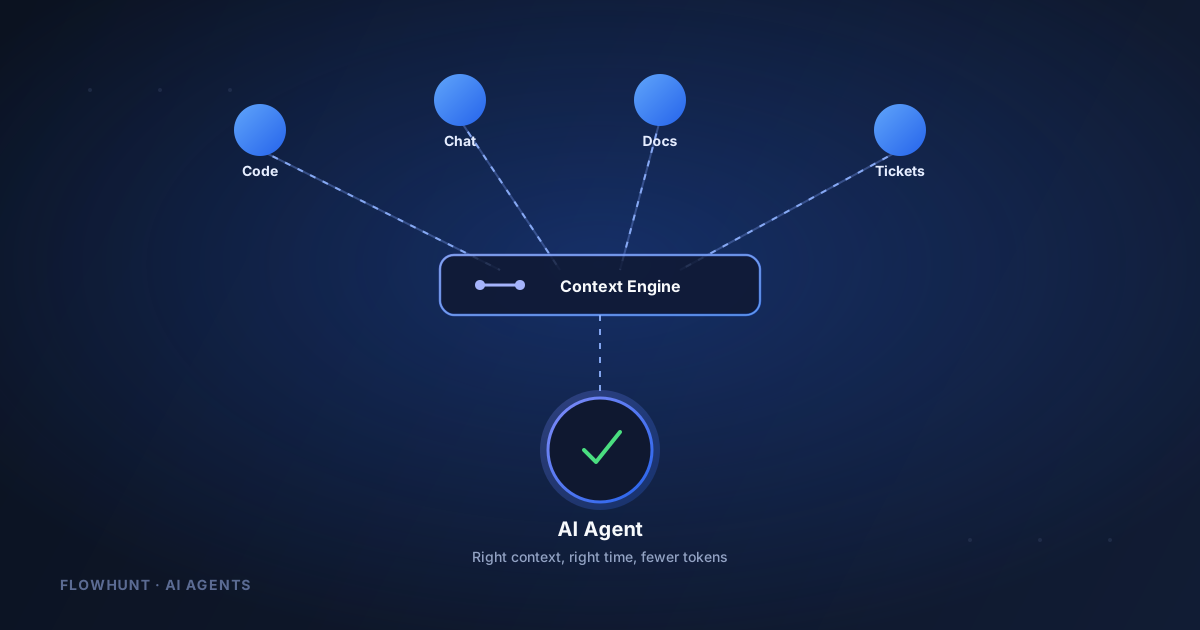
A context engine is fundamentally a sophisticated system designed to aggregate, index, and serve contextual information to AI agents in the most efficient way possible. Rather than forcing agents to search through entire repositories, documentation, or data stores manually, a context engine acts as an intelligent intermediary that understands what context an agent needs and delivers it precisely when required.
The core principle behind a context engine is optimization. Traditional AI agent architectures often suffer from what might be called “context bloat”—agents receive too much information, leading to longer processing times, higher token consumption, and sometimes even reduced accuracy due to noise in the context window. A context engine solves this by implementing intelligent filtering and indexing mechanisms that ensure agents only receive the most relevant data for their specific task.
Ready to grow your business?
Start your free trial today and see results within days.
Why Context Management Matters for AI Agent Performance
In the rapidly evolving landscape of AI-powered development, the ability to manage context efficiently has become a competitive advantage. As organizations scale their use of AI agents for code review, bug fixing, documentation generation, and other complex tasks, the cost implications of inefficient context management become increasingly significant.
Consider the practical implications:
Token efficiency: Every token consumed by an AI model represents a direct cost. Unnecessary context increases token consumption exponentially, leading to higher operational expenses and slower response times.
Accuracy improvement: When agents have access to precisely the right context without noise or irrelevant information, their decision-making improves. They can focus on solving the actual problem rather than parsing through extraneous data.
Scalability: As the number of agents and the complexity of tasks increase, manual context management becomes impossible. An automated context engine enables organizations to scale their AI operations without proportional increases in costs.
Real-time responsiveness: A well-designed context engine can serve fresh, up-to-date information to agents, ensuring they always work with current data rather than stale snapshots.
How FlowHunt Integrates Context Engine Principles
FlowHunt recognizes that modern AI workflows require intelligent context management at their core. As an AI agent platform, its job is to make sure your intelligent agents always work from the right slice of your data, not the whole warehouse. The platform incorporates context engine principles into its automation framework, enabling users to build AI-powered workflows that maintain efficiency even at scale. By integrating with multiple data sources and implementing smart indexing, FlowHunt ensures that your AI agents—whether they’re generating content, reviewing code, or analyzing data—always have access to the most relevant context without the overhead of processing irrelevant information.
Join our newsletter
Get latest tips, trends, and deals for free.
Building an Effective Context Engine: Architecture and Components
A production-grade context engine requires careful architectural planning. The system must handle multiple data sources simultaneously, index information efficiently, and serve that context to various AI agents through a standardized protocol.
Webhook receivers, API connectors, event listeners
The most effective context engines employ a hybrid approach, combining multiple retrieval strategies. Rather than relying solely on one method, they use intelligent routing to determine whether context should come from the indexed engine, direct file access, or documentation lookups based on the specific query and the agent’s requirements. In practice, that query interface is usually exposed as an MCP server, so any compatible agent can connect to it the same way it would connect to any other tool.
The FlowHunt Context Engine: Practical Implementation
FlowHunt has developed an open-source context engine specifically designed for AI agent workflows. Accessible through harx.dev, this context engine demonstrates how to practically implement context management in production environments. The system is built on top of the Model Context Protocol (MCP), a standardized interface that allows multiple AI agents to query the context engine regardless of their underlying architecture.
The implementation includes several key features:
Multi-source integration: The context engine aggregates data from GitHub repositories, Slack channels, Discord servers, Stripe billing information, YouTube content, websites, and ticketing systems. This comprehensive integration means agents have access to organizational knowledge from every critical system.
Intelligent file system management: The engine automatically organizes indexed data into logical entities—bug reports, feature requests, user invoices, customer information—making it easy for agents to navigate and retrieve specific information.
Real-time updates: As new events occur within connected platforms, the context engine automatically processes and indexes them, ensuring agents always work with current information.
Cost-aware design: The entire system is built with token efficiency in mind, using sophisticated algorithms to determine what context is truly necessary for any given query.
Measuring Impact: Real-World Results from Code Review Tasks
The theoretical benefits of a context engine are compelling, but real-world validation is essential. FlowHunt conducted a comprehensive evaluation of its context engine using actual code review tasks performed by their internal coding agent. The results provide concrete evidence of the approach’s effectiveness.
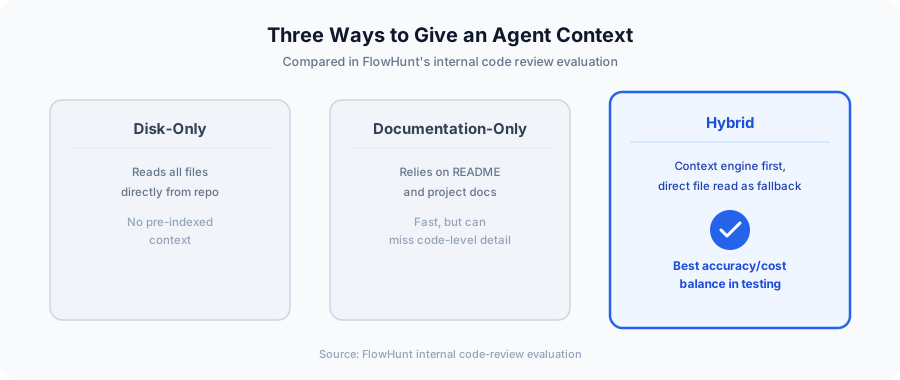
The evaluation compared three distinct approaches to providing context to the code review agent:
Disk-only approach: The agent reads all relevant files directly from the repository without any pre-indexed context.
Documentation-only approach: The agent relies solely on project documentation and README files.
Hybrid approach: The agent uses the context engine for indexed context while maintaining the ability to read files directly from the repository when needed.
The results were striking. The hybrid approach, which combines the context engine with selective file access, achieved the best balance of accuracy and cost efficiency. Specifically, this method reduced token consumption by 23% compared to traditional approaches while maintaining or improving accuracy metrics. This represents a significant cost reduction for organizations running multiple agents continuously.
The data demonstrates that the most efficient path forward isn’t choosing between context engines and traditional file access—it’s intelligently combining both approaches. The context engine serves as the primary source for frequently needed information, while direct file access provides a fallback for edge cases or specialized queries.
Implementing Context Engines Across Different AI Platforms
One of the most powerful aspects of a well-designed context engine is its platform-agnostic nature. Rather than building separate context systems for each AI agent type, a unified context engine can serve multiple agent frameworks simultaneously.
The FlowHunt context engine demonstrates this principle by supporting integration with:
Harx (FlowHunt’s internal coding agent)
Claude Code (Anthropic’s coding assistant)
Codeex (specialized code execution agent)
Pi.dev (Python-focused development agent)
Harness (deployment and testing platform)
This multi-platform approach offers significant advantages. Organizations can standardize their context infrastructure while still maintaining flexibility to choose different agent implementations for different tasks. The context engine becomes the reliable backbone that ensures all agents, regardless of their specific architecture, have access to consistent, high-quality context.
The Economics of Token Optimization
Understanding the financial implications of context engine implementation is crucial for decision-making. Token consumption directly translates to operational costs when using commercial AI models. A 23% reduction in token consumption represents a substantial cost savings, particularly for organizations running agents continuously.
Consider a scenario: an organization running code review agents on 100 pull requests daily, with each review consuming an average of 10,000 tokens. A 23% reduction through context engine implementation would save approximately 230,000 tokens daily. Over a month, that’s nearly 7 million tokens—representing thousands of dollars in reduced API costs. For larger organizations, these savings scale proportionally.
Beyond direct cost reduction, token optimization enables faster agent response times. Smaller context windows mean faster processing, enabling agents to complete tasks more quickly and provide feedback to developers faster. This creates a multiplier effect where cost savings combine with improved productivity.
Best Practices for Context Engine Deployment
Successful context engine implementation requires careful planning and execution. Several best practices have emerged from real-world deployments:
Start with your highest-value use cases: Rather than attempting to index all organizational data immediately, begin with the specific tasks where token consumption is highest and context efficiency matters most. Code review, documentation generation, and bug triage are excellent starting points.
Implement incremental source integration: Don’t attempt to connect all data sources simultaneously. Build integrations incrementally, validating that each new source actually improves agent performance before adding the next.
Monitor and measure continuously: Establish baseline metrics before implementing your context engine, then track changes carefully. Token consumption, accuracy rates, response times, and cost metrics should all be monitored consistently.
Use hybrid approaches: The data strongly suggests that pure context engine approaches aren’t optimal. Instead, combine indexed context with the ability to access source files directly, allowing agents to choose the most efficient retrieval method for each query.
Plan for scale: Design your context engine with growth in mind. As you add more agents and more data sources, the system must continue to perform efficiently without degradation.
The Future of AI Agent Architecture
The emergence of context engines as a critical component of AI agent architecture represents a maturation of the field. Early AI agent implementations treated context as an afterthought—agents received whatever data was available and did their best to work with it. Modern approaches recognize that context management is fundamental to agent performance.
Looking forward, context engines will likely become increasingly sophisticated. Machine learning models that predict which context will be most relevant for specific task types could further optimize token consumption. Integration with more specialized data sources and domain-specific knowledge bases will enable agents to work more effectively in specialized domains. Real-time learning systems could adjust context serving strategies based on agent performance feedback.
The principle underlying all these developments remains constant: the most powerful AI agents aren’t those with the largest models or the most raw computing power, but those with access to precisely the right context at the right time.
Conclusion
Building an effective context engine for AI agents is no longer optional for organizations serious about AI-driven automation. The evidence is clear—a well-implemented context engine reduces token consumption by 23% while improving accuracy, directly translating to lower costs and better agent performance. The technology is mature enough for production deployment, with open-source implementations available and proven results from real-world use cases.
The path forward involves implementing context engines as a core component of your AI infrastructure, starting with high-value use cases and expanding incrementally. By combining indexed context with selective direct access, organizations can achieve optimal efficiency. The organizations that adopt context engines early will gain significant competitive advantages through lower operational costs, faster agent response times, and improved accuracy in AI-driven tasks.
Supercharge Your Workflow with FlowHunt
Experience how FlowHunt automates your AI content and SEO workflows — from research and content generation to publishing and analytics — all in one place.
A context engine is a system that aggregates data from multiple sources within your organization and indexes it efficiently so AI agents can fetch the right context at the right time, improving accuracy and reducing token consumption.
In real-world testing with code review tasks, implementing a hybrid context engine approach reduced token consumption by 23% while maintaining or improving accuracy.
A context engine can integrate with GitHub repositories, Slack, Discord, Stripe, YouTube channels, websites, ticketing systems, and many other platforms to provide comprehensive context to AI agents.
Yes, the context engine discussed is available as an open-source project and can be accessed and implemented through platforms like harx.dev and integrated with various AI coding agents.
Arshia is an AI Workflow Engineer at FlowHunt. With a background in computer science and a passion for AI, he specializes in creating efficient workflows that integrate AI tools into everyday tasks, enhancing productivity and creativity.
Arshia Kahani
AI Workflow Engineer
Optimize Your AI Workflows with FlowHunt
Discover how FlowHunt integrates context engines to maximize AI agent efficiency and reduce operational costs.
Context Engineering for AI Agents: Mastering Token Optimization and Agent Performance
Learn how context engineering optimizes AI agent performance by strategically managing tokens, reducing context bloat, and implementing advanced techniques like...
Advanced AI Agents with File Access: Mastering Context Offloading and State Management
Learn how to build sophisticated AI agents with file system access, implement context offloading strategies, and optimize token usage through advanced state man...
Long Live Context Engineering: Building Production AI Systems with Modern Vector Databases
Explore how context engineering is reshaping AI development, the evolution from RAG to production-ready systems, and why modern vector databases like Chroma are...
23 min read
AI
Vector Databases
+3
Cookie Consent We use cookies to enhance your browsing experience and analyze our traffic. See our privacy policy.